
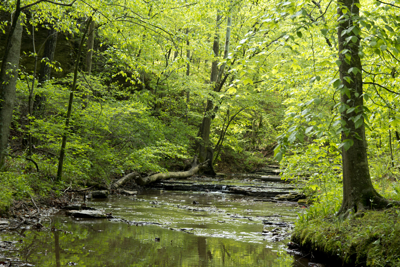

The first thing that popped into my head when I got word of Mayor Freddie O’Connell’s announcement of the expansion of Beaman Park was, “Oh, I wonder if this is about the Joelton chestnuts?”
And then it dawned on me that people probably don’t know about the Joelton chestnuts — partially because that’s just what I call them, and I’ve never called them that to anyone but myself.
But it’s a thing I’ve noticed over the years on Newspapers.com: Every once in a while, there’s a story about someone finding an American chestnut tree in Joelton, here in Davidson County. Much like Bigfoot, the Joelton chestnuts live in the woods, and people spot them when they’re out hunting or when the chestnut ends up in their backyard. Unlike Bigfoot, these American chestnuts sighted up in Joelton probably did exist, and may still. But seeing one is like seeing a passenger pigeon or an ivory-billed woodpecker. You shouldn’t be able to. They’re supposed to be gone.

I keep trying to make my peace with these historic local headstones crumbling and getting lost
Let’s start at the beginning. This region used to be covered in American chestnuts. They were tall trees, and big around. Everything and everyone ate these chestnuts. Many of our original land deeds use distinctive chestnut trees as boundary markers. To give you a sense of how hand-in-hand chestnuts and the Joelton area went, on Jan. 6, 1896, the Nashville American ran a story about men standing around talking about the weather (slow news day I guess) and bullshitting each other: “Every man had his say, and there were more chestnuts re-hashed than could be gathered in a week’s hunt on Paradise Ridge.”
OK, listen. We’re getting back to the chestnuts, but I have to share what comes after that sentence, because it’s pretty funny. The rest of the story goes:
The man who had crossed the Rocky Mountains and had his beard frozen so that when he wiped his face he had a clean shave; the man who captured the wild ducks because while diving for fish the water had frozen and they could not extricate their necks; the man who had attended a revival in Manitoba, where the preacher went to expound a passage of Scripture, and the words froze as they left his mouth, and before he got half through he was knee deep in his own eloquence.
The story doesn’t say, but I assume each of these quips started with “It was so cold …” and all the other folks asked “How cold was it?” and that launched the joke. “Knee deep in his own eloquence.” That’s great. But anyway, my point here is you used to be able to find a lot of chestnuts up on Paradise Ridge in Joelton because there were a lot of chestnut trees in the woods.
And then there was the blight. On Oct. 24, 1917, The Tennessean ran a story that started: “Have you noticed how scarce chestnuts are this year, just when we need them to help out the meager food supply?” It goes on to explain how a blight the paper identifies as coming from China is destroying the American chestnut. It does say that scientists were trying to breed a new strain of chestnut that could withstand the blight, but The Tennessean wasn’t hopeful.
Ten years later, on July 17, 1927, a Tennessean headline proclaimed, “Chestnuts Are Doomed.” The story started: “There is no remedy for the chestnut blight, declares the federal forest service, and within a few years the chestnut tree, one of the most beautiful and useful known to American forestry, will be only a memory. It will be as extinct as the dodo, the great auk or the wild pigeon. There seems to be no hope for any better fate for a great and noble tree.”
The story concludes: “Of course there is an end to all things. Only the souls of men are immortal. But few things have had as sudden and as dramatic deaths as the chestnut. And there are few trees whose passing will provoke more genuine sorrow.”
Jesus. That’s depressing.
The Nashville Banner was a bit more chestnut-optimistic. On Aug. 11, 1947, a story ran in the paper about how the University of Kentucky was hearing reports that some American chestnuts still existed. On April 5, 1948, the Banner reported that the chestnut was back! Alas, these were not the American chestnuts of old, but hybrids cross-bred with blight-resistant Chinese chestnuts.
Then, 10 years later on Oct. 27, 1959, the Banner rad a picture of a smiling man holding a chestnut burr. The caption: “RETURN—Chestnut trees, victimized for several years by a blight, are staging comeback in Middle Tennessee. City Schools Supt. W. Henry Oliver discovered such timber ‘in-burr’ while hunting the past Saturday at Camp Biota, near Clarksville Highway. He holds evidence of the tree’s resurgence.”

From the Nun Bun and Snowbird to Opryland and political corruption, here’s our curated list of pre-‘it’-city Nashville artifacts
Camp Biota was, like it sounds, a camp — like a Boy Scout or Girl Scout camp, but open to everyone. (Well, in 1959, it was probably open only to white children who could get there.) It was just west of Marrowbone Lake and about three miles as the crow flies from the north side of Beaman Park.
By 1962, The Tennessean was starting to believe in the Joelton chestnut. On Oct. 20, they ran their own picture of an oldish-looking person holding a chestnut burr with the headline “Coming Back?” The caption: “The American chestnut may be making a comeback, as Mrs. George Patterson shows by a pile of chestnut burrs. Mrs. Patterson, who lives near Joelton, said a tree sprouted last year on a hillside which was covered with chestnut trees until the great chestnut blight which hit the Eastern United States between 1900 and 1935.”
I found records that listed the address for a George Patterson in Joelton to see if this was, perhaps, the same tree that Superintendent Oliver had stumbled across — but the Pattersons lived way up north of Joelton toward Springfield, nowhere near Camp Biota. Two different trees.
On Sept. 30, 1965, The Tennessean found another American chestnut. Elmer Hinton reported that East Nashvillian John Batson had told him about the only chestnut to survive the blight, up on the ridge, just east of Ridgetop — which, OK, isn’t Joelton, but it is on the ridge.
After that, the chestnut trail runs cold until April 26, 1987. Richard Schweid reports in The Tennessean on the return (yet again!) of the chestnut: “Now, a blight-resistant American chestnut has been bred and four healthy chestnut trees, the first seen in the state in more than 50 years, have recently been planted: two at Camp Biota and two at the Belle Meade Mansion. The trees must be planted in pairs in order for them to propagate.”
Listen, I’m not going to bag on The Tennessean for running stories about the presence of the American chestnut and then a few years later running stories about how — surprise! — the American chestnut is back after nobody saw one for 50 years. But I am going to laugh about it.
Of course I’m excited about scientists figuring out a way to save the chestnut, but I’m more curious about all the sightings before they were deliberately reintroduced to the area. Could we have had a tiny blight-resistant native strain of chestnut here all along? Are there still old chestnut trees up on the ridge? Does this mean that, as Beaman Park continues to expand, we might find some of those legendary Joelton chestnuts growing in the park? Can we send Drake of the "Trees with Drake" account to investigate?
Anyway, the American chestnut. It’s supposed to be gone from the area, but the Joelton chestnuts seem to have kept hanging around over the past century anyway. If you see one, you’re looking at a legend. Cool.



Post a comment as anonymous
Report
Watch this discussion.
(0) comments
Welcome to the discussion.
Log In
Welcome to the discussion.
Keep it clean. Please avoid obscene, vulgar, lewd, racist or otherwise abusive language. Comments featuring hate speech or threatening or violent content will not be tolerated.
PLEASE TURN OFF YOUR CAPS LOCK.
Be truthful. Don't knowingly lie or mislead.
Be proactive. Use the “report” link on any comment that violates our comment policy.
Share with us. We'd love to hear your feedback.