
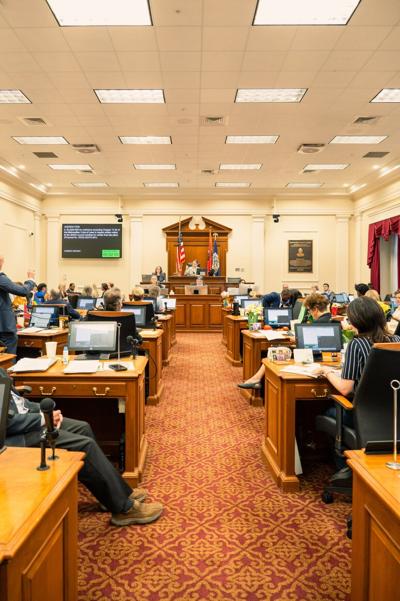


Metro Council chambers, Aug. 5, 2025
The Metro Council has advanced restrictions on surveillance drones, as well as a piece of legislation related to refinancing the Music City Center.
The council on Tuesday night, on its second of three readings, passed a bill that would impose restrictions on the use of Metro Nashville Police drones for surveillance, coming on the heels of the conclusion of MNPD’s pilot “Drone as a First Responder” trial program in Madison.
The bill, sponsored by Councilmember Sandra Sepulveda, would require council approval and a public hearing to be held before other “Drone as a First Responder” programs could be implemented. The bill also allows the programs to be used only in response to or during an active shooter incident, hostage situations, searches for missing persons, or a natural disaster or state of emergency declared by the Nashville mayor. Facial recognition technology used by the drones would also be banned, as well as autonomous drones manned by AI rather than people.
The bill will be considered before the council for its third and final reading in September.

Drones are the latest step in Metro police’s ‘steadily expanding surveillance apparatus’
Also on Tuesday’s docket were two pieces of legislation to refinance the debt structure on Nashville’s Music City Center convention facility. Filed by Mayor Freddie O’Connell’s office, the legislation would allow the city's Convention Center Authority to transfer up to $300 million to the East Bank Development Authority for infrastructure projects. The mayor’s office has said this could strengthen Metro’s credit rating and free up non-tax revenues for affordable housing projects.
The effort follows the Tennessee General Assembly’s passage of House Bill 2085/Senate Bill 1672, which redirects tax dollars generated by tourism to East Bank projects. This funnels sales tax dollars from the Music City Center’s tourism development zone to the East Bank Development Authority, which could use the funds for high-cost infrastructure projects like the planned East Bank Boulevard and a part of the John Seigenthaler Pedestrian Bridge expansion.
The legislation could also pave the way for a $1 billion expansion of the Music City Center’s building presence. In addition, excess revenues could be allocated toward businesses downtown in the form of grants. The Metro Finance Department has said that the refinancing of the debt could free up funds for the city to create an affordable housing bond.
Some councilmembers posed concerns that the legislation unfairly benefits the downtown core rather than Nashville as a whole.
“What we hear over and over and over again from our constituents is that there is a lot of money downtown, and people out in the county don't feel the benefit of that money,” Councilmember Quin Evans Segall said.
“That money stays downtown, and now it's not only going to stay downtown, but the downtown participants will not be paying the same taxes as everybody else.”
Kyonztè Toombs, the bill’s sponsor, argued the measure is a net financial benefit for Metro and emphasized the importance of downtown tax dollars on the city’s budget.
“The money that we make downtown benefits the city as a whole and helps us to fund the things that we fund,” Toombs said. "A significant portion of what we fund comes from downtown. This is a win-win for Metro.”
The bill passed on its second of three readings, with the council to take a final vote on the matter at its next meeting.



Post a comment as anonymous
Report
Watch this discussion.
(0) comments
Welcome to the discussion.
Log In
Welcome to the discussion.
Keep it clean. Please avoid obscene, vulgar, lewd, racist or otherwise abusive language. Comments featuring hate speech or threatening or violent content will not be tolerated.
PLEASE TURN OFF YOUR CAPS LOCK.
Be truthful. Don't knowingly lie or mislead.
Be proactive. Use the “report” link on any comment that violates our comment policy.
Share with us. We'd love to hear your feedback.