
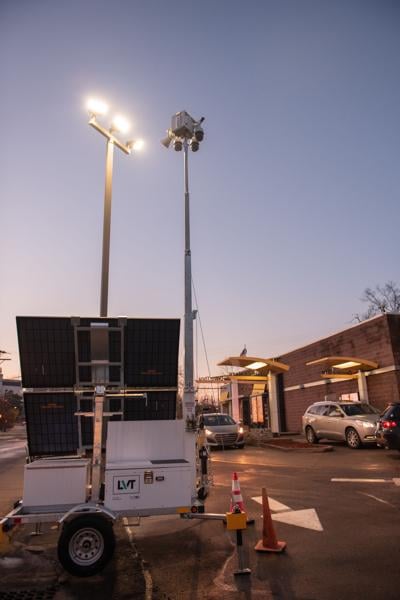


LiveView Technologies surveillance trailer in a McDonald’s parking lot
This story is a partnership between the Nashville Banner and the Nashville Scene. The Nashville Banner is a nonprofit, nonpartisan news organization focused on civic news. Visit nashvillebanner.com for more information.
Mayor Freddie O’Connell’s office quietly filed a resolution with the Metro Council before the Thanksgiving holiday that could bring increased police capabilities and surveillance technology to downtown Nashville. As word of the proposal spread last week, it sparked backlash among some close Metro observers who described it as a backdoor attempt to implement policies, like Fusus, that have been previously rejected.
The resolution is a proposed memorandum of understanding between Metro and the Nashville Downtown Partnership (NDP), a private nonprofit composed of downtown property owners and businesses, that outlines how the latter would use a $15 million grant from Gov. Bill Lee’s Downtown Public Safety Grant Fund, announced in October in conjunction with the governor’s decision to deploy the Tennessee National Guard to Memphis at the insistence of President Donald Trump.
According to documents included in the MOU, these uses include security cameras, “noise camera technology” for noise ordinance enforcement, a “video wall” used to “monitor live camera feeds and incidents” and two separate software platforms for real-time surveillance, data analysis and law enforcement communication.
Another section of the MOU describes using the funds for an “armored rescue vehicle ... to transport MNPD SWAT personnel in response to Active Events” and a “mobile command post” to be deployed for sporting events or holidays.
The MOU is set to be considered by the council on Thursday night. However, in light of the initial reaction to the proposal, Councilmember Erin Evans — the former chair of the Public Health and Safety Committee — tells the Nashville Banner she anticipates many members will seek to defer the resolution. She adds that the administration has said it will not oppose those efforts.

Citing Trump administration’s willingness to defy courts, mayor says ‘guardrails’ may not be enough to implement a contract with Fusus
The mayor’s office says in a statement to the Banner that the NDP has already been awarded the grant and “expects to receive the money by the end of December."
“Under this MOU, NDP agrees to limit the uses of the funds to a finite list, all of which are already permitted by Metro,” communications director Julie Oaks Smith says. “Absent the MOU, NDP has the option to apply the funds to a wider list of uses, though they’ve stated they will not do so. Additionally, NDP will donate most of the grant to Metro, and those donations will be subject to future Council legislation.”
The new proposal comes near the end of a year marked by debate in Nashville over police surveillance technology. After a contentious months-long discussion over a system from the security tech company Fusus that would have given police easier access to private security footage, O’Connell backed off the idea in April, citing overreach at the federal level by President Donald Trump’s administration — a concern opponents had been pointing to all along. Local debate over the deployment of license plate readers has also split along the same lines.
This article first appeared on Nashville Banner and is republished here under a Creative Commons Attribution-NoDerivatives 4.0 International License.



