

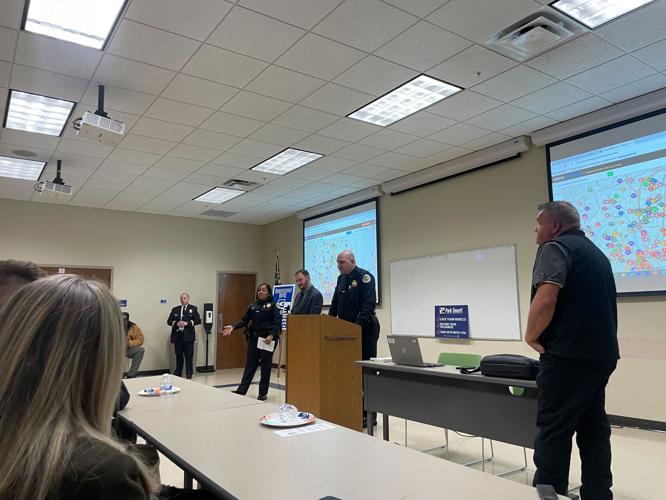

Police blamed troubled youth for a spate of recent car break-ins and burglaries during a packed community meeting Tuesday evening at the Metro Nashville Police Department's East Precinct. Four senior officers fielded questions, including East Precinct Cmdr. Harold Burke. Community members expressed gratitude for officers’ efforts but also frustration and anger. Several East Nashville residents said they endured multiple car break-ins over the past six months.
“Do I want to liken it to a lost cause?” said Robert Russell, a lieutenant in MNPD’s violent crimes division. “No, as somebody that wants to make things better, I would be remiss to say that it's a lost cause. It’s just a challenge. I would like to think of anything we have to occupy these kids in a more constructive way because they're following trends online to steal cars. Has anybody here not heard of the 'Kia Boys' method of stealing cars?”

A community meeting at MNPD's East Precinct, Jan. 7, 2025
The question referenced a trend on YouTube and other social media that provides simple instructions to exploit a security vulnerability in some Kia models, turning auto theft into a DIY activity. Russell — along with Burke and other MNPD senior officers — offered an elusive criminal profile to the frustrated room. Groups of young teenagers, they say, were behind the quick smash-and-grab incidents that have spread through affluent areas of East Nashville. Their coordination and behavior remained unknown, unpredictable and indecipherable. When pressed, officers said that attributing such behavior to a “gang” was a matter of semantics.
“A gang is simply an association of people for criminal activity,” explained Detective Joshua Lefler. “If we four decide to go out and break into cars together and we start getting into a pattern of doing it, and then we decide to call ourselves some name, we are now, by a strict definition, a gang. But is that the sort of gang that we're thinking of as far as big and organized? Probably not.”
While per-capita property theft and violent crime in Nashville have dropped in recent years — and remain far below peaks from the 1990s — the disruptive incidents in quick succession have created aggrieved streets of neighbors who showed up Tuesday in full force. Some pledged to create or join neighborhood patrols, while others pressed police about existing penalties for minors who commit crime.
“What's the threshold before there actually are consequences for a juvenile?” asked one resident midway through the meeting.
“If they’re arrested with a weapon out of a stolen car, they're gonna get — I’ll call it, for lack of a better phrase — a little aggravated sentence,” responded Russell. “They're gonna get maybe a few days, a ‘Don't do it again.’”
Murmurs spread through the crowd.
“What we don't want to see anymore is when they find a gun, then they go rob somebody, or carjack somebody, or God forbid, kill somebody," Russell continued. "It's happening — 15-, 16-year-olds. We don't want anybody to die at the hands of a 15-year-old with a gun.”

A community meeting at MNPD's East Precinct, Jan. 7, 2025
Residents alarmed about car break-ins have reported shattered windows and items stolen from cars along major streets in East Nashville, like Woodland Street and Gartland Avenue. Beyond suspecting young teenagers to be behind the break-ins, police offered little information about the incidents.
The meeting also served as a rallying point for neighbors who want to take further action to personally deter crime.
“What it comes down to is, MNPD is losing 11 to 15 officers a month or something like that,” said one resident, eliciting cheers and clapping from the room. “The mayor’s office hasn’t approved license plate cameras. People show up when something happens on their street, but they don't think about it when something's not happening on their street. The only way that we make a difference is if we start putting pressure on the mayor's office.”
Automated license plate readers have been approved for use but not funded or implemented across Nashville.
Other members vowed to join or organize neighborhood watch programs in East Side neighborhoods Inglewood, Lockeland Springs and McFerrin Park. Keiara Ward-Whitely, MNPD’s community coordinating sergeant at the East Precinct, told interested audience members that she would help these efforts around the area.

Split Metro Council rejects video integration technology by one vote despite plea from mayor
Police, community members and Assistant District Attorney Jenny Charles also spoke about contested police technologies that have not been approved or implemented by the mayor’s office or the Metro Council. Residents criticized elected officials for not granting Fusus, a video integration software, or automated license plate readers, which have been approved but not yet funded, to MNPD. Police and Charles spoke positively about these tools but stopped short of criticizing O’Connell or the Metro Council.
Charles sat a few rows from the front. She identified herself as a resident of West Nashville and frequently stood up, faced residents and answered questions for officers when conversation strayed into legal or judicial topics.
“You can purchase your own LPRs,” Charles explained in response to one question about technologies. “Homeowners’ associations have purchased them. You can go through a private vendor. I live in the West Precinct. We had a shooting of a young woman — she crawled to the neighbor's home. They might have seen her on camera. That neighborhood has purchased an LPR. That neighborhood has access to that data. The Metro Council is not allowing that neighborhood to tap into [the National Crime Information Center].”

Three forms of police technology raise questions about privacy and public safety
The Metro Council rolled out automated License Plate Readers in 2023 but has not fully developed a citywide LPR program. On Dec. 4, the council blocked a city contract for Fusus-enabled video sharing between private cameras and the police. NCIC, the national database mentioned by Charles, allows information-sharing between city, state and federal agencies; it was one of several examples of widespread data-sharing that led councilmembers to deem Fusus too permissive toward law enforcement.
MNPD public affairs director Don Aaron watched from the back of the room.
“Some of these aren’t the answers these people want to hear,” Aaron tells the Scene. “If a kid breaks into their car, they want to put them in jail.”



