

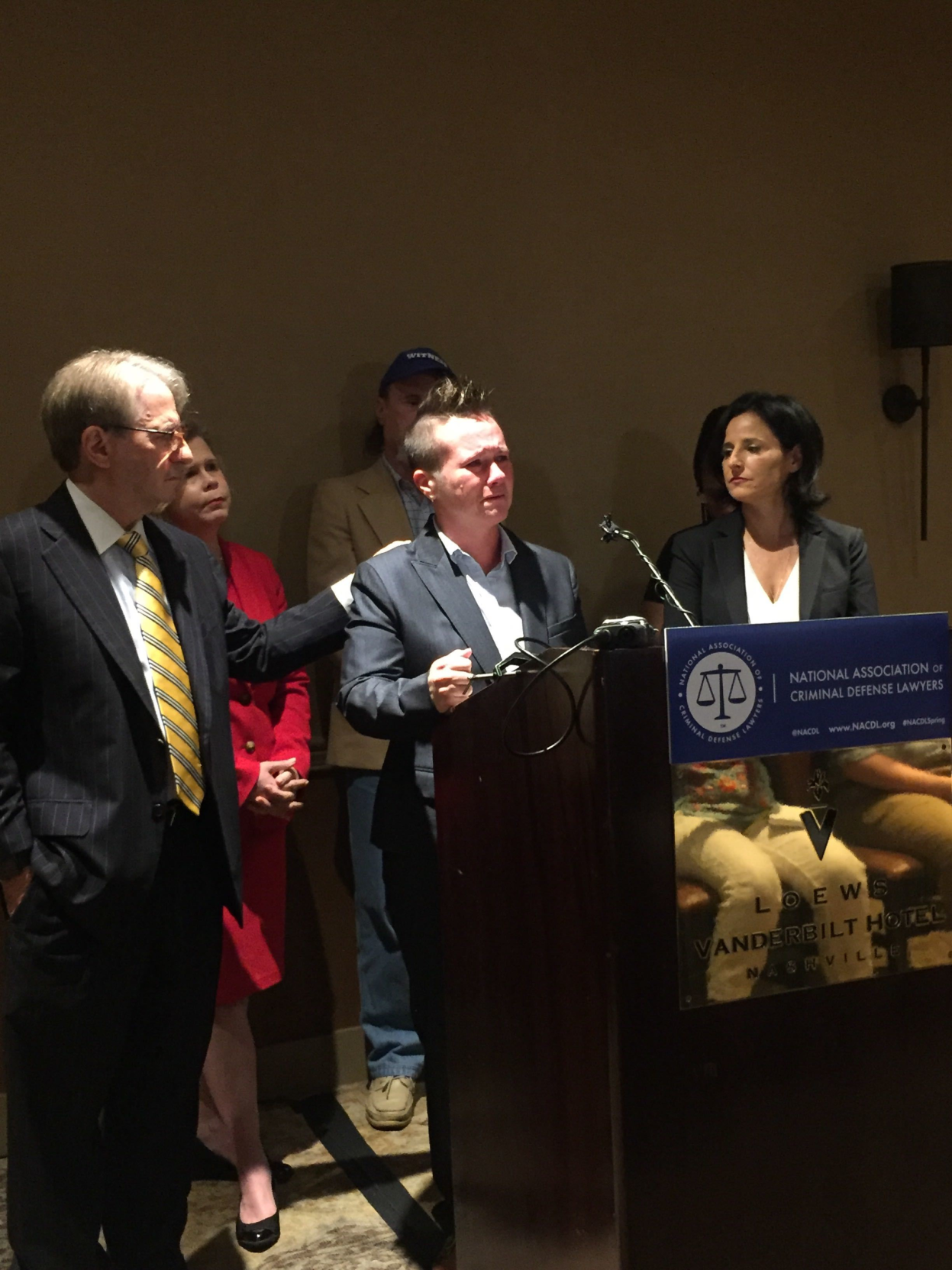
April Alley speaks at a May 1 press conference
April Alley and a collection of attorneys announced Wednesday their renewed effort to have DNA testing done on evidence from the 1985 rape and murder of Suzanne Collins for which her father, Sedley Alley, was convicted and sentenced to death. An as they did so, it was impossible not to think of Paul House.
In 1986, House was convicted and sentenced to death for the murder of Carolyn Muncey a year earlier. Muncey had been found raped, beaten and killed on the bank of a creek near her home in Luttrell, Tenn., only a few days after Collins had been brutally raped and murdered while she was jogging near Millington Naval Base outside Memphis. House, who'd recently moved in with his mother nearby, was arrested and charged with Muncey's murder. But after 22 years on Tennessee's death row, new evidence — including witnesses with testimony suggesting Muncey's abusive husband had killed her and, eventually, DNA evidence — proved he was innocent. Paul House did not rape and murder Carolyn Muncey. And after more than two decades — in July 2008 — he was released from prison. After more DNA testing, prosecutors dropped all charges against him in 2009. The state had planned to kill him for the crime.
There are more, though. In 1985, Ndume Olatushani was convicted and sentenced to death for the 1983 murder of a Memphis grocer named Joe Belenchia. Olatushani maintained his innocence for decades. In 2004, his sentence was reduced to life in prison after the revelation that prosecutors had withheld key evidence from his defense team. Seven years later, Olatushani was awarded a new trial after more problems with the case against him emerged. He was ultimately released after he agreed to an Alford plea deal — an agreement under which a defendant can plead guilty while maintaining their innocence, acknowledging that sufficient evidence exists to convict them at trial.
Olatushani's case is different from the Alley case in that it did not involve DNA. But Randall Mills' case did. Mills spent 11 years and three months in prison for the 1999 rape of a 12-year-old girl — until DNA evidence exonerated him in 2008.
It was impossible not to think of men like these yesterday — the 165 people who have been exonerated and freed from American death rows since 1973, and the total of 2,433 exonerations that have occurred since 1989. It was impossible not to think of them because they are the reason we believe, the reason we know, that innocent people are sent to prison and even sentenced to death.
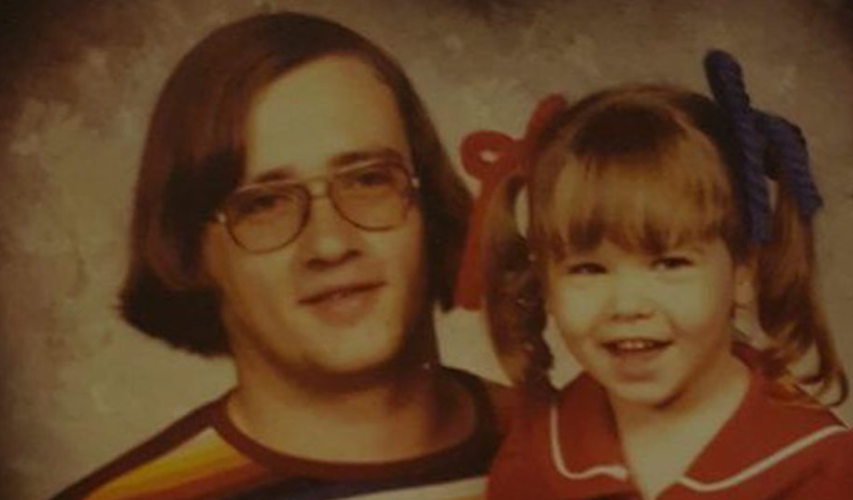
But Sedley Alley is different, because Sedley Alley has already been executed. The state of Tennessee executed him by lethal injection on June 28, 2006, after courts and then-Gov. Phil Bredesen declined to stop the execution to allow for DNA testing that his lawyers believed would prove his innocence. He spoke his final words: "Yes, to my children. April, David, can you hear me? I love you. Stay strong." Alley then thanked the prison chaplain and said, "I love you, David. I love you, April. Be good and stay together. Stay strong." April and David, who were there for his execution, reportedly held their hands against the window of a witness room that looks into the execution chamber. "We will, Dad," April said.
“God help the people in this process if the DNA proves he didn’t do it,” Kelley Henry, an assistant federal public defender who represented Alley, was quoted in The Tennessean as saying after the execution. “We will test the DNA.”
Thirteen years later — and following a 2011 Tennessee Supreme Court ruling that found the courts had erred in blocking DNA testing in Alley's case — April Alley, Kelley Henry and Innocence Project co-founder Barry Scheck held a press conference in Nashville to announce their effort to follow through on that. Death row exonerees Ray Krone and Sabrina Butler-Smith had also traveled to town to support the effort.
In a court filing in Shelby County, and a letter to Gov. Bill Lee, they ask for DNA testing on evidence taken from the crime scene where Suzanne Collins' body was found in 1985. In particular, men’s red underwear that the police believed was worn by the murderer.
Scheck said the Innocence Project began revisiting the case after receiving a tip from law enforcement that a man named Thomas Bruce, charged with a brutal rape and murder in Missouri, was a possible alternate suspect in the rape and murder of Suzanne Collins.
April Alley briefly came to the podium to speak on Wednesday before she was overcome with emotion.
"This is very overwhelming," she said. "I feel like I'm being pulled in a thousand different directions. Watching my father die was so painful that I'm hoping I can get the answer, one way or the other, that I want."
Sedley Alley had confessed to the crime, but attorneys argued Wednesday that his case had all the hallmarks of a false confession. They cited parts of his confession that matched police theories at the time, but ended up being false.
During a visit to Riverbend Maximum Security Institution to see her father before his execution, April had asked him whether he did it, assuring him that even if the answer was yes, she still loved him. His answer, as The New York Times' Jim Dwyer wrote yesterday, was the same one he'd given to psychiatrists after his arrest and to many other people over the years.
"If I did do it, I deserve what I get. But I don’t remember doing it.”
The truth could have been determined before his execution. In 2006, Tennessee's Board of Probation and Parole — which included Patsy Bruce, who wrote the song "Mama's Don't Let Your Babies Grow Up to Be Cowboys" — recommended just that. DNA testing on evidence from the horrific crime scene could have either confirmed his guilt or excluded him and identified someone else. That did not happen then — Bredesen deferred to the courts, which blocked the testing. But it can happen now.
"April Alley wants to know the truth," the attorneys write in their letter to the governor. "If her father was innocent, she wants to know who really committed the crime for the sake of everyone involved in this tragic event, and to make sure that person never commits another crime. There is no legitimate reason why the truth should not be sought when the legal authority and scientific ability exists to reveal it. An examination of the evidence in this case reveals that there is a substantial question whether Mr. Alley was guilty of the rape and murder of Suzanne Collins."
Asked about the potential scenario in which DNA testing confirms Alley's guilt, Scheck acknowledged that "it could happen."
"Look, we're not afraid to find the truth," he said. "All we ever asked for was the truth."
The truths we already know in this case are horrifying. Suzanne Collins was just 19 years old when she was attacked while jogging, struck at least 100 times, mostly around the head and neck, and strangled. She'd been sexually assaulted with a 30-inch tree branch that had pierced her lung. But there are more horrifying truths we could yet learn. It is possible — and no doubt the attorneys present at Wednesday's press conference believe — that Tennessee executed an innocent man in 2006, leaving Collins' true murderer free to terrorize someone else. We don't know. But we can.



Post a comment as anonymous
Report
Watch this discussion.
(0) comments
Welcome to the discussion.
Log In
Welcome to the discussion.
Keep it clean. Please avoid obscene, vulgar, lewd, racist or otherwise abusive language. Comments featuring hate speech or threatening or violent content will not be tolerated.
PLEASE TURN OFF YOUR CAPS LOCK.
Be truthful. Don't knowingly lie or mislead.
Be proactive. Use the “report” link on any comment that violates our comment policy.
Share with us. We'd love to hear your feedback.