
After last week's electrocution of David Earl Miller, Tennessee's death penalty comes to a pause.
The next prisoner set to die in the state is Donnie Johnson, whose execution is scheduled for May 16, 2019. After that, three more men are set to be executed in 2019, with two more following them in 2020.
The cases of the three men put to death by the state in the past four months — Billy Ray Irick by lethal injection, and Edmund Zagorski and Miller by electrocution — highlighted numerous flaws with the death penalty in Tennessee. Irick and Miller both had histories of severe mental illness, while Zagorski's case illustrated the arbitrary nature of the sentence (and belied the idea that death row is home to unrepentant monsters). But because all three men were white, the revival of the death penalty in Tennessee has not yet prompted a discussion of one of its other major problems — it's racist.
That's not breaking or particularly surprising news, of course. The criminal justice system as a whole is thoroughly infected with racial bias — why would its most severe penalty be any different?
Still, the numbers are stark.
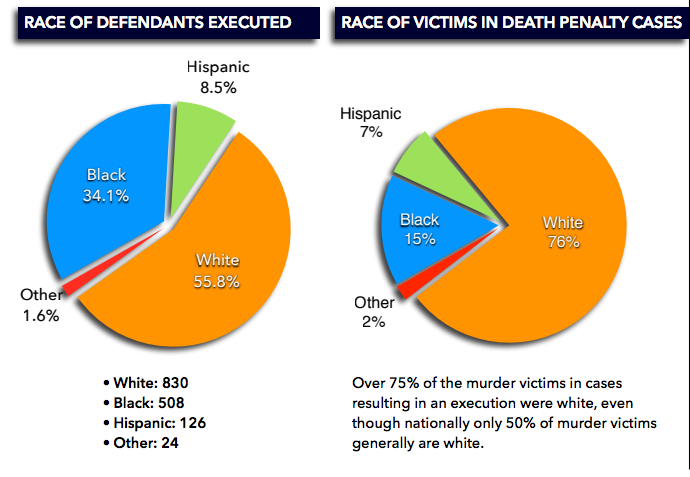
There are currently 58 prisoners remaining on Tennessee's death row, and 28 of them are black. That's 48 percent in a state with a population that is just 17 percent black. Death sentences have been declining nationally, but the disparity remains. In Tennessee, 17 men have received a death sentence since the year 2000 — 11 of them are black.
But the death penalty isn't just biased against African-American defendants. Studies have consistently found racial disparities when it comes to the race of the victim as well.
This section from an American Bar Association assessment of Tennessee's death penalty published in 2007 summarizes some of those findings:
Former Tennessee Supreme Court Chief Justice Birch also has voiced concerns that racial bias may be permeating the death penalty process in Tennessee. In State v. Chalmers, Justice Birch noted that “numerous studies have indicated that racial bias may play a significant role in determining which defendants receive the death penalty.” A recent study that reviewed capital sentencing in Tennessee from 1981 to 2000 and was conducted as part of this ABA Tennessee Death Penalty Assessment Report has given credence to Justice Birch’s concerns. The study concluded that “those who kill whites are more likely to be sentenced to death than those who kill blacks.” In addition to the race of victims and suspects in homicide cases, the study took account of legally relevant factors that are legitimately related to the imposition of the death penalty, namely two prevalent aggravating factors in death penalty sentencing: whether the crime took the life of more than one victim; and whether the homicide involved accompanying felonies, such as rape or robbery. The study found that individuals who killed whites were 4.75 times more likely to receive the death penalty than those who killed blacks in the absence of these aggravating factors. When at least one of these aggravating factors was present, individuals who killed whites were 3.15 times more likely to be sentenced to death than individuals who killed blacks.
In their report
"Tennessee's Death Penalty Lottery"— published earlier this year in the Tennessee Journal of Law and Policy — attorneys Bradley MacLean and H.E. Miller Jr. note the considerable role that discretion plays in death penalty cases.
"The exercise of discretion permeates a capital case — from the time of arrest through the charging decision, the district attorney's decision to seek the death penalty, innumerable decisions by all of the parties and the judiciary throughout the proceedings, and the ultimate jury decision of life versus death," they write. "Where there is discretion, there is room for implicit bias."
As they note, district attorneys wield significant power, and discretion. And in Tennessee, all 31 district attorneys general are white. If you have doubts about whether that matters — or whether implicit, and even explicit, racial bias is ever at play in prosecutions in Tennessee — take it from the prosecutors themselves. In a November 2015 letter to the Tennessee District Attorneys General Conference — which is cited in court filings by attorneys for Abu-Ali Abdur'rahman, a black man whose execution has been set for April 9, 2020 — Davidson County District Attorney Glenn Funk highlights and disavows comments made by a former Nashville prosecutor at an annual conference.
The comments were made by Rutherford County Assistant District Attorney, and former Nashville ADA John Zimmerman. Funk writes:
The first of these inappropriate comments was when he said that as an ADA in Nashville, he would strike jurors with a 37215 area code, an affluent part of town, if the if the case involved people from "the inner city" because "in Nashville, rich people don't care about what happens in East Nashville."While the racial implications in the previous comment were inferential, his next statements were blatant advice to use race in jury selection. Specifically, Mr. Zimmerman described prosecuting a conspiracy case with all Hispanic defendants. He stated he wanted an all African-American jury, because "all Blacks hate Mexicans."
Abdur'rahman's attorneys write: "If in today's race-conscious world, when prosecutors are under public scrutiny, Mr. Zimmermann was willing to describe and advocate for racist practices in a CLE presentation to fellow prosecutors, then it is fair to infer that Mr. Zimmermann was willing to use race in jury selection at the time of Mr. Abdur'Rahman's trial."
Tennessee is not alone, of course, when it comes to racial bias in the death penalty. The Washington Supreme Court struck down that state's death penalty earlier this year because the court found it to be "arbitrary and racially biased."
These charts from the Death Penalty Information Center break down executions nationwide since 1976 by the race of the defendants and the race of the victims: