
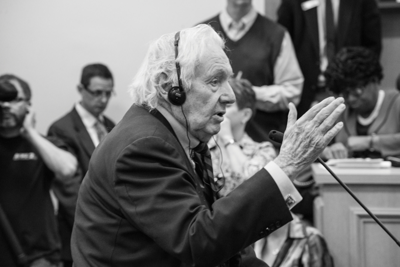
To say John Jay Hooker is a man of conviction is an understatement. The political gadfly ran five times for governor, four times for U.S. Senate, battled in the courts in the name of the state constitution, and spent his life as a thorn in the side of countless politicians, sounding persistent themes — most notably, the need to reform campaign financing and judicial appointments.
Over the past year, the 85-year-old perennial candidate, civil rights advocate and consummate insider/outlier — confidant to the Kennedys, friend to Muhammad Ali and Warren Beatty and former newspaper baron — has been waging one last public crusade on two fronts. He is battling Stage IV metastatic melanoma, a type of skin cancer. As he fights the disease, he is also fighting for the right to legally end his life, on his terms.
He’s losing both battles.
While Hooker lay in a hospital bed last week, the Tennessee Supreme Court dealt a delay to his court fight. It dismissed his argument that the highest court, not the appellate court, should hear his case to establish so-called “death with dignity” rights in the Volunteer State.
”Although the Court is not unsympathetic to Mr. Hooker’s health issues,” the Supreme Court wrote, “there are dispositive non-constitutional issues that were addressed by the trial court and which must be addressed on appeal before any Constitutional issues raised by the Plaintiffs.”
According to Tennessee state law, it is illegal for doctors to prescribe life-ending drugs to patients. After an unsuccessful effort this year to convince state legislators to change the law, Hooker took his fight to court.
Five states have established laws allowing the terminally ill to arrange their own deaths in close consultation with a physician, according to Death With Dignity, an Oregon-based nonprofit. Fewer than half of U.S. states are actively debating legislation.
The cause has been dubbed “Hooker’s Last Stand” by close acquaintances. But if anyone thought ill health had softened his combative streak, the Hooker of old reared up in September after Chancellor Carol McCoy initially dismissed his lawsuit in Davidson County Chancery Court, ruling he had no legal standing.
In turn, Hooker accused McCoy of political nepotism. Her husband, Tennessee Court of Criminal Appeals Judge Roger Page, was under consideration for a Tennessee Supreme Court vacancy — a post appointed by Gov. Bill Haslam, who is named in Hooker’s suit. Hooker argued that left McCoy with a potential conflict. (McCoy had heard the initial arguments before the Supreme Court seat opened up, although she released her ruling after.)
Some praise the blows to Hooker’s cause, such as Tennessee Right to Life president Brian Harris.
”Terminally ill persons deserve full care and pain relief, not a prescription for an early death,” Harris says in a statement. “Tennessee’s law strikes a careful and compassionate balance in ensuring that basic safeguards for human life are in place and honored.”
But the outspoken lawyer remains more determined than ever. At the September meeting of the L-Club, a loose network of local liberal activists and hobnobbers, Hooker stood perched near a baby grand piano at the residence of former Hillsboro Presbyterian pastor David Kidd. He spoke at length about trying to wean Robert Kennedy’s son off drugs and addressed a litany of past regrets, such as his failed presidential bid and the demise of the Minnie Pearl Fried Chicken chain he co-founded — a debacle that helped to hobble his political aspirations.
Even with regular check-ups to replenish electrolytes, Hooker’s itinerary is stacked with lectures at Vanderbilt Law School and afternoon trips to the Belle Meade Starbucks, where venti Frappuccino drinkers regularly catch their breath at the sight of his trademark Lincolnesque hat and long coat. Even ravaged by illness, the man still turns heads.
Hooker was admitted to the hospital last week. Even so, he remains an indomitable fighter and retains his rascally wit, as proved by his bedside phone interview with the Scene. The following transcript has been edited for brevity:
You recently attended Fred Thompson’s funeral. What was it about Thompson that made him such a bipartisan figure beloved by both Republicans and Democrats alike?
You don’t have Alzheimer’s, but I’d have it checked. Here’s what I think you said and this is only with partial hearing. You said that I recently attended Fred Thompson’s funeral. I did not attend Fred Thompson’s funeral.
Oh, you were in the hospital. Your representative said you attended the funeral.
But I’m telling you, if I could have walked, I would have gone. But I had to go in with a wheelchair. It was raining. At the War Memorial Building, you go up those steps. I didn’t want to get two or three people involved in this with the wheelchair going up the steps and making a huge spectacle. I didn’t go because I didn’t want the appearance of being so disabled. I didn’t want to take the risk, because there was danger to it, you know.
I didn’t go, but I was there in spirit. I talked to many people who were there. The only thing I know about the funeral is that everybody said it was extremely well-done and highly well-attended. It was a moving event. Do you follow me? So that’s all I know about the funeral. And any other question you want to ask me about Fred Thompson, you can be my guest.
Is there anyone you looked to as a mentor in leading the Right to Natural Death Act? Was it about finding your own way?
Yeah, Martin Luther King Jr. and Bobby Kennedy. In other words, this is what I say is the ultimate civil right. And I got my start in the fight for civil rights around Bobby Kennedy. I met Martin Luther King Jr. at Bobby Kennedy’s house in 1961. I regard the right to take my own life as the ultimate civil right. And the state of Tennessee has no power, other than the Tennessee Constitution, to tell me that I’m not a free man and that I can’t take my own life if I want to.
When they pass the law that says they can’t get the doctor to help me die with dignity, they interfere with my privacy rights, which are protected by the Tennessee Constitution. Therefore, that law that they passed up there, which says that I don’t have the right to take my own life, makes me a prisoner. It makes me a prisoner in my own bed. The ultimate civil right is the right to leave. The state of Tennessee shouldn’t be allowed to tell me that.
I have the right to die. But I’m in the caboose of the train. I’m not some bigshot driving the train. But I want others to join me in the caboose. And if the state of Tennessee repeals this law, it will be a larger step in getting other states to repeal it. I want the state of Tennessee to be on board because our constitution says, “All power is inherent in the people,” and, “All free governments are founded on their authority instituted for their peace, safety and happiness.” In memory of Martin Luther King Jr. and Bobby Kennedy, I want to leave this earth and give others the right to take their own life as I want to take mine.
In hindsight, should you have taken a different tack in arguing your case before the Davidson County Chancery Court?
Yeah, I didn’t get a fair trial in the Chancery Court of Davidson County. And one of the reasons that I didn’t get a fair trial is that Chancellor Carol McCoy’s husband applied to fill a vacant seat in the Tennessee Supreme Court. She decides that I don’t have the standing to bring the question. How do I not have standing? I’m going to die. The doctor told me that I had six months to a year to live. I’m taking a toxic medicine that makes it so hard that I can hardly walk. I have to get in a wheelchair. I get short of breath and can hardly talk. I am taking this medicine to stay alive long enough to accomplish this job. At this stage of my life, I am dedicated to hit a home run here. ...
The Constitution says that the judges shall be elected by the qualified voters of the state. Every lawyer in Tennessee knows that in fact it says judges shall be appointed by the governor, which violates the constitution, which says that judges shall be elected by qualified voters of the state. Every damn lawyer in Tennessee has put up with that for 40 years. The governors, the legislature, the newspapers and the Fourth Estate have ignored it. They haven’t done a damn thing about it and you let the state of Tennessee usurp your basic rights.
I want people to have the right to challenge the government. This country was founded on the idea of government of the people, by the people and for the people. That’s what Abraham Lincoln said in Gettysburg. And now we have a government of the government, by the government and for the government. It’s been condoned by all the governors, all the legislators and all the judges, including McCoy. The people have the right to elect those judges.
In layman’s terms, how is the right to natural death different from euthanasia?
The right to die is a liberty right. And for the same reason that you have the right to put your dog down, you’ve got the right to put yourself down. The government doesn’t own you and doesn’t own your dog. And so whatever the semantics are, you can say euthanasia or whatever. It’s a liberty right, and that’s what Thomas Jefferson talked about. If the power is in the people, they have the right to exercise that power. They didn’t get that power from the Constitution, but from God Almighty.
Andrea Zelinski contributed to this story.



Post a comment as anonymous
Report
Watch this discussion.
(0) comments
Welcome to the discussion.
Log In
Welcome to the discussion.
Keep it clean. Please avoid obscene, vulgar, lewd, racist or otherwise abusive language. Comments featuring hate speech or threatening or violent content will not be tolerated.
PLEASE TURN OFF YOUR CAPS LOCK.
Be truthful. Don't knowingly lie or mislead.
Be proactive. Use the “report” link on any comment that violates our comment policy.
Share with us. We'd love to hear your feedback.