
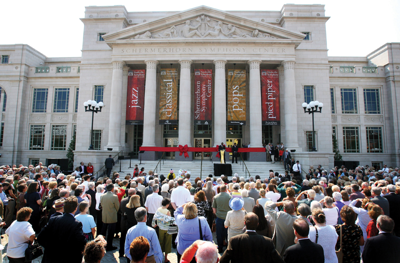

Nashvillians will be hearing less of Gustav Mahler and more of Amy Grant, Vince Gill and Kenny Loggins next season at the Schermerhorn Symphony Center. That's because the Nashville Symphony Orchestra is overhauling its schedule and programming for the 2013-14 season, placing a greater emphasis on pops concerts while eliminating seven of its 14 Thursday-night classical performances.
"Attendance for our classical concerts on Thursdays was much lighter than we had hoped," says Alan Valentine, the NSO's president and CEO. "People who go to our pops series are entertainment buyers who are attracted to the hall for different reasons, and we think those concerts can be more profitable. The bottom line is we need to bring in a lot more revenue to support the hall."
That fact became painfully apparent last week, when the orchestra posted a note on its website indicating it would not renew a letter of credit on about $100 million in bond obligations. The NSO is hoping that action will prompt its lenders to renegotiate the amount of its debt, which was incurred to build the Schermerhorn.
Disturbingly, the symphony's letter to its patrons also hinted that the matter could wind up in bankruptcy court. Kevin Crumbo, a board member and treasurer for the NSO, said that worst-case scenario would likely be a last resort. For now, the NSO expects no interruptions in its operation.
"What happened was our original business plan did not work out the way we thought, so there was only a slim chance that we would have been able to pay back the entire debt on schedule," Crumbo says. "We felt it would have been irresponsible for us to run out of cash later, so we decided we needed to renegotiate the debt right now. We need to deal with that debt as part of a comprehensive financial restructuring."
Since moving into the acoustically marvelous concert hall in 2006, the NSO has received critical acclaim — not to mention seven Grammy Awards — for the quality of its performances and its innovative programming. The orchestra under the direction of Giancarlo Guerrero has become a leading champion of contemporary American music. In fact, next year the orchestra will present the world premiere of a new piano concerto by pop star (and NSO board member) Ben Folds.
As the orchestra was winning kudos, however, its financial troubles were mounting. Some of the initial problems were ascribed to the normal growing pains associated with moving into a new and complex symphony hall. "We learned that some things were going to be more expensive than we initially thought," Valentine says. "But we were not in a crisis in the beginning."
Indeed, big trouble didn't appear on the horizon until 2008, when the economy took a nosedive. Like most orchestras around the country, the NSO didn't feel the effects of the recession at first — most groups were still living off subscription sales made the prior year. The pain came in 2009.
"Our subscription renewals really dropped, and our investments took a huge hit," Valentine says. NSO management responded with a wage freeze and significant budget cuts. Those measures helped.
But then in 2010 the symphony was hit by a perfect storm — or more precisely, a 500-year flood. That disaster caused nearly $40 million in damage to the concert hall. The symphony has been able to recoup most, but not all, of its losses from the Federal Emergency Management Agency and from other insurance. But that money didn't insulate the symphony from the initial monetary hit.
"People may think FEMA comes out and writes you a check for $40 million, but that's not the case," Valentine says. "You have to spend the money first, and then FEMA reimburses you."
To find that kind of cash, the symphony had to borrow from its unrestricted endowment. And that transaction added to the $27 million in red ink that the symphony reported on its federal tax returns for the years 2009 to 2011.
"You'll see a surplus on the tax returns we haven't released yet, because we've received the FEMA money," Valentine says.
Drew McManus, a Chicago-based arts consultant who writes the orchestra business blog Adaptistration, has been following the Nashville Symphony closely for years. He said the orchestra's decision to borrow from its own endowment was a smart move. "It made much more sense than taking out a bank loan at interest," he says.
McManus noted that orchestras that find themselves mired in unsustainable concert-hall debt have only a few options, and doing nothing is not one of them. Perhaps the most obvious thing is to go after the organization's stakeholders — namely, the musicians.
"That's what they did in Detroit," says McManus. "But that approach can really damage the quality of your orchestra."
In the wake of the 2008-09 recession, the Detroit Symphony found itself on the brink of bankruptcy due to declining attendance and $54 million in debt on its Max M. Fisher Music Center. Symphony management sought major salary cuts from the musicians, who went on strike for 26 weeks.
In the end, the musicians accepted a 23-percent pay cut, and management eventually reached an agreement with its banks to resolve the debt. The details of that agreement remain a closely guarded secret. Many of Detroit's top players, however, including its concertmaster, left for other orchestras or academia.
Another option, which the NSO has chosen, is to square off with the banks. "That approach carries its own risks for the board directors, who could be affected in both their businesses and social lives," McManus says. "But I think the Nashville Symphony deserves credit for taking this action, because you can't cut your way to success at the expense of the musicians and your audience, and you can't save your institution by doing nothing about unsustainable debt."
The NSO musicians' contract expires this summer, but Valentine has already indicated a strong aversion to targeting their compensation. "Our musicians already receive the lowest salaries in our budget category," Valentine says. The current contract guarantees NSO players a minimum annual salary of $60,000 — a respectable sum, but hardly the mouth-gaping $105,000 minimum that the Detroit players received. (San Francisco Symphony musicians, now on strike over their contract, are guaranteed a $141,000 minimum.)
Valentine has spent years turning the NSO into a Grammy-winning powerhouse. So he's not interested in gutting contracts, which would likely chase away talent while sending the orchestra back to the minor leagues. That's where Valentine found the group in the late 1990s, shortly after it had emerged from an earlier bout of bankruptcy.
Given that you can't make a classical symphony be more efficient — it takes the same number of musicians to play Beethoven's Fifth Symphony today as it did when it premiered in 1808 — it's hardly surprising that Valentine has decided to focus most of his energies on increasing revenue. Astute observers of the Schermerhorn have probably already noticed some big changes.
Over the past year or so, the Schermerhorn has gone from being primarily a symphony hall to being a regional entertainment presenter. On nights when the symphony isn't performing, the Schermerhorn has been booking comedians such as Bill Cosby and Sarah Silverman, and popular music acts such as Lyle Lovett and B.B. King.
"In arts administration, we call that the 'never-dark theory,' " says McManus. "You make your venue more profitable by using it more."
The NSO hopes to increase revenue from its pops series next season by bringing in higher-profile acts like Chicago and Kenny Loggins. It's also looking at replacing the pops series' signature table seating with aisle seats, which can accommodate many more people. Moreover, the orchestra recently hired a new director of artistic administration, Laurence Tucker, a veteran artist representative who is as adept at handling temperamental maestros as schedules and programming.
And in perhaps its biggest coup, the NSO has talked Amy Grant and Vince Gill into moving their popular Christmas show from the Ryman Auditorium to the Schermerhorn. Grant was instrumental in saving the symphony when it fell into bankruptcy in the 1980s. Now Grant and Gill's Christmas show could become the Schermerhorn's version of the Nashville Ballet's annual Nashville Nutcracker — the cash cow that makes the rest of the year possible.
Classical fans are not being left totally in the cold. The symphony has cut seven Thursday performances, but it is adding a new Coffee and Classics Series, which will feature three short Friday morning concerts. Admittedly, the NSO will present just two performances of Mahler's Symphony No. 7 next season. But it will make up for the loss with bigger stars, such as gala headliner Renée Fleming.
"Classical music will always be the Nashville Symphony's core product," Valentine says.
Email editor@nashvillescene.com.
A shorter version of this story originally appeared on theScene's arts and culture blog, Country Life.



Post a comment as anonymous
Report
Watch this discussion.
(0) comments
Welcome to the discussion.
Log In
Welcome to the discussion.
Keep it clean. Please avoid obscene, vulgar, lewd, racist or otherwise abusive language. Comments featuring hate speech or threatening or violent content will not be tolerated.
PLEASE TURN OFF YOUR CAPS LOCK.
Be truthful. Don't knowingly lie or mislead.
Be proactive. Use the “report” link on any comment that violates our comment policy.
Share with us. We'd love to hear your feedback.