
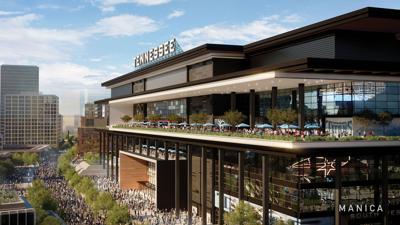

Nearly a year ago, news broke that the Tennessee Titans and Mayor John Cooper had abandoned plans to renovate Nissan Stadium. Instead, they’d pursue a new build. Nissan was outdated — a VCR in the streaming era, according to Titans CEO Burke Nihill. Cooper had his eyes on a completely redeveloped East Bank. A $2.1 billion line item appeared in the budget a few months later, previewing the second-most-expensive sports stadium in the world and floated by $1.3 billion in public money.
The deal has been a collage of moving parts across state and local governments, financing and media, complete with carefully crafted messaging and high-powered players. The NFL — a savvy entertainment megadealer that was, until recently, the world’s largest nonprofit — hired lobbyists and helped the Titans access hundreds of millions in financing. With updated facilities around the country, the league can offer a better product to media markets. (It sold $110 billion in broadcast rights in 2021.) At a Metro Sports Authority meeting in November, Nihill briefly referenced pressure the team has gotten from the NFL to update its outdated facility.
Despite rosy projections from Nashville’s tourist-industrial complex — quite excited to vie for a new tier of events like the NCAA playoffs and a Super Bowl — sports stadiums do not return public investment, according to economists. The real beneficiaries will be the team, a $3 billion franchise expecting to bump its value with a new round of season ticket sales, and the NFL. The city benefits in that it avoids the potential financial repercussions of its current lease with the team, a liability that the Titans estimated at $1.8 billion through 2038. Despite efforts from the Metro Council to order an independent cost analysis of the city’s obligations under the current lease, the city hasn’t gotten its own numbers but has agreed to pay dearly to get off that hook. It will keep paying, in related infrastructure costs and by pledging future tax dollars, to develop a new commercial district surrounding the stadium — currently a jigsaw puzzle of industrial sites and parking lots.
The mayor calls this “Nashville’s next great neighborhood.” He’s engaged in a delicate messaging dance with skeptical councilmembers, aggrieved residents, smiling football executives and pious media, eager to share the latest on a high-profile billion-dollar deal. The Scene can confirm that the stadium’s glossy renderings get a lot of clicks. Back in the summer, the Metro Council formed its own panel, the East Bank Stadium Committee, to kick the tires on everything coming out of negotiations between the team and Cooper. Bits of legislation — a request to solicit potential real estate developers, formal approval for a boosted hotel-motel tax — sailed through a compliant council in November and December. The most pushback came with the deal’s terms sheet, viewed as a precursor for a new lease. Wary to give what might be construed as the body’s blanket approval for mayor-team negotiations, Councilmember At-Large Bob Mendes, who chairs the East Bank Stadium Committee, went to great lengths to clarify that the far-ranging document remains nonbinding, and council approval comes purely to facilitate ongoing discussion between the team and mayor.
A new stadium for the Titans would be the biggest thing the city has done in decades. It has two real peers — the Music City Center, built for $623 million in 2013, and the city’s decades-long effort to overhaul its sewer system — and several painful could-have-beens, like the city’s failed mass-transit push in 2018. To some residents, a new stadium has come to represent priorities misplaced by out-of-touch politicians while the rest of us struggle with growing commutes, rising rents and paychecks that don’t go as far as they used to.
Meanwhile, the Titans completely tanked a season that looked Super Bowl-worthy in October, adding a new variable — shaky public opinion of the team — to a story in which the team’s favorability does factor into political considerations for Cooper and other supporters. Many Nashvillians don’t care about football and said so during five public hearings this fall.
This one has it all: big money deals, national intrigue and closed-door discussions, with each party spinning complicated realities to suit its position while many basic facts remain unknown. The mayor thinks it’s a chance to preempt future liabilities and tap potent real estate opportunities across the river from downtown Nashville. Some Metro councilmembers bristle at being treated like an afterthought by Cooper, but they don’t have the actual votes to stop anything. The team and league want a new domed arena suitable for all-weather public concussions. Proponents cite volatile bond markets and building supply shortages, saying time is of the essence.

From the mayoral race to independent local venues, potential development of the East Bank, TennCare coverage and more, here are eight stories to keep an eye on this year



Post a comment as anonymous
Report
Watch this discussion.
(0) comments
Welcome to the discussion.
Log In
Welcome to the discussion.
Keep it clean. Please avoid obscene, vulgar, lewd, racist or otherwise abusive language. Comments featuring hate speech or threatening or violent content will not be tolerated.
PLEASE TURN OFF YOUR CAPS LOCK.
Be truthful. Don't knowingly lie or mislead.
Be proactive. Use the “report” link on any comment that violates our comment policy.
Share with us. We'd love to hear your feedback.