
For more of our In Memoriam 2016 coverage, click here.

Ed Temple
Ed Temple
1927-2016
Track coaching legend
By Ron Wynn
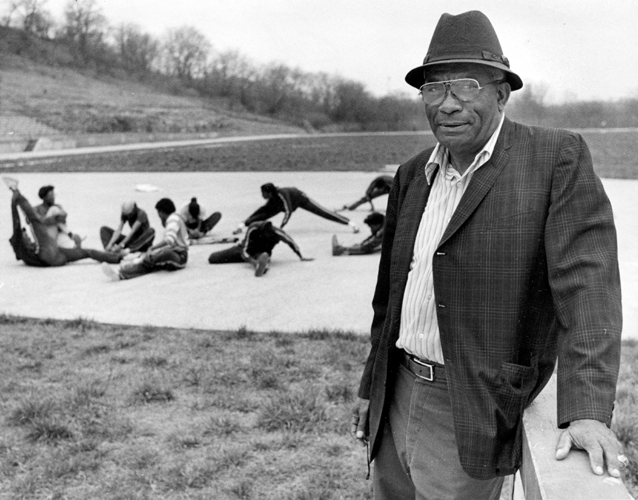
Many truly great people are also among the most humble, because they recognize the artificiality of fame, and understand the value of humility. Legendary Tennessee State University track coach Ed Temple, who died Sept. 22 at age 89, was never comfortable talking about his fame or achievements. But he always lavished praise on his athletes, and no one in any sport, pro or college, ever accomplished more working with less. His career began in an era when black athletes were marginalized in terms of publicity and opportunity, and black colleges were paid even less attention.
Even more amazing is the fact Temple never planned to be a track coach, though that was one of three sports in which he achieved all-state honors at John Harris High School in Harrisburg, Pa. But since he’d been a great football and basketball player as well, when he attended what was then Tennessee State Agricultural and Industrial School on a track scholarship in the late ’40s, he envisioned a future coaching on the gridiron or basketball court.
He might not have become the women’s track coach there if the person holding the job when he graduated in 1950 hadn’t departed. The school suggested he fill in while working on a master’s degree in sociology. He inherited a job at a school that didn’t even have a regulation track. (Their track was a U-shaped 300 meters, rather than the conventional Olympic 400-meter oval.) Temple was simultaneously a new coach and a newlywed, marrying Charlie B. Law that same year.
Temple didn’t let obstacles — like the lack of a staff or resources — stop him. Instead, he began an incredible run that produced 40 Olympians in a stretch from 1950 until 1993. That celebrated Tigerbelles roster accounted for 13 gold medals, six silver and four bronze.
What Temple’s team achieved in 1960 at the Rome Olympics alone will never be equaled. That year, America’s women’s 4-by-100 meter relay team consisted entirely of TSU Tigerbelles. Their glittery array of team championships included 34 national titles divided between 16 indoor, 15 outdoor and five junior crowns. But he was just as proud of his Tigerbelles’ educational achievements. Among the 40 Olympians, 39 graduated with bachelor’s degrees, 28 earned master’s degrees, and eight earned medical degrees or doctorates.
Still, while those numbers tell part of the story, they’re hardly all of it. Temple didn’t just begin his career coaching a track-and-field team at a historically black institution during the height of the segregation era — he did so leading the women’s team. During his first season, the Tigerbelles participated in a grand total of one (one!) meet. In the early years,Temple had to pay out of pocket for food on the road. He often relied on the famous Green Book, a list that blacks traveling Southern roads could consult to avoid ugly places where they wouldn’t be served. Even if there had been a travel budget for a hotel, there weren’t many available on the highway where African-American teams could stay.
“I coached, I rubbed down, I was the counselor, I was the parent, I was everything,” Temple recounted in one of many articles commemorating his accomplishments, this one in The New York Times. “But you had to be because there was no other person there.” He wasn’t even able to offer scholarships until 1968, which meant all the spectacular women who achieved Olympic greatness prior to that date were doing other things besides running and jumping. Duties would range from clerical to janitorial, and everyone, even the magnificent Wilma Rudolph, arguably the greatest woman track-and-field athlete of the modern era, had to do double duty to make it through school.
The accomplishments of Rudolph (who won three gold medals in the 1960 Olympics and was the first woman to achieve that goal in track), Wyomia Tyus (gold medal in 1964 and 1968 in the 100-meter dash), current men and women’s coach Chandra Cheesborough-Guice, Edith McGuire, Mae Faggs and many others brought international recognition and deserved fame to Ed Temple, whose masterful combination of athletic wisdom, personal advice and spiritual guidance was the constant through decades of achievement. “The people who ran for me simply loved the sport,” Temple often said.
“I would always tell the girls that first, you are young ladies,” Temple told the Tennessee Tribune in 1995. “Always carry yourself that way. Next, you are a track person. You are using your track in exchange for an education. You are doing this to walk across that stage and receive your degree. Athletics opens up doors for you, but education keeps them open.”
In 1981, Temple took four athletes to the AAU national indoor championships at Madison Square Garden. He wanted to take six, but only had the funds for four. So a quartet of Cheesborough, Brenda Morehead, Kathy McMillan and Debbie Jones proceeded to beat all comers and bring the title home to Nashville.
As his reputation and fame grew, so did the chance for Temple to get out of Nashville and display his skills abroad. He was the head women’s track coach for both the 1960 and 1964 U.S. Olympic teams. During the 1964 Olympics, he had to fight on behalf of his women’s team with the men’s team, who routinely refused to provide such necessary items as proper uniforms and starting blocks for the runners. Nevertheless, he didn’t complain publicly, and just brought home more winners.
The Tigerbelles became such a local sensation that Temple finally got the TSU track updated for the modern era. After his announcement that the track program would cease due to the worn-out condition of the school’s track in 1976, Music City business leaders raised $100,000. The state Board of Regents added the other $600,000 required to build what was dedicated in 1978 on campus as the Edward S. Temple Track.
He lived long enough to see his achievements celebrated for the younger generations who didn’t see those great Tigerbelle teams. Nine different halls of fame inducted him, among them both the National Track and Field and United States Olympic halls. The final honor came in 2015, when a statue of Temple was installed near the outfield at First Tennessee Park, the new home of the Nashville Sounds.
As Temple’s life neared its end, he stayed active, playing basketball on a regular basis. When asked, Temple would duly tell whatever stories were requested. But what he never did was return to the Olympics. “I enjoy looking at it on television,” Temple told The New York Times. “I don’t need all that commotion. I had it. I went through it. I enjoyed it. That’s it. I passed the baton on to someone else.”
William B. Brimm Sr.
William B. Brimm Sr.
1923-2016
A coach who changed lives
By Frank Pendleton (as told to Nicki Pendleton Wood)
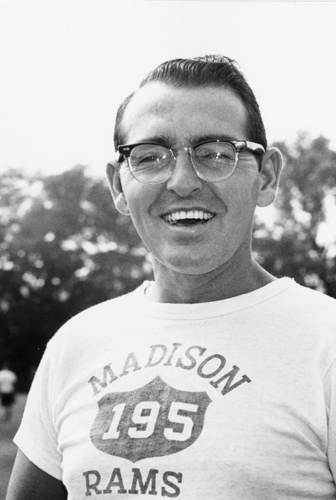
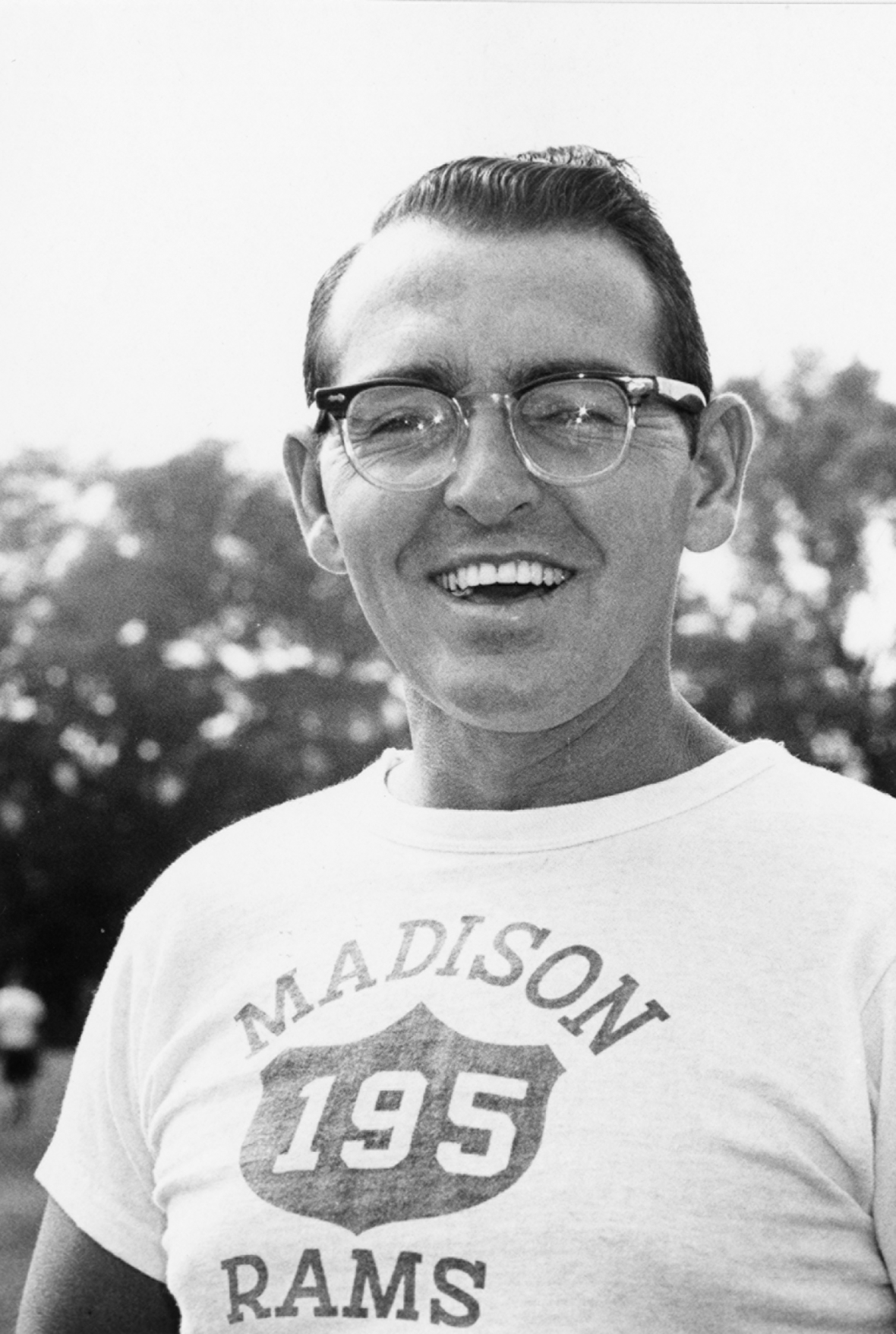
I met Coach Brimm when I was a sophomore in high school, 16 years old, so I’ve known him 60 years. Madison High was only 2 years old — we were just the second graduating class. Brimm came to Madison High from Goodlettsville High and coached three sports: football, boys’ basketball and baseball.
He was very innovative in football, and a skillful coach. The split-T formation was coming into vogue, and we ran it before anyone else in Middle Tennessee. Coach Brimm developed players’ skills, and he was a good motivator. We won games we shouldn’t have won. He never cursed on the field — he was a devout Baptist who played clean and made the players play clean. He was a founding member of the Fellowship of Christian Athletes in Middle Tennessee, and there used to be a Coach Brimm award or scholarship.
He worked our butts off. When game time came, you were glad to just play a game because it was so much easier than practice. But the grinding practices made sure we were in shape. By the fourth quarter, everyone else was dragging, but we were still going.
Around then, Shirley Majors was named football coach at Sewanee. Majors went around to the cities close to Sewanee and asked coaches if they had any players who were pretty good students. Danny Woods and I were called out of class to meet them. I thought, “Oh my goodness, I may get to go to college!” Three weeks later, I got a full academic scholarship letter, and Woods got major scholarship money. Madison turned out to be a good feeder school for Sewanee.
There were maybe six kids about my age who probably would have gone to jail, and definitely were not able to go to college. Brimm got them into junior colleges. There were guys whose fathers had either died young or were in prison. Brimm adopted one of the boys to get him through high school, and another lived with them for a stretch of time.
Brimm stayed in touch with players — they called us “Coach’s boys.” We got together frequently and swapped stories, caught up. I started taking him and his wife to lunch 15 or 20 years ago. Our wives were like sisters. We had a lot of good times with them.
Jim Zapp
1924-2016
Baseball player, Negro League star
By Ron Wynn
Like many baby boomers who were born as the Negro Leagues were on their last legs, my knowledge of and appreciation for James Stephen “Jim” Zapp, who died Sept. 30 at age 92, is fueled by recollections from others and the limited available accounts that chronicle his decade-long stint in both the Negro Leagues and minors. While Zapp didn’t get the opportunities he deserved, especially while in his prime, he was still among a host of outstanding athletes who refused to let segregation’s unjust exclusion deny them the joy of playing baseball.
The high school Zapp attended in Nashville didn’t have a baseball program, so his introduction to competitive baseball came in the military. He was stationed at Pearl Harbor. The athletic ability he’d shown during his forays into softball quickly became evident. Zapp was eventually transferred from an all-black team to the “integrated” squad, joining Andy Ashford as the team’s only two African-Americans. That squad won back-to-back Navy titles in 1943 and 1944, setting the stage for Zapp to join the Baltimore Elite Giants after his discharge.
He was known during his peak years with multiple Negro League teams (including the Nashville Cubs and Nashville Stars) as a tremendous outfielder and excellent contact hitter with good power. Career highlights include Zapp helping the Birmingham Black Barons win the 1948 Negro American League pennant, hitting the game-winning home run in the third game of the seven-game series. During part of his time with the Black Barons he played alongside Willie Mays. His finest season outside the Negro Leagues came with the Paris Lakers of the Mississippi-Ohio Valley League in 1953: He batted .330 with 20 home runs and 136 runs batted in, a league record.
Zapp served as a civil service worker for 24 years after his retirement, but he never completely severed his ties with the sport he loved. He spent part of his final years umpiring high school games in Texas. Fortunately, today there’s far more research and documentation about the Negro Leagues, something that ensures Zapp won’t be forgotten by the generations to come.
Nera White
1935-2016
Baseketball star
By John Glennon
Well before there was Cheryl Miller, Sheryl Swoopes, Chamique Holdsclaw or any of the other great women’s basketball players — well before Pat Summitt — there was Nera White. When the roots of women’s basketball are traced, the search often leads back through Macon County, where White was born and where she began a career that would lead her to the Naismith Memorial Basketball Hall of Fame and the Women’s Basketball Hall of Fame.
White died April 13 in Gallatin at age 80, bringing an end to a legend that was crafted several decades before YouTube clips or SportsCenter highlights. Playing in an era long before Title IX brought attention and equality to women’s college sports, White didn’t let her graduation from Macon County High end her basketball career. She attended Peabody College in Nashville, now part of Vanderbilt, but Peabody didn’t have a basketball program, so White played Amateur Athletic Union basketball for Nashville Business College and led that school to 10 AAU titles between 1955 and 1969.
The 6-foot-1 White starred on the international basketball stage as well, as she guided the U.S to the gold medal in the 1957 World Championships in Brazil and was named the tournament’s Most Valuable Player. White’s skill level was such that she reportedly once dribbled the basketball for the length of the fourth quarter in high school to prevent the other team from scoring. But her athleticism and scoring ability were feats to behold as well.
In the book Swish: The Quest for Basketball’s Perfect Shot, authors Mark Stewart and Mike Kennedy wrote this about White: She “thrilled fans with her soaring rebounds and drives to the basket. She was a great scorer who had a deadly hook shot and an accurate 25-foot jump shot. Another of her specialties was sinking baskets from half court. White also had amazing leaping ability. Every so often, she would rise to the rim and dunk the ball, bringing the crowd to its feet.”
It’s easy to see why the gym at Macon County High was renamed Nera White Gymnasium and a section of highway from Lafayette to the Kentucky state line was named for her as well.
Bill Wade
1930-2016
Football star
By Pat Embry
Bill Wade was the most accessible of Nashville sports superstars — so much so that we may have forgotten just how big an impact he made on and off the playing field.
Born in Vanderbilt Hospital, son of a Vanderbilt football hero, star quarterback at Montgomery Bell Academy and later up West End Avenue at his dad’s alma mater, Wade remained just one of us. Many still called him “Billy.” It fit. He was a hand-shaker. A hail-fellow. A sunny smile-wearer.
Spending a second career behind a desk as a bank executive, Wade first and foremost remained a walking, talking preacher of all things great and glorious about sports and God Almighty as a longtime leader of the Fellowship of Christian Athletes. Revisionist history is such that the local daily’s newish sports columnist recently claimed that Vanderbilt’s star linebacker, slotted as a likely mid-first-round NFL draft pick this spring, is “the most decorated player in program history.”
Puh-leez.
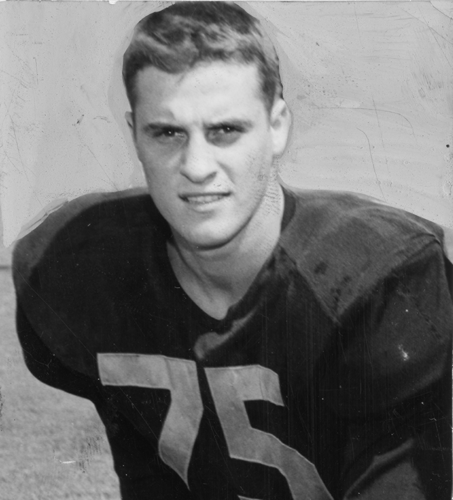
At Vanderbilt, Wade earned SEC Player of the Year and two-time All-American honors. The Los Angeles Rams chose him No. 1 overall in the 1952 draft. Surrounded by beautiful young women, his square-jawed grin graced the cover of Look magazine, then the equivalent of scoring the cover of People. After leading the NFL in passing one year with the Rams, Wade was traded mid-career to George Halas’ Chicago Bears — then known as the Monsters of the Midway, the baddest of the bad boys, when the line of scrimmage meant forearm shivers upside the head and inside pass routes ended with clothes-line tackles. Wade, a master of the short, concise forward pass and one tough guy, never missed a down. He scored two touchdowns on short runs as the Bears beat the New York Giants to win the NFL title in pre-Super Bowl 1963.
His hometown popularity during his playing days was such that Bears games were shown locally on tape delay on Sundays during the season — after the evening news. Imagine that. Blind but determined for the last decade or so of his life, Bill Wade died at age 85 on March 9, 2016, in Nashville.
“Bill Wade,” Bears Chairman George McCaskey said in a statement, “was a gentleman in every sense of the word.”

Art Demmas in his playing days at Vanderbilt
Art Demmas
1934-2016
NFL referee
By David Boclair
Art Demmas never really thought about a career as a football official until legendary Nashville Banner sports editor Fred Russell suggested it. During the three decades he wore the stripes during professional football games, he never thought about doing anything else. Not even the most extreme hazards of the job caused him to waver.
A collision with a player during a 1992 game left him hospitalized with a cracked sternum and severely bruised lungs. While hospitalized he developed pneumonia and then bronchiectasis, which required a heavy regimen of antibiotics and for his wife to regularly pound on his back in order to drain his lungs.
“That stuff comes with the job,” Demmas told Sports Illustrated four years later. “I never seriously thought about quitting.”
Demmas was a football star at Vanderbilt, a tackle from 1952-53 and 1955-56 who played on that school’s first bowl team (the Commodores beat Auburn 25-13 in the 1955 Gator Bowl) and was a captain in his final season.
In his later years he served as president of Hillwood Country Club, Vanderbilt Commodore Club and the NFL Referees’ Association. In between, he filled his weeks as an insurance and estate planning executive and his weekends with football contests.
At Russell’s urging he began to call high school games in 1958 and quickly jumped to SEC games, which he worked for eight years. In 1967 he was hired to work for the American Football League and continued to call professional games until he retired in 1996. He primarily was an umpire, which put him in harm’s way, right behind the defensive line in the middle of the field. It was from that vantage point that he called four Super Bowls.
“Art was a man’s man, and he helped me so much as a referee,” longtime referee Red Cashion told the Football Zebras site. “We worked together for 11 years in the NFL. We were a team. He was a marvelous umpire.”
Mike Moore
1956-2016
MTSU football legend
By David Boclair
Mike Moore built his reputation one carry at a time.
A Chattanooga native, he was the first Blue Raiders player to rush for more than 1,000 yards in three seasons, and he finished his career as the program’s all-time leading rusher (he is still second) with 3,678 yards.
He wasn’t elusive so much as he was unrelenting. A featured player in coach Ben Hurt’s veer offense, he set program records for carries in a game (38), a season (296) and a career (807) — all of which still stand. No other Blue Raider has ever carried as many as 700 times in a career. Thirteen times from 1974-77 he rushed for 100 yards or more in a game. Twice he topped 200 yards. He was the OVC Player of the Year in 1975 and an All-American in 1976.
He was inducted into the MTSU Blue Raider Hall of Fame in 2007. He also is a member of the Chattanooga Sports Hall of Fame.
The Miami Dolphins drafted him in the 12th round in 1978, and he played preseason games that year for the Houston Oilers, who had another rookie running back, first-round pick Earl Campbell. It was a situation that did not afford him enough of an opportunity to make an impression.
Until his passing, though, he remained in close contact with many of his MTSU teammates. Not that he needed to.
“[Moore] had a charisma about him, and he was so engaging,” MTSU director of athletics Chris Massaro told The Daily News Journal. “You meet him and don’t forget him.”
Remembered …
Dan Catignani, longtime boys football and basketball coach at Christ the King.
Bob Cummings, football coach at Isaac Litton, Hendersonville and Beech high schools.
Mamie Rallins, TSU Tigerbelle and Olympic track athlete.
Spencer Richardson, East High basketball star.



Post a comment as anonymous
Report
Watch this discussion.
(0) comments
Welcome to the discussion.
Log In
Welcome to the discussion.
Keep it clean. Please avoid obscene, vulgar, lewd, racist or otherwise abusive language. Comments featuring hate speech or threatening or violent content will not be tolerated.
PLEASE TURN OFF YOUR CAPS LOCK.
Be truthful. Don't knowingly lie or mislead.
Be proactive. Use the “report” link on any comment that violates our comment policy.
Share with us. We'd love to hear your feedback.