

The race for state Senate District 19 in Davidson County began with a vocabulary lesson.
Skulduggery (noun): underhanded or unscrupulous behavior, a devious device or trick.
State Sen. Brenda Gilmore, who has represented the district for one four-year term, announced she was retiring, but only as the qualifying deadline for the August primary was passing. She used her retirement announcement to announce she had picked Keeda Haynes as her successor. And Haynes, conveniently, had just qualified to run.
Unfortunately for the duo of Democratic women, the state has a law banning such dastardly, anti-democratic moves. Gilmore’s surprise decision to withdraw so late in the cycle triggered an extension of the qualifying deadline, Haynes dropped out, and a handful of other Democrats took the opportunity to run for the now-open seat.
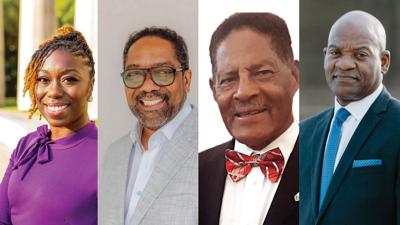
Voters in the district, which following 2022 redistricting includes a jigsawed selection of central and southeastern Davidson County, face a choice that has turned into something of a proxy war in Nashville politics. One Republican, Pime Hernandez, is running, plus Democrats Barry Barlow, Jerry Maynard, Charlane Oliver, Rossi Turner and Ludye (“On Duty”) Wallace.
Wallace and Maynard are both well-known former Metro councilmembers. Maynard has remained heavily involved in city politics as a lobbyist for the Tennessee Titans, the Nashville Convention & Visitors Corp and Nashville General Hospital. Wallace, a past president of the Nashville NAACP, briefly ran for mayor in the 2018 special election, with his candidacy used as an instrument to fast-track the election that Metro officials sought to put off for months. Oliver has been a regular presence in Nashville’s progressive circles for years, especially since co-founding The Equity Alliance in the wake of Donald Trump’s 2016 election.
While Wallace is a known quantity and has been active on the campaign trail, it’s Maynard and Oliver who have attracted the most attention and split some of the city’s most prominent public figures. One candidate’s polling found that more than half of district voters were still undecided in the primary.
Maynard is backed by former Mayor Karl Dean, a handful of Nashville state lawmakers, Metro Councilmember Sharon Hurt and Gilmore herself, while former Mayor Megan Barry (whose resignation led to Wallace’s last significant foray into politics), Metro Public Defender Martesha Johnson and Metro Nashville Public Schools board chair Christiane Buggs are backing Oliver.
For Oliver, it was in part the skulduggery that drew her to the race.
“That went directly against my values,” Oliver says. “I have been a staunch voting rights advocate. Everyone gets to have a voice. When that was literally taken away from us, I said ‘No, that’s not acceptable, and we should have options.’ When I looked around at who was looking to run, I didn’t like my options, and I felt like I was a better candidate.”
In the years since it was founded, The Equity Alliance has focused on engaging and registering Black voters around Tennessee, work that led to a high-profile fight with Secretary of State Tre Hargett. Oliver is not shy about criticizing Maynard for his establishment connections and past work both in and near government.
“I would challenge anyone to look at this race and say, ‘Who has been the one speaking up?’ ” says Oliver. “ ‘Who has been the one showing up when people are being displaced in Nashville? Who has been the person that has been registering voters to get people to turn out? Who has been the person who has protested companies that are coming here asking for corporate incentives and not making it fair and equitable for people to live in Nashville?’ That person has been me. People want to tout that they [were] on the council, but you’re also responsible for the terrible situation that we’re in in Nashville where people can’t afford to live here. … It’s one thing to run for office and wave your hands and talk about what you’re doing, but where have you beat the pavement and talked to voters? Where have you registered a voter? Where have you got out here and put your body on the line and protested? Those are real things I’ve sacrificed.”
In a release announcing his candidacy, Maynard touted work on voter registration efforts during his time as a Tennessee Democratic Party official in the 2000s.
For Gilmore, Maynard’s experience and connections are what make him the choice in the Democratic primary. (The Democratic nominee, whoever it is, is heavily favored to win the largely progressive district’s general election in November.)
Though she thinks all of the Democratic candidates “are good people,” Gilmore is supporting Maynard because she thinks he would be most effective in the Republican-dominated legislature, and thinks he will work to support abortion rights, gun control measures and equity in business.
“Jerry is a negotiator,” Gilmore says. “With a supermajority in both the House and the Senate, I think he’ll be able to reach across the aisle without selling his soul and get things done. … He has a reputation for getting things done, and that’s what we need in the Tennessee General Assembly.”
Gilmore has held elected office since the late 1990s, first on the Metro Council, then in the state House and now in the Senate. As she did when she first backed Haynes, she says she is stepping down because she “wanted to give the next generation of leaders an opportunity to serve.” Though Maynard is older than Haynes, himself having worked in Nashville since the 1990s, Gilmore says she sees Maynard, too, as “part of the next generation."

State and federal primaries and Davidson County general elections are on the Aug. 4 ballot



