
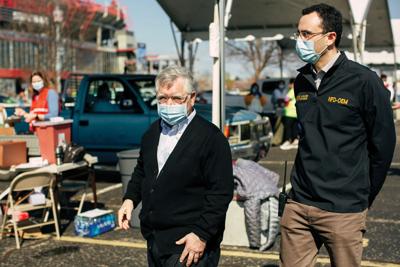

On Sept. 7, with Tennessee ranking among the world’s leaders in new COVID-19 cases, Nashville’s Metro Council took up a resolution urging the city’s public health department to reinstate a mask mandate for public indoor spaces. Although vaccines are now widely available, nearly half the city’s residents have not yet gotten the jab, and the Delta variant has proven far more contagious than the original strain of the virus.
The COVID-19 death toll in Nashville has now surpassed 1,000 people.
“Our priority should also be our constituents and keeping them alive,” said Councilmember Joy Styles, lead sponsor of the resolution. “So I think that we should support the health department and push them to put this mask mandate back in place.”
Speaking in opposition to the resolution, Councilmember Tonya Hancock encouraged her colleagues not to “get political” and referenced a similar resolution that the council had voted down last year, in the name of deferring to city health officials.
“We are not nurses, none of us are doctors,” Hancock said.
The resolution went on to pass — narrowly, with 21 councilmembers voting for it, nine voting against and five abstaining. Meharry Medical College president and infectious disease expert Dr. James Hildreth — one of the city’s most visible public health leaders throughout the pandemic — praised the council’s action. A statement from the Metro Public Health Department following the vote expressed appreciation for the council’s “encouragement.”
In early August, Mayor John Cooper did reinstate a mask mandate inside all Metro government buildings. Soon after that, the Metro school board voted to require masks in the city’s schools. One Cooper staffer tells the Scene that the administration believes its policy on Metro buildings helped clear the way for the subsequent Metro schools policy. But officials had already indicated they weren’t inclined to go further than that, and a little more than a week after the council passed its resolution, Metro Public Health Department Director Gill Wright reiterated that position.
In a letter to members of the Metro Board of Health, Wright said the health department “unequivocally agrees” with the recommendation from the Centers for Disease Control and Prevention that people should wear masks indoors regardless of their vaccination status. But he denied the council’s request for a citywide mask mandate.
“Prior to the vaccine, masks and distancing were the only public health interventions available to use, which led to public health orders that included a county-wide mask mandate and capacity restrictions,” said Wright in his letter. “MPHD phased out all restrictions shortly after an appropriate medical intervention — the vaccines — became widely available. As valuable as masks are, the way through this pandemic is vaccination.”
Among the factors Wright said would complicate a mask mandate’s effectiveness is the inconsistency of COVID policies in the region. Many of the patients contributing to the strain on Nashville’s hospitals are from outside the county, Wright said, meaning that a Metro mask mandate would be unlikely to affect such cases. Other officials skeptical of a return to requiring facial coverings have cited the difficulty of enforcing such a rule and raised questions about what metric the city would use to determine when to lift a mandate.
There’s another factor also apparently weighing on city health officials, though — one that was not mentioned in Wright’s letter but was openly discussed in a tense council committee meeting earlier this month. Councilmembers who opposed the resolution voiced a reluctance to further politicize mask-wearing, and staffers in the mayor’s office frame the administration’s position similarly, as one of deference to public health officials over politics. Be that as it may, Nashville’s health department is still operating under political pressure.
During the Sept. 7 meeting of the council’s Health, Hospitals and Social Services Committee, Tom Sharp — the health department’s policy director and governmental liaison — briefed committee members on the latest COVID data and explained the department’s position on a mask mandate. Sharp would later echo Wright’s statements about how the availability of vaccines as a medical intervention made officials less inclined to mandate masks. But he also cited the threat of not only preemption by state lawmakers if Metro brought back citywide COVID-related mandates, but also retaliation.
Asked early in the meeting by Councilmember Emily Benedict to explain the department’s reasons for opposing a mask mandate, Sharp said: “I think the main one is, and this is speculation on my part just from having been through these things, that it could have very negative outcomes for the health department politically, at the state level.”
Nashville is already at odds with the state over the school board’s decision to stick by its mask requirement in the face of the governor’s attempt to undermine it with an executive order allowing parents to opt out. Sharp referenced state House Speaker Cameron Sexton’s efforts to strip the state’s six independent health departments — including Nashville’s — of authority over disputes regarding COVID restrictions, and suggested a new mask mandate could draw unwanted attention to Metro.
“I will tell you that I really don’t believe that the state would fund the health department here anywhere near the level that you guys have traditionally funded,” he said.
The issue likely isn’t going away. Along with the resolution urging the health department to act, Styles and others also sponsored a bill that would institute a mask mandate by Metro ordinance. That bill passed on the first of three readings earlier this month, and as of this writing, is on the agenda for the council’s Sept. 21 meeting.



