
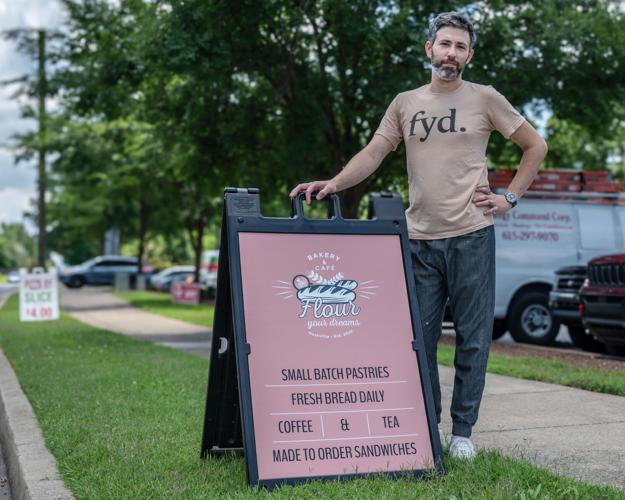

Danny Greenberg was surprised when he received a letter from Metro Codes in October of last year: Remove the sandwich board signage in front of Flour Your Dreams Bakery and Café or face a $60-per-day fine.
Greenberg and his wife Tania Salas opened the brick-and-mortar scratch bakery on Dodson Chapel Road in Hermitage in 2023. The cafe has good permanent signage, but the way the strip mall building and parking lot are set, it can be hard to see from the road. So Greenberg bought a folding-frame sandwich board. He put it out at 7 a.m. and brought it back in at 2 p.m. when the bakery closed. He placed it on the grass easement near the sidewalk so it wouldn’t block access. For months there wasn’t a problem. Plenty of customers told him they hadn’t known Flour Your Dreams was there until they saw the sign.
When he got the Codes letter, Greenberg called Councilmember Jordan Huffman, whose District 14 is home to Flour Your Dreams. Huffman was also surprised.

Members bring renewed focus to local politics as congressional fight roils Capitol
“We’ve got bigger fish to fry in Nashville than picking on small businesses that are trying to advertise things,” Huffman tells the Scene.
Greenberg says Huffman made some calls to Codes, and after a few days told him he could put the sign back out.
“Then, one day I see [someone from] Codes taking photos of the sign,” Greenberg says. “And he says, ‘You have already been cited. I don’t know why you are not listening.’” Greenberg got Huffman on the phone again, this time to talk to the inspector from Codes, who refrained from issuing a fine. But that wasn’t a permanent solution. So Huffman set out to change the law.
“I never thought in a million years that I would be drafting legislation on A-frame signs, but here we are,” Huffman says. “I don’t write legislation just to write it. There has to be a sufficient need.” Huffman says research shows these signs can increase business revenues by 5 to 15 percent.
Huffman’s legislation passed in May, allowing small businesses to have such signage in the right of way with certain restrictions. The Nashville Department of Transportation and Multimodal Infrastructure is developing a permit program for sandwich boards, but does not currently have a timetable for when they will be available. That’s according to Brendan Scully, public information coordinator for NDOT. This is good news for small businesses looking for ways to reach customers in an increasingly competitive city. The change does not, however, allow sandwich boards on private property, says Jessica Shepherd, administrative services division manager for Metro Codes’ Zoning Help Desk.
Melanie Mills was surprised when her landlord told her she could not have a sandwich board on the grass or the porch in front of The Makeup Altar, her business in East Nashville, noting that Codes had asked for the signage to be removed. Like Greenberg, Mills put signs out when the business was open, highlighting daily events such as tarot card readings, and brought them inside when the store was closed. The Makeup Altar is located in a Victorian house on South 11th Street in East Nashville’s Five Points — without the signs, she says, some people don’t realize it’s a business. Putting them on the grass would help bring people in while keeping signs off the sidewalk, where they could obstruct the right-of-way. Like Greenberg, Mills says customers have told her they learned about the business from the sandwich board.
Many small business owners are frustrated. Some spoke to the Scene on condition of anonymity, concerned that if their names appear in print, Codes inspectors might stop by. While they see the new A-frame signage change that Huffman ushered in as progress, some say the various regulations regarding signage are confusing and they feel restrictions are enforced with small businesses but not with record labels, Broadway behemoths or corporations. One Music Row nonprofit, for example, was told by Codes that it needed to remove a banner with its business logo from in front of their building — near where many Music Row record labels fly banners celebrating chart-topping songs. Banners require a permit, according to Shepherd, the cost of which is based on the sign’s cost. The minimum permit fee is $55.

Live Nation apologizes for promo for its new venue stenciled on sidewalks near The 5 Spot and Springwater
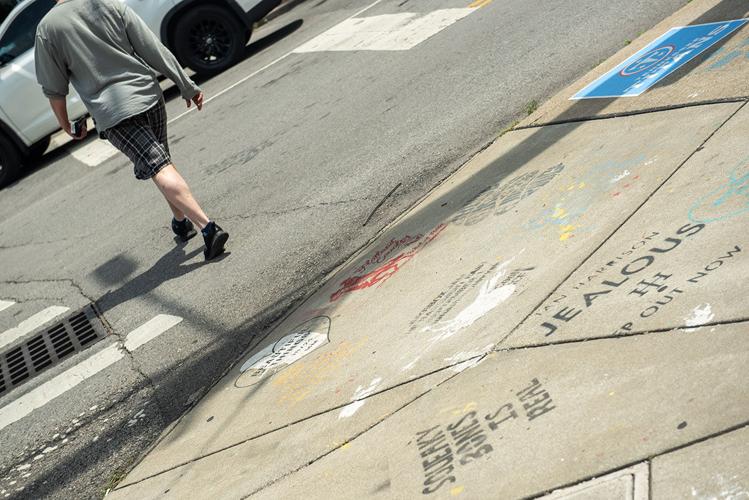
Others note the plethora of sidewalk graffiti ads painted in high-traffic areas, often promoting concert tours, album releases and sports franchises like the Tennessee Titans. Earlier this year, Live Nation apologized for a promotion in which ads for its forthcoming Nashville venue, The Truth, were stenciled on the sidewalk in front of some indie venues. Live Nation quickly had those ads removed. The massive ticketing, touring and venue management corporation did not return the Scene’s messages about other stenciled ads for tours that remain. Live Nation and other companies often use third-party firms for sidewalk graffiti ads.
NDOT’s Scully says stenciled sidewalk graffiti ads are not permitted and are illegal. “In the past, NDOT has issued sidewalk encroachment permits in a very limited capacity for these activities,” he says. “However, we are no longer issuing any permits for advertising decals or painted applications on sidewalks. No advertising is permitted on sidewalks.”

Sidewalk Graffiti in Five Points
NDOT jurisdiction covers sidewalks in the public right-of-way. Sidewalk graffiti on private sidewalks does not require a permit, according to Shepherd. Small business owners note that while private sidewalk graffiti ads may be allowed, murals on buildings and painted names of businesses on windows may require a permit.
Lauren Swedenborg co-owns Lykke Haus Curated Vintage, a store and showroom for other vintage proprietors on Trinity Lane. She says she cannot afford to rent space on Gallatin Road or elsewhere with higher foot traffic, so good signage is crucial. “Having signage upfront tells people you are open,” she says, adding that she thinks the increase in revenue is more than the 5 to 15 percent Huffman cites.
Before she opened two-and-half years ago, Swedenborg hired local artist Ellie Caudill to paint the Lykke Haus name on the windows, and Swedenborg painted a mural for a neighborhood small business crawl on the Jones Avenue side of the business, with her landlord’s permission. After the mural and window painting were completed, she was told by a Codes inspector that there could be fines associated for not having permits for both murals and windows, although he could not tell her the amount of the fines. She also had a sandwich board that she was told to take down, but when the law changed, she was allowed to put it back out.
Swedenborg doesn’t mind paying for permits and says she had good relationships with Codes in a previous career. But she is discouraged by what she sees as a lack of clarity in what’s required and by a perception that the burden of these regulations often falls on small businesses.
“When we are not allowed to write the name of the business on the window without a permit, that is starting to seem like a money grab,” she says.
Codes’ Shepherd says updates to sign ordinance 17.32.065 now require a permit to advertise on windows, such as paint on windows. Swedenborg was told her windows are grandfathered in, but she would need a permit if she were to change them in the future. Because the mural on Jones is for an event, it too can stay. But if she were to paint a mural with the business name or logo, she would need a permit. According to Shepherd, those are one-time — not annual — permits.
Swedenborg notes that even $55 fees can add up for small businesses, but more than the fees, she says she struggles with the changing regulations and the difficulty of getting accurate information.
Shepherd suggests business owners reach out to the ZHD (zoninghelpdesk@nashville.gov) before signing a lease to understand what may be allowed in terms of signage at that location. However, a sign permit will not be issued until the use has been established by permit.
“As we continue to grow as a city, we have to update our laws,” Huffman says. “Our city, the Metropolitan City of Nashville, was founded in the early ’60s, and a lot has changed since then. Hermitage was a cow field in the early ’60s.”



Post a comment as anonymous
Report
Watch this discussion.
(0) comments
Welcome to the discussion.
Log In
Welcome to the discussion.
Keep it clean. Please avoid obscene, vulgar, lewd, racist or otherwise abusive language. Comments featuring hate speech or threatening or violent content will not be tolerated.
PLEASE TURN OFF YOUR CAPS LOCK.
Be truthful. Don't knowingly lie or mislead.
Be proactive. Use the “report” link on any comment that violates our comment policy.
Share with us. We'd love to hear your feedback.