
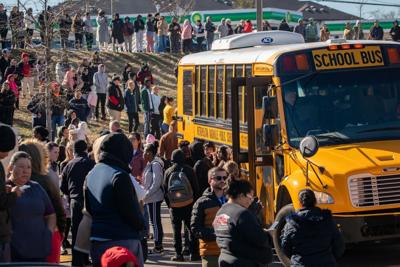

Had things gone differently, Josselin Corea Escalante would’ve just begun the spring semester of her junior year at Antioch High School.
It’s been one year since the 16-year-old was fatally shot by another student in the cafeteria of Antioch High School just after 11 a.m. on Jan. 22, 2025. Soon after the shooting, Escalante’s name and photo flooded local and national news outlets, where she was remembered as a “bright and compassionate” sophomore who played soccer and had aspirations to become a doctor. She had celebrated her quinceañera just a year prior.
Among the response team in the immediate aftermath of the shooting were employees with the Metro Department of Public Health. They describe the day as both chaotic and surreal, noting the impact not only among students, but also faculty and staff at AHS, including the cafeteria workers who they describe as being “visibly shaken”
“How do you create hope?” says Anidolee Melville-Chester, director of behavioral health and wellness at the health department. “How do you build resilience when everybody's broken? For me, that was that day.”
The clinicians spent the entire week following the shooting in the Antioch community, where they heard concerns from many students who feared going back to school. Some said they considered dropping out.
“It’s looking at humanity at its best and its worst,” Melville-Chester says of the job. “It's best when you're being resilient, when you're trying to bounce back, when you're trying to find your legs to stand after such a huge fall, when students are standing outside because they're afraid to come in and watching all of that, watching all that fear, watching that anger ... when there's students that are trying to come inside to be brave enough to get back into an environment of learning after such immediate tragedy.”

School board OKs $300K agreement following July lawsuit claiming MNPS failed to protect students from harm
Roughly eight hours after the shooting, about 80 people gathered for a vigil at Hamilton United Methodist Church. Those in attendance included AHS students, Mayor Freddie O’Connell, Metro councilmembers and gun reform activists. A GoFundMe campaign was soon launched, ultimately raising more than $108,000 in funds to support Escalante’s family and send her body back to Guatemala, where she was born. Escalante had immigrated to the U.S. with her family when she was 9.
“We had a dream for a better life,” Escalante’s father, German Corea, told The New York Times last year. “But the reality is that it’s not better anywhere. In Guatemala, you’ve never heard of someone killing someone in school.”
Escalante’s death prompted hundreds of protesters to head to the Tennessee State Capitol. Among those who demonstrated were members of Escalante’s family, who pleaded for statewide gun reform. Meanwhile, the state’s Republican supermajority narrowed its focus to a special session focusing on school vouchers, immigration and Hurricane Helene relief.
No meaningful progress was made on gun reform in the legislature last year, and protests at the Capitol over the matter generally fizzled out as the Tennessee General Assembly continued with its regular business. This marked a stark contrast from just two years prior, when thousands of people flocked to the state Capitol to protest in the wake of the Covenant School shooting, which resulted in the death of three children and three school staff members.
Otis Carter IV, a public health administrator with Metro Public Health’s Community Safety Program, notes how the Antioch High School shooting may have had a different community impact than the Covenant shooting.
“The Covenant shooting, I know for a lot of Black and brown residents, it didn't necessarily resonate close to home,” says Carter. "It was like it happened, but it still felt ... like it was out of town. It's part of the Nashville community, and we’ve seen the response, and we were grieving with the people, but I didn't know anyone ... versus Antioch. It was like, you know students that were impacted, you know parents that were impacted. ... It was just so many people that we have relationships with, from doing school outreach, from doing work within the community.”
Legislators did pass a law during last year’s session that allows for juvenile court records to be unsealed, only if the juvenile is dead after committing homicide on school grounds. This led to the release of the AHS shooter’s records in May, which showed the student had been on probation for previous violent behavior and that the teen had signed paperwork the morning of the shooting prohibiting him from possessing guns, ammunition or other weapons.
Metro Nashville Public Schools came under scrutiny because Omnilert — the AI-powered weapons detection system employed by the school under a $1 million contract — failed to detect the gun used on the day of the Antioch shooting. The Metro school board soon piloted the weapons detection system Evolv — the same AI-run technology used at Nissan Stadium — at AHS. Not long after, the board approved a $1.25 million expansion of the system to all area high schools. Now a pilot expansion in local middle schools is underway.
Escalante’s family sued MNPS and Metro in June, saying they failed to protect students from harm and that additional steps should have been taken to keep students safe. With no public discussion, MNPS approved a $300,000 settlement with the family at a school board meeting in November.
“The cafeteria was reopened at the start of the school year with physical and design changes to the layout meant to create a more welcoming space for students and faculty,” MNPS spokesperson Sean Braisted says of recent changes at AHS. “We were able to do so with a combination of district and donor allocations.”
As MNPS heightens safety measures, students continue to express anxieties about their well-being at school. Some describe the increased protocols as “reactionary,” while others feel student voices aren’t being considered when decisions are made.
Meanwhile, gun violence persists throughout the nation, and schools are still regular targets. According to Education Week, 18 school shootings resulting in personal injuries or death occurred in 2025. Antioch High School was the first.
In addition to those physically present at the school on Jan. 22, 2025, clinicians with the public health department emphasize the impact on the greater Nashville community. They note that second-hand trauma from the event is real, and that violence should be viewed as a public health issue.
But Melville-Chester says, a year later, looking forward is the best solution.
“The question is still the same," she says. "How do we keep our focus on humanity? How do we keep people hopeful when hopelessness is all around them? In order to heal, you have to come to a place of hopefulness, not hopelessness.”



Post a comment as anonymous
Report
Watch this discussion.
(0) comments
Welcome to the discussion.
Log In
Welcome to the discussion.
Keep it clean. Please avoid obscene, vulgar, lewd, racist or otherwise abusive language. Comments featuring hate speech or threatening or violent content will not be tolerated.
PLEASE TURN OFF YOUR CAPS LOCK.
Be truthful. Don't knowingly lie or mislead.
Be proactive. Use the “report” link on any comment that violates our comment policy.
Share with us. We'd love to hear your feedback.