
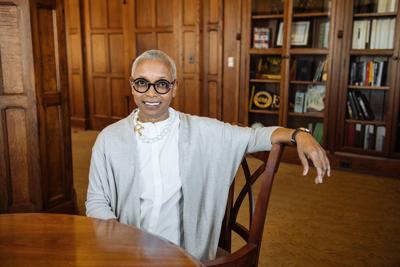

Fisk University’s Cravath Hall sits at a special intersection of history and the future. The 93-year-old neo-Gothic building houses card catalogs left over from its time as a library, relics from the university’s 158-year existence, and astonishing murals from modernist painter and Harlem Renaissance leader Aaron Douglas. It’s also home to the office of Fisk’s administrative staff, including its newest president Dr. Agenia Walker Clark.
Replacing board of trustees chair Frank Sims — who served as interim president after the sudden departure of Vann Newkirk in August 2022 — Clark assumed leadership of the historically Black university earlier this month. She comes to Fisk after 19 years as CEO of the Girl Scouts of Middle Tennessee. Throughout her career, Clark has led human resources departments for various institutions, among other roles, and she has taught as a volunteer instructor at Fisk. Clark serves on the boards of FirstBank Financial Corp. and Belmont and Simmons universities, and is a trustee emerita on the board of the Haslam School of Business at the University of Tennessee. Clark recently sat down with the Scene to discuss her new role.
What do you hope to accomplish during your tenure?
What I hope to accomplish is that students will say, “I was there when the transformation began.” I want the faculty to say, “I witnessed a transformation.” And I want the alumni to say, “When I came back, I saw a transformation.” There are so many opportunities to transform. The foundation is solid, but there are great needs on this campus — this campus is [more than] 150 years old. There are quite a few buildings on campus that are in the historic register. The campus is in a historical overlay itself. With that comes buildings that need to be updated and upgraded. There are new buildings that need to be built. But the infrastructure underground is more important than what will be happening aboveground. … I would like for Nashville and Nashvillians and the people that live here to say, “I remember when a transformation began.”
What are you most excited to bring to the table, and what are you nervous to tackle as president?
I am passionate about what I do. The beauty of what I’ve been able to do with my career — I feel very fortunate to say this — I’ve only worked with areas that I’m passionate about. You cannot live in this community for 30-plus years and not be passionate about Fisk University. … When you’re passionate about something, it doesn’t matter what time your day starts, it doesn’t matter what time your day ends. The issues are not issues, they’re opportunities. You just take a different lens to the whole experience. I’m just lucky that a search firm called. I’m luckier that the board said, “This is who we want to take this on, to take us into the next space.” This is just the beginning of a new chapter for Fisk, and I’m excited that I’m having the opportunity to be a part of that. I can’t say that there’s anything about this that I’m nervous about. I will say the only thing is, I want things to happen faster. But everything will come in due time. And the other part about it that’s been so exciting is that because I’m a product of our community, I also have a better sense of who to call and ask questions of. … I think it hasn’t felt as daunting because I do have a sense of where to start and who to contact to get coaching and guidance and advice on how to approach an issue.
Who will you turn to when you need advice?
That list is broad and deep, and many of them have already heard from me. And what’s fascinating is they come from a broad range of places and spaces, too. I knew who to call to help me put together a communication strategy. I know who to call to talk to about an overall strategy to address organizational structure, for instance. I haven’t had any trouble figuring out who to call and who to ask, but that’s a direct result of years of being here and always being actively involved in the community. So I’m excited that my Rolodex of relationships have really helped me approach getting answers to questions just a little bit quicker, so that I can start formulating what my strategy will be for the institution.
Before you started there was controversy at Fisk surrounding a new policy that threatened to quickly remove some students from classes if they didn’t pay their balances soon enough. What’s the current state of that matter? Have you addressed it with students?
This all happened before I got here — this was the purge. [On my first full day] I spent a couple hours with a group of students to talk to me about what they see my priorities should be. And in the midst of that conversation, the purge came up. And I found that fascinating, because every institution purges — I mean, that’s nothing new in higher ed. But what I learned from talking to them is that here at Fisk, it wasn’t purging. It was like you were asking a family member to move out of the house. And just seeing their emotional reaction to that was something totally different for me. Which is why it is so important … to engage in the listening, and hearing from the different constituents, but more importantly the students, what my priorities should be. The purge wasn’t the purge that I’ve heard about for years in higher ed. To them, it went deeper. These were members of their family, in the figurative sense, that all of a sudden weren’t in class the next day. And to hear them talk about that helped me realize I need to make sure that doesn’t happen again. And if it does happen again, that we as a staff and our leadership take a totally different approach to it.
They felt that the communication around that was inadequate and should have been better. They had lots of reactions to that. The only thing I can do since I wasn’t a part of it happening is to make sure, if it should ever happen again, it has to be approached totally differently. And if it does ever happen again, I can take the voices that I heard in the room with me on [my first day] and let it guide me and the staff on how we approach this. That was an awakening for me to hear them talk about that, because the language in the context of it was so far removed from a standard higher ed purge. But that also speaks to the culture here. And that was a great moment for me to share with these students, because it will affect everything that I do when I move forward if that ever becomes a necessity again.
Has there been communication with the students who were purged? Have they been able to return if they were able to get their finances together?
The only thing I know is that was a short window and time frame ago. And so I don’t know what the current status of that is yet — that’s one of the debriefs I haven’t caught up on. I haven’t had a debrief on that yet. And that’s coming up, because we’re getting ready to approach a new semester, so we’re getting ready to dive into that.
Fisk has an astounding legacy. Is there a certain aspect of it that’s particularly inspiring to you?
Right before I started, I took some time off and I was vacationing in Washington, D.C., and I went over to the Phillips Collection there in D.C. because they have an exhibit on African American modernism. And I walked around the third-floor gallery — most of that collection is from the archives of Fisk University. Then I learned that there are nine pieces out of our collection that are going to be featured at an exhibit coming up, curated by the Metropolitan Museum of Art. So for us here in the community, we’ve heard mainly about the Stieglitz Collection, which is the famed collection that is now shared between Fisk University and the Crystal Bridges Museum in Arkansas. But we don’t know about all the other, and there’s so much other. So I want to really make sure the community is spending more time getting to know more about everything else that’s here, in relationship to the arts.
Fisk has produced some brilliant civil rights figures throughout history. How do you hope to continue shepherding that kind of presence, particularly in Tennessee’s current political climate?
My job, I think, is to continue to share the excellence and thinking that comes from this campus. That and that alone I’m hoping will reshape what all of our leaders are thinking about for the future of every citizen in this city and in this state and in this country. I honestly believe that we are all guided by something that we hear, see something new that we learn about, and that’s why the sharing of messaging is so important. It has been known that — especially for those of us who are in this country, and Black, and are descendants of a slave trade — that it was the storytelling and the passing of messaging, and the passing of stories. And I just sort of feel that what Fisk has done is continue to share stories that we hope will have greater impact outside of this campus. That is who we are, that is what we do. … I don’t see that ending anytime soon. It is a part of our legacy, and it looks like the opportunity to do more of that gets greater every day. So I’m just excited that we continue to want to have a part and a voice in all of that.
But at the same time, I look at how we’ve touched this country and this world in so many other ways. … When people from around the world visit the Phillips Collection, they’re gonna see Fisk University’s name throughout it. One day last week, I had to get to campus early in the morning … around 6:30. There was a family standing out here in the middle of the lawn … from Germany. They are here to tour Middle Tennessee, and this was on their list. So I said, “So where are you going next?” “Jack Daniel’s.” I thought, “Oh my gosh, Fisk before Jack Daniel’s — it doesn’t get any better than that.”



Post a comment as anonymous
Report
Watch this discussion.
(0) comments
Welcome to the discussion.
Log In
Welcome to the discussion.
Keep it clean. Please avoid obscene, vulgar, lewd, racist or otherwise abusive language. Comments featuring hate speech or threatening or violent content will not be tolerated.
PLEASE TURN OFF YOUR CAPS LOCK.
Be truthful. Don't knowingly lie or mislead.
Be proactive. Use the “report” link on any comment that violates our comment policy.
Share with us. We'd love to hear your feedback.