


After a two-year absence, the Alfred Stieglitz Collection has returned to Nashville's Fisk University, marking the collection's first homecoming from Crystal Bridges Museum of American Art in Bentonville, Ark., which now owns a 50 percent interest in the works following a seven-year legal battle. The history of that deal is important, but what really matters is that Nashville's best art collection is back where it belongs.
The Stieglitz Collection was given to Fisk in 1949 by Georgia O'Keeffe, the renowned painter and widow of pioneering photographer Alfred Stieglitz. A fascinating window into modern art in general — and into Stieglitz and O'Keeffe's creative circle in particular — the collection includes more than 100 works ranging from the late 19th to the mid-20th century, boasting entries by Paul Cézanne, Pablo Picasso, Henri de Toulouse-Lautrec, Arthur Dove and Pierre-Auguste Renoir, as well as photographs by Stieglitz and paintings by O'Keeffe. The new exhibition opened at Fisk's 87th annual Spring Arts Festival earlier this month.
In 2006, facing economic difficulties that threatened to close the university — Nashville's oldest, which celebrates its sesquicentennial this year — Fisk sought to sell a portion of the collection. This set off a storm of controversy enraging a host of interests from local art lovers to the Tennessee Attorney General's office. It also resulted in a 2007 lawsuit — later dropped — by the Georgia O'Keeffe Foundation, which argued that selling or breaking up the collection is in violation of O'Keeffe's wishes for a gift that was given in support of the university's mission to educate African-Americans during a time when most universities in the South were segregated. The smoke cleared in April 2012, when the Tennessee Supreme Court upheld a lower court decision allowing Crystal Bridges to acquire a 50 percent stake in the collection, which now rotates between the institutions every two years — Crystal Bridges' inaugural display of the collection ran from Nov. 9, 2013, to Feb. 3, 2014. The Arkansas museum, which was founded by Walmart heiress Alice Walton, paid $30 million for its share in the works, along with an additional payment of $1 million to upgrade Fisk's gallery facilities and security.
The newly renovated space offers a spiffy setting for this latest exhibition of the collection — an inspired display that weaves an interesting narrative, and not just a show of the works for their own sake. Jamaal Sheats, director and curator of the Fisk University Galleries, has organized Origins of Influence, an exhibit that points to the impact African art made on European modernists, who in turn inspired American painters like Arthur Dove and Marsden Hartley. Here traditional African art is displayed alongside Impressionist works, which give way to Cubist canvases, which are reflected in the abstracted landscapes of an American like Dove. With 43 works, the exhibition includes nearly half the collection, and the exhibit's works on paper will be rotated every 90 days during the show's run, which continues through 2017.
A display that highlights the development of modern art is especially ambitious given that these artist's names could hold the walls all by themselves: "Tête de Femme (Head of a Woman)," is a stunning blue painting of a woman's profile attributed to Pablo Picasso; a color lithograph of one girl pinning another girl's hat could only be by Pierre-Auguste Renoir; another small color lithograph of nude male bathers at the beach features the unmistakable lines of Paul Cézanne.
My favorite works in the show are by Dove, whose small oil-on-board "Moon" opens the show. Dove was a pioneering American abstract painter who most famously translated landscape painting into the language of modernism. "Moon" is a great example of Dove's legacy, picturing the satellite peeping over a hillside — a pale yellow beacon in a void of nested, undulating ripples of black and gray. The collection includes a number of works by Dove, and it's fascinating to compare works like the stylized "Moon" and the flat, pure abstraction of "Something in Brown, Carmine and Blue," which owes its slick surface and weird, washed-out tones to Dove's method of painting oils on a sheet of metal. It's gorgeous.
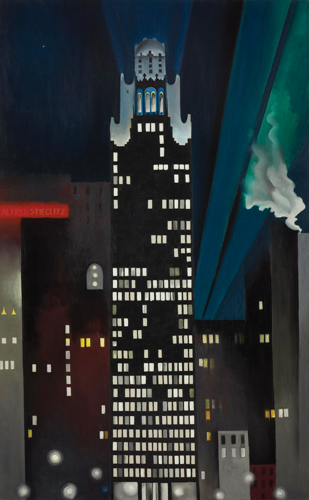
But of course, the works by O'Keeffe and Stieglitz will be highlights for most gallery visitors. O'Keeffe is generally best known for her labial flowers, but the signature work of the collection is her "Radiator Building — Night, New York," which captures the landmark skyscraper in a painting that O'Keeffe intended as a portrait of Stieglitz, whose name appears emblazoned on a red neon sign. O'Keeffe's "Flying Backbone" is a surreal scene that pictures the titular vertebra floating above a Southwestern desert scene. Fans of the artist will recognize how this desert milieu recalls similar skull and bone paintings associated with O'Keeffe.
"Flying Backbone" floats near a few small cloud study photographs by Stieglitz. The works speak to one another in a conversation about fleeting time, change and transformation. And they remind us to value these beautiful, important works before they disappear again.
Email arts@nashvillescene.com



