
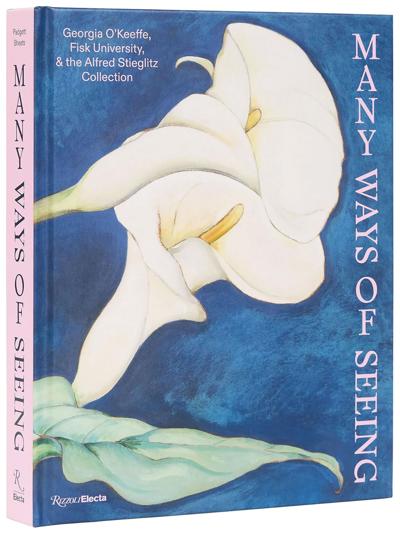

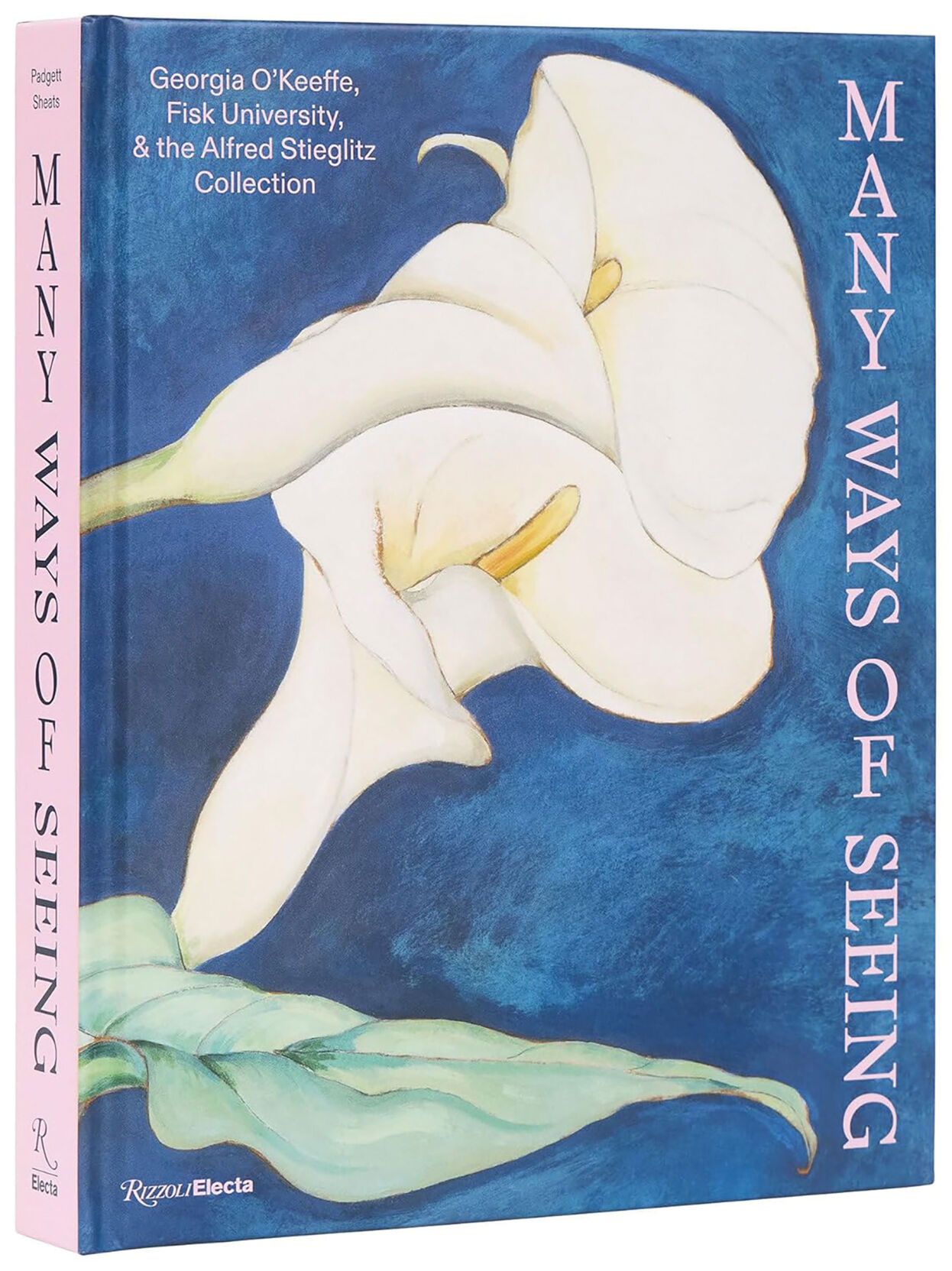
For a book that looks as lighthearted as Many Ways of Seeing — with its calla lilies on the cover and thick, pale-pink spine — you might expect a breezy, uncomplicated read. But the story it tells is remarkably complex.
It involves death and money, pride and frustration, race and privilege. It’s the story of one of the most influential art collections in the South — and one with the most strings attached.
Prominent photographer and New York City gallerist Alfred Stieglitz died in 1946, and his widow, artist Georgia O’Keeffe, was tasked with finding permanent locations for his extensive personal collection of art. By 1949, O’Keeffe had settled on Fisk University — one of the country’s most prestigious historically Black universities — as the recipient of 101 works from Stieglitz’s archive.
The collection of O’Keeffe’s donation — and the legacy that has followed it — is the complicated subject of Many Ways of Seeing. With full-color plates of each artwork, historic photos of exhibitions and key players, and new essays and scholarship devoted to the collection, this book pulls back the curtain on one of the most eventful exchanges in Southern art history.
“O’Keeffe’s motivations, the nature of the donation, and the subsequent impact of the collection over decades at Fisk have never before been fully explored,” writes co-editor Jen Padgett in her essay, which in many ways works as the book’s introduction.
If it simply chronicled the works in the collection, Many Ways of Seeing would be a worthwhile endeavor. Alfred Stieglitz was one of the leading advocates for modern art in the United States, and as a gallerist he organized the first American exhibitions of Cézanne, Matisse, Picasso and Rodin — European modernists so influential that, even a century later, they are still recognized by a single name. The selection of works from his collection that are now owned by Fisk include works by some of these masters, including a painting from Picasso’s Blue Period (1901 to 1904).
When asked why she chose Fisk — an institution that Stieglitz had never visited — for such a generous chunk of his archive, O’Keeffe said, somewhat cryptically: “because I think it is a good thing to do at this time and that it would please Stieglitz.”

After a two-year absence, the Alfred Stieglitz Collection has returned to Nashville's Fisk University, marking the collection's first homecomi…
But as the book’s title suggests, there are many ways to interpret the gift — it is invaluable to Fisk’s reputation as an art-forward institution, as well as to the students who spend time with the art collection, “to look at it rather than read about it,” as O’Keeffe wrote. But it’s also a huge expense that a university has not always been equipped to contend with. The university first renovated a building that had previously served as a gymnasium to house the collection. As Padgett outlines in her essay, O’Keeffe had on at least one occasion offended the head of Fisk’s art department, Aaron Douglas. Beyond personal conflict, Douglas remained concerned that the Stieglitz Collection would pull focus from the work of Black artists that Fisk had been collecting since the university was established in 1866. The legendary Douglas murals that adorn Fisk interior library walls, for example, had been made in 1930, more than a decade before the Stieglitz donation. For Douglas, Padgett writes, “advancing Black thought and underscoring African contributions to modernity took priority over preserving the legacy of the vanguard white artists of the Stieglitz circle.”
This is a refreshing approach to an art-historical story that is often saturated with hagiography and romanticism. O’Keeffe is depicted as a benefactor who put Fisk’s art department on the map, but also one whose “naturalized attitudes of Eurocentric entitlement” were hard to ignore.
Padgett, who co-edited Many Ways of Seeing with Fisk’s Jamaal B. Sheats, is the first endowed curator at Crystal Bridges, an institution that struck a $30 million deal with Fisk that works a little like parents having joint custody. The Stieglitz Collection entered into a co-ownership agreement between the two institutions, which agreed to be equal partners in the care and display of the collection, with all 101 objects transferring between the locations every two years. (It will next be on display at Crystal Bridges in Arkansas in June.)
The book works like a primer on this long and ongoing saga. Archival photographs of exhibitions put documentary context into the grand collection of modern art. Inclusions like the calla lilies on the book’s cover — a detail from a 1926 painting by Charles Demuth — contain detailed descriptions about the work itself as well as its history within the Fisk community. Demuth dedicated the work to Bert Savoy, a vaudeville actor and female impersonator who was struck by lightning on a Long Island beach in 1923. Art historian David Sledge provides detailed, scholarly commentary on the work, which includes a synopsis of a lecture Aaron Douglas gave on the painting in 1951. “For Douglas,” Sledge writes, “art was central to human flourishing, not an afterthought to it.”
Together, all these elements accumulate into something larger than a conventional art history. They show how the collection — with its African figures, its colorful Arthur Dove abstractions, its drawings by Rodin and Toulouse-Lautrec — has functioned as a cultural inheritance that continues to shape the legacies of its stewards.



