
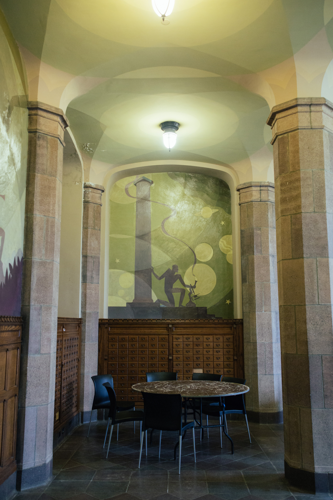
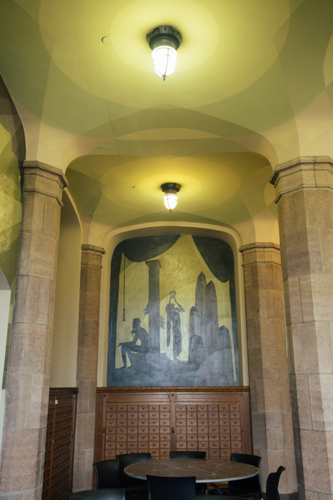
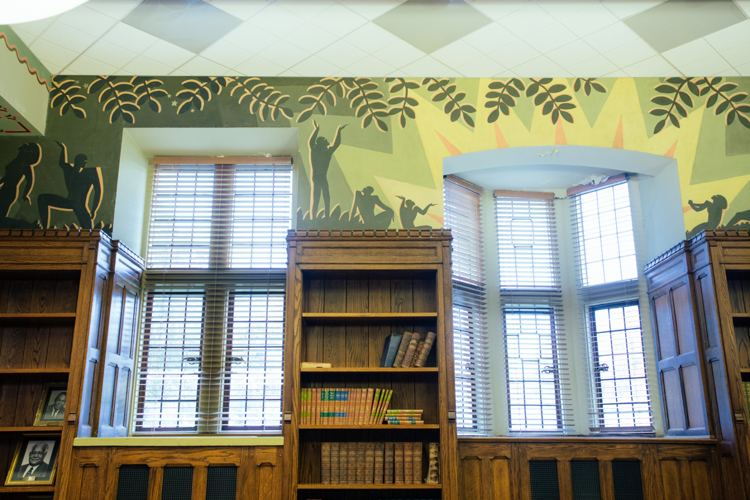
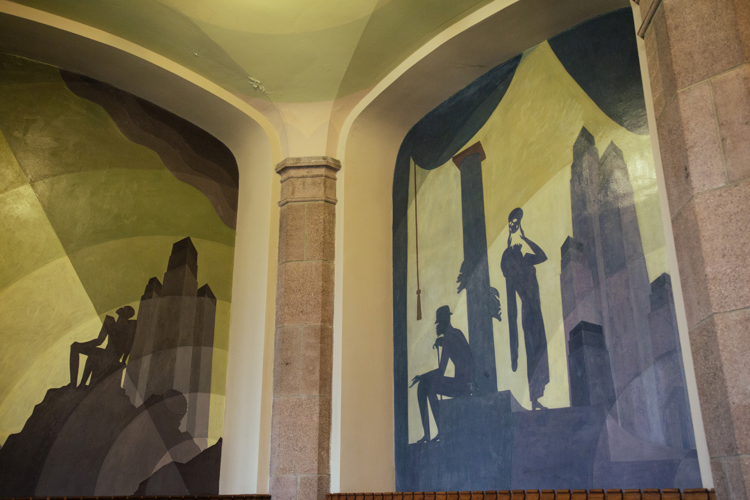
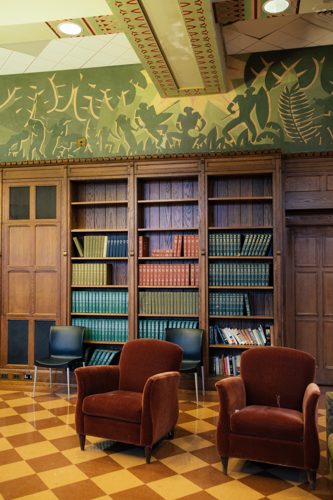
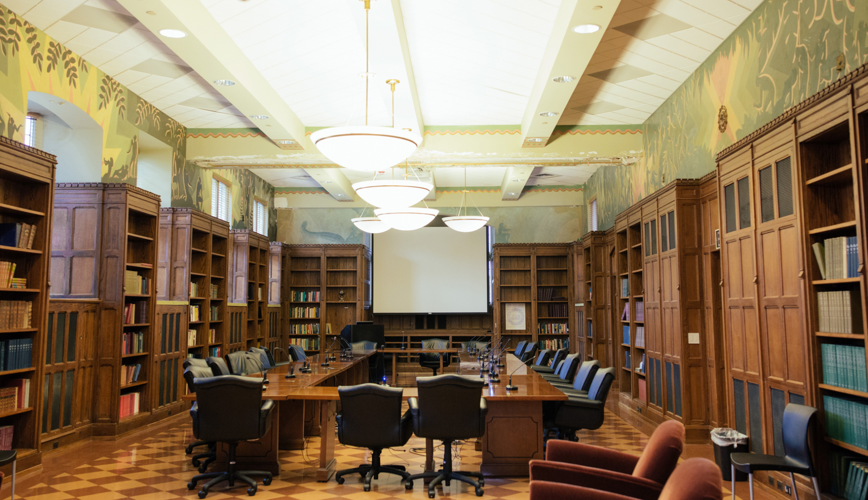


Fisk School opened to all people, regardless of race, just six months after the Civil War ended. In 1930, the newly accredited university invited modernist illustrator and painter Aaron Douglas to conceive a mural cycle for the new Neo-Gothic Cravath Library. Fisk’s book collection eventually moved to a new library across the quad. Today, Cravath houses various administrative offices and Aaron Douglas’ signature work — a jaw-dropping cycle of murals.
Douglas was one of the founders of the Harlem Renaissance, and moreover he created the movement’s artistic groove, an imprint with aesthetic relevance that was rooted in social change. As a modernist, Douglas, who died in 1979, used monochromatic palettes, sharp lines and bold design. Like his Harlem Renaissance contemporaries, Douglas sought to create a narrative of collective memory that would uplift and empower black Americans.
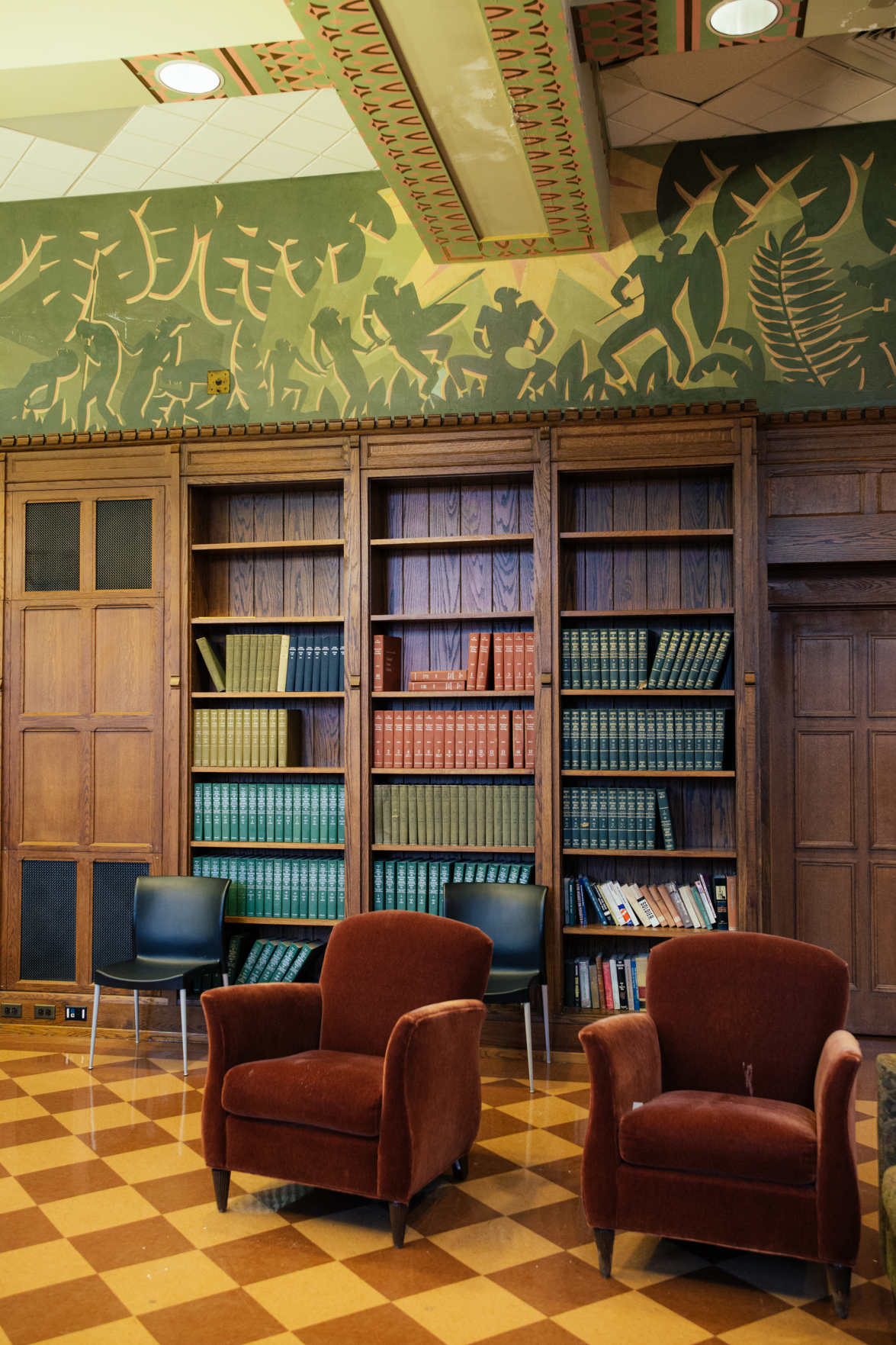
Douglas drew from Egyptian reliefs, masks from the Ivory Coast and Liberia, and contemporary art of the Congo and the Gold Coast (now Ghana) to create an ambitious cycle of murals. Set in multiple rooms, the murals form a single continuous narrative — a panoramic vision in which Africans both living on the continent and spread across the globe could share a common history and future. Starting in Cravath’s north reading room, the mural shows silhouetted figures in the jungles of Africa as they face European colonizers, eventually walking to the shore in chains.
In the south reading room, Douglas depicts the way out of bondage as being through education. A figure peers into a telescope. Another person traces a hand along a globe. A third carries a diploma. For Douglas, education provided opportunity for renewed freedom and personal determination. Down the hall in the rotunda — once used as the card-catalog room — Douglas depicts a thriving race of musicians, scientists, poets and artists. It’s an inspiring vision of mobility through education that epitomized the ideals of Douglas’ time, and indeed, the founding of Fisk University itself.
For Jamaal Sheats, director of the Fisk University Galleries, a library is the “academic heart” of a university. “When you walk into the rotunda, for me, each one of those represents a chamber in the heart,” he says. “For [faculty and students], it’s speaking to the exploration of those ideas. When we’re talking about music, theater, poetry, science … these are things we’re doing day and night as we’re producing the next generation of scholars. … That’s something that’s really powerful for students today.”
Because Cravath is constructed from stone that is porous, the murals suffered dramatic water damage over the years. Emissions from a nearby coal factory added to the normal wear and tear. They underwent a complete rescue-and-restore effort in 2003. Some were impossible to salvage, but others were rediscovered under layers of dirt and paint. The university is looking to fund another restoration in the coming years to keep Douglas’ tremendous legacy visible to Fisk students.




Post a comment as anonymous
Report
Watch this discussion.
(0) comments
Welcome to the discussion.
Log In
Welcome to the discussion.
Keep it clean. Please avoid obscene, vulgar, lewd, racist or otherwise abusive language. Comments featuring hate speech or threatening or violent content will not be tolerated.
PLEASE TURN OFF YOUR CAPS LOCK.
Be truthful. Don't knowingly lie or mislead.
Be proactive. Use the “report” link on any comment that violates our comment policy.
Share with us. We'd love to hear your feedback.