
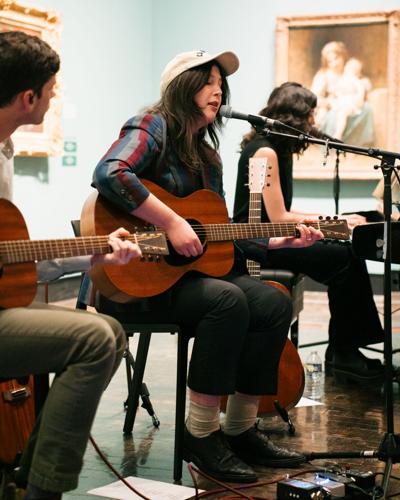


Lucy Dacus at the Frist, 4/28/2025
“I get such cool views in this life, and this is one of them,” mused singer-songwriter Lucy Dacus during her intimate show inside the Frist Monday night.
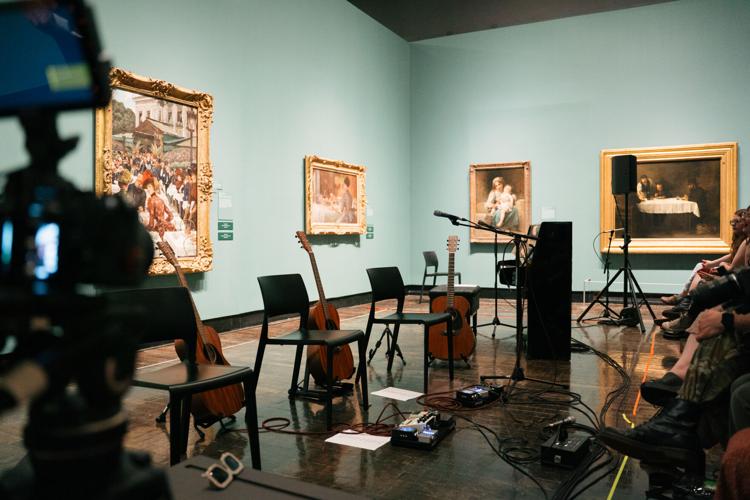
Ahead of Dacus’ two headlining shows at the Ryman Tuesday and Wednesday, a small crowd of fans of all ages packed into the museum’s Ingram Gallery after-hours for the stripped-back performance, an exclusive opportunity for members of Nashville Public Radio’s music discovery station WNXP (which hosted the show) and for museum members. Nestled amid the Frist’s Farm to Table: Art, Food, and Identity in the Age of Impressionism exhibit, guests were treated to a short Q&A with Dacus and WNXP morning host Celia Gregory before Dacus and her band performed a baker’s dozen of fan favorites and rarities spanning her solo career.
The set list heavily featured songs from Dacus’ most recent record Forever Is a Feeling, released in March via Geffen. Each of her albums has been recorded at least in part in Nashville with producers Collin Pastore and Jake Finch, and Dacus remarked from the stage that “a huge portion of this record came from Jake’s garage.” Though her circle of collaborators has widened over time, that partnership is essential to her sound and creative process. When Gregory asked about her connection to Nashville, Dacus replied plainly, “Part of my heart is here.”
The setting could not have been more apt for songs from a record deeply inspired by romantic eras of art across history. After kicking off the set with a pair of songs from 2021’s Home Video, Dacus dove into new material: “Ankles,” a flirty meditation on desire; “Limerence,” a ballad about the impending end of a romance; “Big Deal,” which explores the complexities of a relationship that needs to evolve to survive; and “Modigliani,” an ode to friendship inspired by Dacus’ relationship with boygenius bandmate Phoebe Bridgers.

In the Frist's Ingram Gallery for Lucy Dacus' performance, 4/28/2025
The weight of the material was enhanced further by the artwork directly behind the stage, James Tissot’s 1885 painting “The Artists’ Wives.” The piece depicts a banquet for artists and their wives on Varnishing Day, when artists would gather for a private viewing the day before a new exhibit opened at the Salon in Paris. It prominently features the women rather than their husbands, and front and center one is gazing intently at the painting’s viewer — or in this case, peering curiously over Dacus’ shoulder throughout her performance. It felt as though she was gazing through time, proud that art and open expression of desire have become options for women in a way that wasn’t even a consideration then. The woman on the canvas seemed enthralled by it all, and maybe even a little envious.
That’s what good art does, no matter the medium. It transcends space and time, connecting us all through the feelings we all experience — our losses and our longings, our joys and our hopes. That’s what forever is, after all: a feeling we share.
About halfway through the set, Dacus and the band — Sarah Goldstone on piano, Phoenix Rousiamanis on violin, and Alan Good Parker on guitar — opened the show up for requests from the audience. After proclaiming “I don’t even know that song!” in response to one request for a deep cut, Dacus surprised the audience (and seemingly herself) with a solo rendition of “Trust” from her 2016 debut No Burden. The band joined back in for the next request, “Come Out.” Next came “Best Guess,” and then a special guest appeared: The inimitable Allison Russell joined Dacus for “Bullseye,” a duet Dacus performs with Hozier on Forever. Though Russell was only in town for 48 hours, she clearly didn’t mind taking the time out of her schedule for a cameo, bouncing with excitement before, during and after the song.
The band took two more requests — “Lost Time,” a serious contender for best modern love song, and a gorgeous Auto-Tune-free rendition of “Partner in Crime” — before closing it all out with Dacus’ breakout single “Night Shift.” The group invited the crowd to use what might be their only opportunity to scream in a museum. Many of us obliged, joining in a chorus of catharsis that echoed through the gallery halls and into the night.



Post a comment as anonymous
Report
Watch this discussion.
(0) comments
Welcome to the discussion.
Log In
Welcome to the discussion.
Keep it clean. Please avoid obscene, vulgar, lewd, racist or otherwise abusive language. Comments featuring hate speech or threatening or violent content will not be tolerated.
PLEASE TURN OFF YOUR CAPS LOCK.
Be truthful. Don't knowingly lie or mislead.
Be proactive. Use the “report” link on any comment that violates our comment policy.
Share with us. We'd love to hear your feedback.