
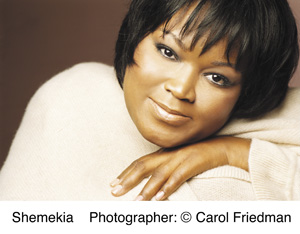

Shemekia Copeland has nice taste in outside material, but her new full-length Never Going Back only really finds its voice in the originals, which are mostly written by her producers. She's a blues artist in the modern manner—an interpreter whose version of pop isn't as nuanced as she might wish and whose taste for experimentation saves her more often than not. Never Going Back sounds like received wisdom until you listen closely, and then it simply sounds wise.
The daughter of blues guitarist and singer Johnny Copeland, Shemekia was born in Harlem in 1979 and grew up listening to a typically varied mix of music. "I listened to a lot of music in general, and not necessarily blues," she says. "I listened to a lot of soul and gospel, like Mahalia Jackson. I also listened to Patsy Cline and Hank Williams, and to Koko Taylor and Etta James, and I liked Sam Cooke and Otis Redding."
The only song on Never Going co-written by Copeland, "Sounds Like the Devil" leads off the record with a weary blues about deception. "I ain't got health care / Lord, it ain't fair / I can't even afford to die," Copeland sings. With rather easy targets in its sights—television evangelists and politicians who claim personal relationships with God—the song nevertheless communicates suppressed rage.
"I have never really talked about politics and religion on my previous records, because I feel like people have to deal with that all the time," Copeland says. "They don't want to hear it on their night off, and they don't want to be preached to."
Formally, "Sounds Like the Devil" is pop blues, with organ, background vocals and Oliver Wood's slide guitar complementing Copeland's melismatic vocals. Julie and Buddy Miller's "Dirty Water" gets a shrewd arrangement that again features slide guitar. "Maybe you're the kind of love that I can't afford / And I don't have a taste for what's in the glass that you poured," Copeland sings.
"Dirty Water" works beautifully, but Copeland is defeated by the demands of Joni Mitchell's "Black Crow" (from Mitchell's 1976 Hejira album). Guitarist Marc Ribot and keyboardist John Medeski create a respectable jazz groove for the song, and Copeland attempts to lighten her voice, but she lacks the finesse for Mitchell's composition. Like Cassandra Wilson and any number of jazz- and blues-influenced interpreters, Copeland often has trouble translating singer-songwriter solipsism into an idiom she can use.
Still, "Black Crow" takes chances. As Oliver Wood says, "Shemekia and I both approached this record with the idea that it would be different. Although she was reluctant about trying some stuff, she was very open-minded, and we had a lot of fun trying different things. We were very purposefully trying different kinds of songs, musicians and vocal styles from what she'd used in the past."
The record's experimentation comes into vivid focus on "Never Going Back to Memphis," which features an amazing guitar solo by Marc Ribot and nightmarish lyrics about a crime gone terribly wrong. "Cops walked in / Dog pullin' on a chain / Lookin' for a woman / Ran in from the rain," she sings. The band plays a light, menacing Latin rhythm, and Ribot's guitar shadows the narrative at every turn. It's the aural equivalent of a Craig Brewer film set in the dark underbelly of Memphis.
Wood says some song choices were discarded early in the recording process. "There were ideas that got scrapped, but not because they didn't turn out well. My favorite was the Hank Williams tune 'I'm So Lonesome I Could Cry.' We made it real dark and spooky. It turned out beautifully, but it didn't quite fit in with the rest of the songs, so we decided to leave it off the record."
Copeland bows to tradition with her cover of "River's Invitation," which Percy Mayfield first recorded in 1953. It's an honorable version that doesn't diminish the power of the original, or of Junior Parker's exquisite 1971 recording. The beauty of Never Going comes from its evocation of a damaged America, where people "pull the trigger on that big brand-new religion" and find themselves starting from scratch and going on the run.
"My mind keeps playing some old Junior Parker," Copeland sings in "Never Going Back to Memphis," but the old blues is mostly a memory throughout the record. Copeland sings a new kind of blues that Parker probably would be able to recognize. After all, Junior Parker wrestled with modern demons and seemingly unsuitable material 38 years ago, and it says something about Never Going that Copeland does about as well with Joni Mitchell today as Parker did with George Harrison's "Taxman" back in the day, before blues finally turned into a class act.



Post a comment as anonymous
Report
Watch this discussion.
(0) comments
Welcome to the discussion.
Log In
Welcome to the discussion.
Keep it clean. Please avoid obscene, vulgar, lewd, racist or otherwise abusive language. Comments featuring hate speech or threatening or violent content will not be tolerated.
PLEASE TURN OFF YOUR CAPS LOCK.
Be truthful. Don't knowingly lie or mislead.
Be proactive. Use the “report” link on any comment that violates our comment policy.
Share with us. We'd love to hear your feedback.