
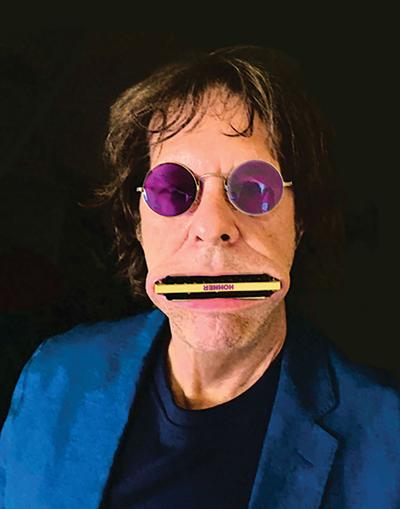


There’s much to say about Jim Hoke’s résumé — after all, the beloved multi-instrumentalist and songwriter has collaborated with a murderers’ row of musicians, including Dolly Parton, Paul McCartney and Buddy Guy. His creative process, though, is even more fascinating. Hoke’s ideas often come from his subconscious mind, whether they appear to him in dreams or emerge during otherwise quotidian moments like rushing through traffic.
On his solo LP I Was Born in Ohio, whose release he’ll celebrate Thursday at The 5 Spot, Hoke builds upon the dream-inspired songs of his previous record The Floating Zone for a more expansive, sonically varied collection of songs that also touches on — if obliquely — the ills facing society today. Hoke played every instrument on the record himself, with the exception of strings (played by Kristen Weber and Austin Hoke) and additional guitar from Chris Cottros. Hoke has a succinct description of the record’s sound: “I’m stuck in the ’60s, and you can print that.” The Scene caught up with Hoke to talk about about writing message songs, making music with his son, the aforementioned Austin, and literally composing songs while sleeping.
Was there a song or idea that kick-started this record for you?
The first solo album of pop songs that I did came out in 2018. That was The Floating Zone. The whole album came from songs that I dreamed — literally. I’d wake up in the middle of the night hearing the song, and then if I was lucky enough to be able to remember it, I’d write them down and, you know, develop them that way. There were so many of them that there were a bunch of spillover songs that didn’t go on that album. Then I put a band together to play The 5 Spot. I got a nice little band with my son playing cello and Kristen Weber on violin. And they’re just so, so good that it kept the momentum going for me, and I kept writing songs for the band.
What’s a song from this record that came from a dream?
“Wake Up the Whole World.” It’s kind of a message song. The dream that brought me that one was about listening to Rubber Soul outtakes. In my dream, I’m hanging out at some friend’s house and he’s saying, “Oh, I just got this bootleg of Rubber Soul outtakes from Abbey Road. Let’s listen to it.” And the whole course of that song — the chords, the lyrics, the arrangement — was pretty much complete. So I just had to write some verses.
Backtracking a minute, it must be special for you and your son to play together.
It’s a very big experience. We switch gears from being father and son to being, you know, bandmates, or musical cohorts. It can be confusing, to forget the history and that dynamic. But it’s very rich. He’s such a good musician, and he doesn’t hold back when he’s criticizing ideas I have. He’s not always gentle with his assessments of things. [Laughs] “You know, Daddio, you don’t want to do that. That’s so ’90s.” I don’t even know what “’90s” means because I’m stuck in the ’60s.
You can certainly hear that ’60s influence all over the record. I’m thinking of “Gotta Go,” with that kind of push-and-pull shift in feel and the trippy lyrics.
That was just a bit of silliness. I was hurrying out the door. I was late for lunch and I just started nervously going, “Gotta go, gotta go. Gotta go. Gotta go now.” And it just came out of nothing. I got in my car, and I’m driving down the street, and I’m still chanting that thing. Next thing you know, here comes the slow part, when it kind of takes a sharp turn into that slower section. So I fleshed that out. I had my wife, Lisa Haddad, sing harmonies on that. She’s a one-man background vocal group.
Given how you wrote “Gotta Go” and your tendency to write from dreams, it sounds like spontaneity is a big part of your process.
Yeah. Songs can be silly little ideas that just happen and pop into your head washing the dishes or shoveling your driveway or driving someplace. A lot of my ideas have come that way, totally. And I’ve learned not to just blow them off, because the smallest little germ of an idea, you put a little rhythm to it and then it takes on a life. You throw some chords behind it, and you’ve got something. So many songs that we love came that way. They’re not very profound if you really analyze them, but something happened with it.
The world has changed a great deal since you released The Floating Zone, and mostly not for the better. Did that influence creep into your songwriting?
I’m sure it did. Some of those songs came about during COVID. Everyone had all this free time. So that allowed for deeper dives into the process. But it’s not like I wrote the songs, you know, two months ago. Whatever version of trouble has come along — and there’s certainly been just so, so much tragedy in the world — I just hope that my songs point to a way out, for individuals anyway, to deal with life and feel good.





Post a comment as anonymous
Report
Watch this discussion.
(0) comments
Welcome to the discussion.
Log In
Welcome to the discussion.
Keep it clean. Please avoid obscene, vulgar, lewd, racist or otherwise abusive language. Comments featuring hate speech or threatening or violent content will not be tolerated.
PLEASE TURN OFF YOUR CAPS LOCK.
Be truthful. Don't knowingly lie or mislead.
Be proactive. Use the “report” link on any comment that violates our comment policy.
Share with us. We'd love to hear your feedback.