
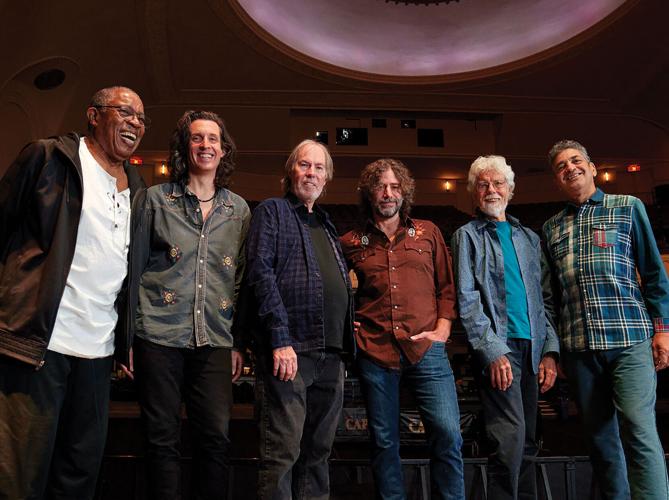


From left: Sam Clayton, Scott Sharrard, Bill Payne, Tony Leone, Fred Tackett and Kenny Gradney
“We’re not doing a literal translation of Waiting for Columbus.”
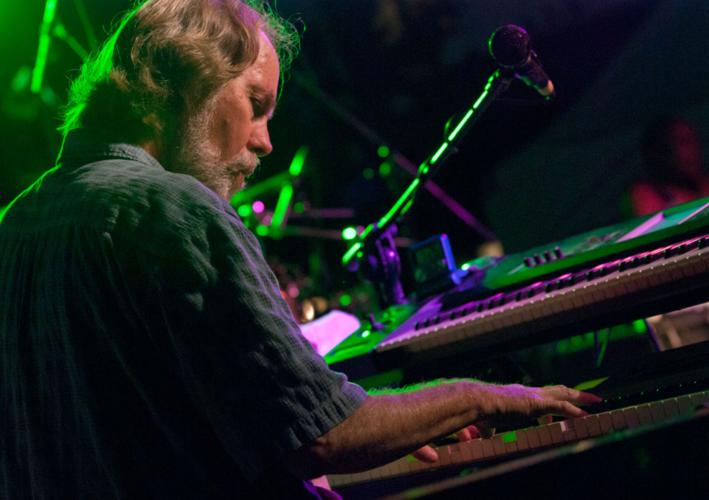
From the other end of the phone, Bill Payne, co-founder and keyboardist of the legendary Little Feat, has uttered the words every fan wants to hear. A pillar of rock ’n’ roll, a proto-Americana milestone and a predictor of key evolutions in the jam-band phenomenon, the double LP recorded in 1977 and released in ’78 is one of the definitive live documents of rock at its grandest. The record is a stone-cold party-starter, bursting at the seams with indelible hooks and grooves and artfully presented stories — they are the connective tissue between the bursts of collective improvisation, and yet they’re so much more.
Copying the album note for note just wouldn’t capture the tone that makes it special. And despite the original release being packed to the gills with choice selections from across Little Feat’s filler-free catalog, there’s still plenty more to choose from. The ongoing 45th anniversary tour for Columbus stops at the Ryman March 16 and 17 with a boatload of special guests who run the gamut from Rosanne Cash to Billy Strings to Eric Church to Bettye Lavette; it’ll also be taped for a future PBS special.
“It’s going to be fun,” says Payne of the two-night Mother Church stint. “[We have] new members, with Scott Sharrard on guitar and vocals, and Tony Leone playing drums. It leaves [longtime members] Sam Clayton, Kenny Gradney and I, and Fred Tackett, to round out the rest of it. And it’s just going to be a challenge in how we approach things from night to night.”
Little Feat, a band from Los Angeles that could easily fool you into thinking they were from New Orleans, is still going strong after 53 years and a zillion miles on their radials. They’ve managed to survive shifting tastes and changing tides as well as the heartbreaking losses of founding frontman Lowell George, drummer Richie Hayward, and guitarist and songwriter Paul Barrere. And they’ve done it all while expanding the scope of their sound and staying true to their roots. It is — please forgive me — no small feat to make a band work for a few years, never mind five decades. Payne seems to have found the secret to success in that exploratory spirit that makes Waiting for Columbus a desert-island record — which in turn informs the new set list for each night.
“It’s a matter of leaving things open,” he says. “We’re going to open it up to either the extended or the expanded version of that album, which adds songs like ‘Red Streamliner’ and ‘One Love Stand,’ ‘Cold Cold Cold’ — and/or, we do ‘Let It Roll,’ ‘Roll Um Easy,’ ‘Roll Your Eyes.’ [Laughs] No. We’re leaving it open to try a bunch of different things and that’ll keep it fresh.”
With a skyscraper-high stack of stunning songs as a foundation and some of your favorite musicians’ favorite musicians onstage, Payne & Co. are prepared to build on their already heady legacy. Sure, if you had a back catalog of jams like “Fat Man in the Bathtub,” “Oh Atlanta” and “Willin’ ” — the third of which was wielded like a magical amulet by the goddess Linda Ronstadt on her Heart Like a Wheel — you could probably get away with resting on your country-funk laurels. But where’s the fun in that?
The majesty of songs like unbeatable sing-along “Dixie Chicken” or Cheech-and-Chong-grade stoner anthem “Don’t Bogart the Joint” is that they rope you in with fun times and the promise of freedom. There’s a lightness to the lyrics and an effervescence to the melody, even when the subject at hand is profound loneliness. And the grooves are locked so snugly in the pocket that they practically beg for a jam.
“The depth of the songs is meaningful,” explains Payne. “It’s a great platform, [for] some really good musicians tackle it, either as a [straightforward] song or when you put on your jam-band persona, I guess, which we do anyway. But it’s just that platform where we can take you a lot of different places. That, to me — the exploration — has always been a huge part of being in Little Feat.”

As we talk it becomes clear that the wandering spirit that runs through Little Feat isn’t just a work obligation but an essential part of Payne’s character. Our conversation runs from winter surfing in the ’60s — “the wetsuit I had didn’t cover my feet or my legs, and it was freezing out there” — to being invited to join The Rolling Stones in the ’80s. We talk about Nat King Cole and legendary pianist Glenn Gould, and having Steely Dan’s Donald Fagen hip you to new music. We talk about streaming music and its ups and downs.
“The access to music was wonderful,” says Payne. “It’s informing quite a bit the way I approach music. And even though we don’t get paid very well in general from streaming services, I said, ‘Well, I’m going to just build my library of jazz, of world music, of classical music.’ ”
It all confirms that the more things change, the more they stay the same: Little Feat has always been about voracious listeners making music for other voracious listeners. The thrill is still there, and there’s yet more music on the way. Payne has a stash of co-writes with late Grateful Dead lyricist Robert Hunter and is working with folks like Blackberry Smoke’s Charlie Starr (who’s also going to drop in at the Ryman) and poet Paul Muldoon. It’s a helluva third act and inspiration for all of us rock ’n’ roll lifers.
“There’s some really good stuff going on right now. The energy is right in every sense of the word.”



Post a comment as anonymous
Report
Watch this discussion.
(0) comments
Welcome to the discussion.
Log In
Welcome to the discussion.
Keep it clean. Please avoid obscene, vulgar, lewd, racist or otherwise abusive language. Comments featuring hate speech or threatening or violent content will not be tolerated.
PLEASE TURN OFF YOUR CAPS LOCK.
Be truthful. Don't knowingly lie or mislead.
Be proactive. Use the “report” link on any comment that violates our comment policy.
Share with us. We'd love to hear your feedback.