
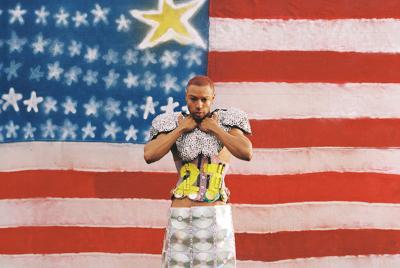


Houston Kendrick
“I, Houston Kendrick, am here to make a massive change in the way we listen to R&B music, the way we look at Black and queer people and the way that we consume Blackness and queerness.”
It’s a lofty declaration, but Kendrick isn’t shying away from it, nor is he asking for permission. The Nashville R&B artist is making good on his promise with his LP Portrait of a Boy on Fire. Released Aug. 21, the album is a natural evolution for Kendrick: a maximalist marriage of R&B, Blackness, queerness and Southern identity. It all sprouted from one seed — metaphorically, but in a more concrete way than you might expect.
Kendrick began assembling the bones of Portrait of a Boy on Fire around the time he released his previous album Small Infinity in 2021. Slowly and without conscious intent, his ideas began to coalesce into songs. In 2023, he experienced an intense hyperfixation on plants and learned about a type of resin-coated seed that won’t crack open, germinate and grow without the heat of a wildfire. (For the botanically curious: Plants that have evolved this adaptation, like sequoias and eucalyptus, are called pyrophytes.) The image resonated with him deeply, and it eventually formed the idea for an album title in his head.
At its best, pop music reflects the culture that it’s created in. Marvin Gaye’s “What’s Going On” was a direct response to police violence aga…
“I’m like that seed,” Kendrick tells the Scene. “I’m going through this process of being cracked open by intense heat, by pressure, by intensity in general. So when I was thinking about Portrait of a Boy on Fire, I was thinking of a snapshot of a moment of transformation.”
On the album, Kendrick navigates meaningful personal themes of self-examination and unrequited love with his trademark bombastic flamboyance — what he calls “art&B.” It’s R&B with a deeply ingrained flair: lavish, theatrical and intentionally excessive.
“These things sort of happen simultaneously, and they weren’t conscious,” Kendrick says, reflecting on the inspiration for the album. “Life just started to really force me to grow up in ways that I thought I already had grown up. In love, in the way I create, in my physical body, in the way I conduct myself in friendships.”
Each song is a simmering pot of his unabashed queer, Black and Southern influences. In “American Trash,” Kendrick wraps up uncomfortable experiences in beautiful lyrics that nonetheless don’t sugarcoat the pain, with trippy beats and soaring, soulful vocals that come across proud and confident. On songs like “Paper Doll” and “I’m a Pisces,” Kendrick uses hypnotic falsetto and head-bobbing rhythms to detail his love life and tendencies to be unapologetically too much in relationships.
That same sense of defiant extravagance and larger-than-life energy has allowed Kendrick to kick open industry doors and break through the barriers that have historically marginalized Black and queer artists around Nashville. Simply stepping through those openings isn’t enough. He’s making a spectacle of his entrance.
“This city has forced me to really be OK with who I am,” he says. “And as an extension of that, the music is what it is.”
Though he’s making waves throughout the South with his own projects, Kendrick hopes to make sure those doors stay open for those who come after him. For him, a cultural rebirth isn’t a far-off fantasy. It’s happening now, and he’s dressed and ready to go.
“We are in a completely new era,” says Kendrick. “A sort of new renaissance is dawning, and I think that I’m evidence of that. I think that so many artists and queer people who are creating right now are evidence of that.”
Kendrick plans to bring Portrait of a Boy on Fire with him to stages around the country. Saturday, he’s set to play a Sofar Sounds show at an East Nashville location that will be disclosed only to ticketholders. He’ll also be opening a few shows for Joy Oladokun on her The Heavy Things Tour, including a stop at the Ryman on Nov. 19.
Even with a new album out and stages waiting, Kendrick’s ambitions remain larger than a release cycle.
“It’s bigger than just this album, it’s bigger than just a single, it’s bigger than a show. Me, as I’m talking to you right now — get used to me.”




Post a comment as anonymous
Report
Watch this discussion.
(0) comments
Welcome to the discussion.
Log In
Welcome to the discussion.
Keep it clean. Please avoid obscene, vulgar, lewd, racist or otherwise abusive language. Comments featuring hate speech or threatening or violent content will not be tolerated.
PLEASE TURN OFF YOUR CAPS LOCK.
Be truthful. Don't knowingly lie or mislead.
Be proactive. Use the “report” link on any comment that violates our comment policy.
Share with us. We'd love to hear your feedback.