
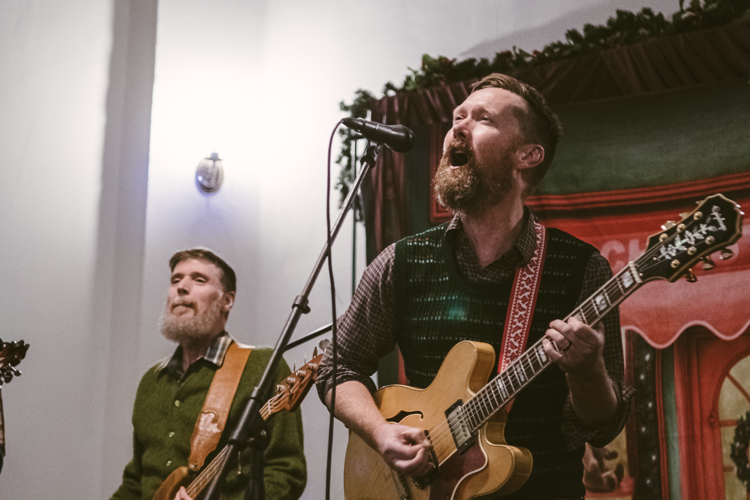

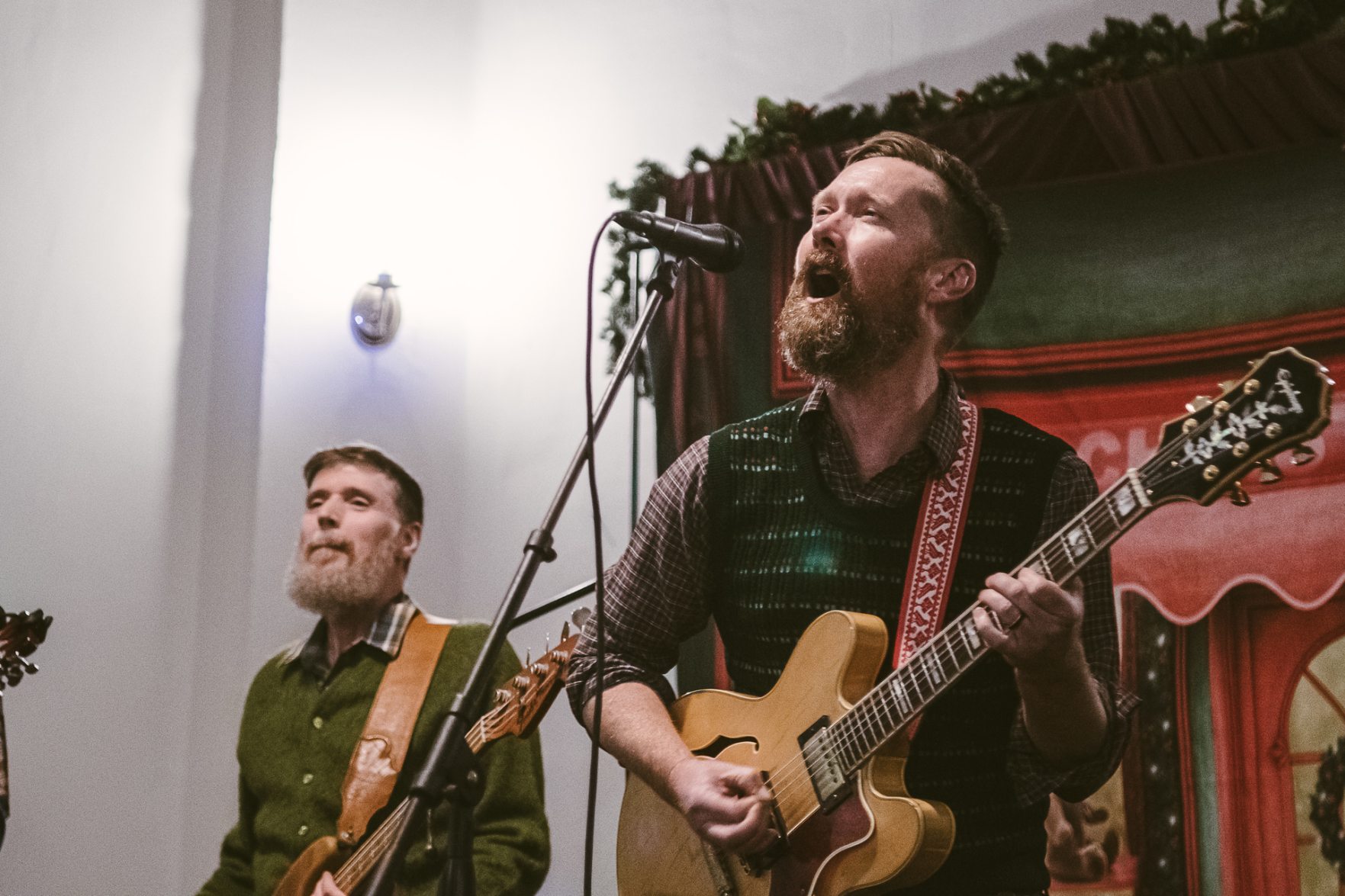
The Features perform during the Spongebath Records Reunion at Lindsley Avenue Church of Christ, 12/13/2019
It started as just an idea — a conversation between two friends who wondered, “What can we do to help our public radio stations?” From there it snowballed into a benefit show and a reason to reunite one of Nashville’s most beloved bands. Then another beloved band from back in the day got back together. Then the show sold out, and they added another show. And that show sold out. Then they added another room with free shows featuring close to two dozen bands, artists and DJs over the two nights, plus a silent auction and a raffle. Before anyone knew what was happening, The Features and Glossary were atop a bill for an extravaganza at Eastside Bowl to raise money for community radio station WXNA as well as Nashville Public Radio’s news station WPLN and music discovery station WNXP. The free gigs will be in Eastside’s smaller space The ’58, and the bill runs the gamut from songsmiths like Jasmin Kaset and Jessica Breanne to rock bands like Blank Range and Heinous Orca to rapper N. Justice and beyond.
“I’ve been a public radio listener since the late ’90s and I’ve never contributed,” says Matt Pelham, guitarist and singer for archetypal Nashville indie band The Features. His story is not unusual. Radio is literally in the air, there for the taking. Whether public (read: funding sources include federal money, like Nashville Public Radio) or strictly community (they rely on underwriting and personal donations, like WXNA), community-supported radio stations ask for your cash a few times a year. But they don’t cut you off if you don’t have the money to pay for them, and they’ve been a cultural constant for generations — by design, even if that means a lot of people who could donate do not.
But then the Trump administration returned to the White House and started slashing budgets for public media. Like many, Pelham realized that the resource he had taken for granted for so many years was endangered, under attack from the sort of fascist cowards who fear a diverse, informed America. “And when all this went on, it was like, ‘OK, dude, it’s time to pay your dues,’” he says. “Local radio had always been extremely supportive of us.”

We get the rundown from the band and others in advance of The Mahaffey Sessions 1999
Pelham called Michael Eades, proprietor of YK Records. The local label released the self-titled debut of Pelham’s current band Matt and the Watt Gives as well as a recent reissue of The Features’ classic sophomore album Some Kind of Salvation and an official release of their legendary unreleased tapes, The Mahaffey Sessions 1999. Eades’ local-rock roots stretch way back. A Middle Tennessee native, he remembers discovering alternative rock on Thunder 94, the late, lamented sister station to long-running Nashville indie commercial station Lightning 100. He took a more active role in the rock community in the late 1990s, when he became the web guy for Spongebath Records — the label that released the earliest music by The Features and helped establish Murfreesboro as an epicenter for independent music.
“Matt Pelham should get all credit for planting the seed,” Eades says, noting that the singer-guitarist also made his case and rallied the rest of his former bandmates to take the stage for their first show in almost a decade.
The next challenge was finding an opener. A few names were floated, but Eades remembered hearing Bingham Barnes, co-owner of local print shop Grand Palace — who also served as an administrator at MTSU student station WMTS once upon a time — mention on a podcast that members of his band Glossary had been getting together for fun, banging out some tunes and generally having a good time. Glossary evolved through indie-rock and Americana before becoming a no-frills, all-thrills rock outfit that toured the U.S. and beyond.
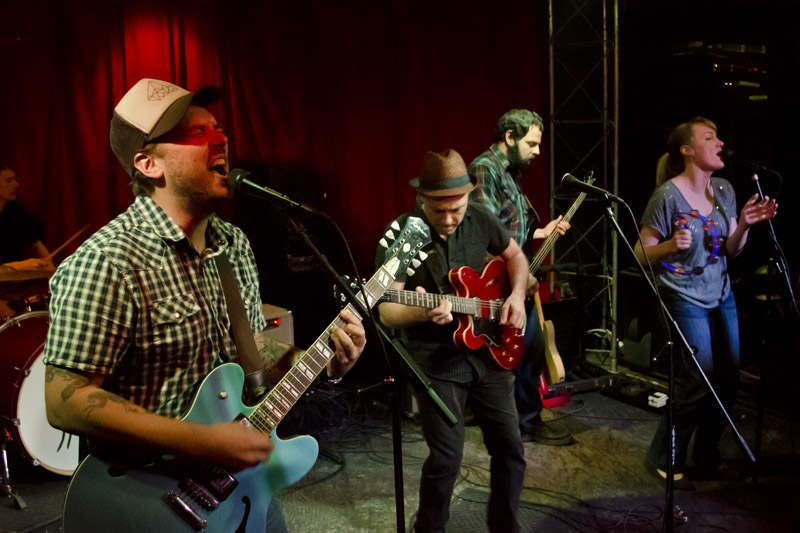
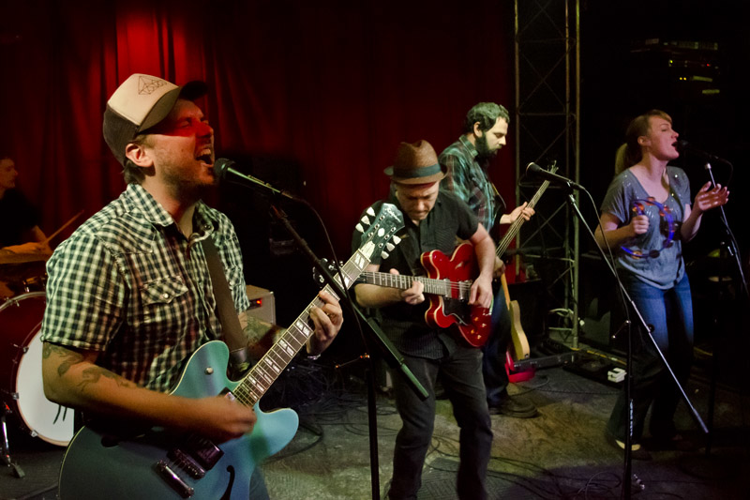
Glossary performs during the release party for 'Long Live All of Us' at The 5 Spot, 10/7/2011
“Glossary never broke up or anything,” says Glossary singer-guitarist Joey Kneiser, on a call with the Scene that Barnes also dialed into. “It just went on a hiatus that just never stopped because we came back from a European tour and —”
“Had kids,” interjects Barnes.
“Then we had kids, right,” Kneiser continues. “It just was a long [break]. I mean, the last time we played together was the 20th anniversary [show], so almost a decade ago.”
If it feels like you’ve seen a Features-Glossary bill before, you probably have. The bands have been sharing stages for nearly 30 years. Barnes recently uncovered the flyer for what might be the very first team-up between the two: a 1998 vintage photocopy for a show at Sebastian’s, the bar on Murfreesboro’s downtown square that also played host to early shows from heavy hitters like Cat Power, Drive-By Truckers and Disco Biscuits. It was a different epoch in Middle Tennessee media, when file-sharing was fringe and nobody had even pondered the metaphysics of rolling a joint on an MP3.

I had no idea I needed former Glossary frontman Joey Kneiser’s Pure Positivity Power Hour so badly. I’ve been avoiding most of the streams and…
“Really at that time, the only way you got to hear a lot of that stuff was on college radio,” says Kneiser. “Even if I went down to the record store in my town, which was a Cat’s Records and Tapes, you couldn’t get the Superchunk record, you know what I mean? You could only get the bigger kind of records.”
A part of the impetus for this pair of shows, for both the performers and promoters, is that radio still beams music you won’t find in what are now the typical places, straight into your house, car and workplace. TikTok and Spotify — and whatever new fresh hell of a platform the tech industry is working on to siphon creativity and capital out of the world and into their pockets — don’t care about you, or your neighbors or your community. The tech industry has used music as a lure to trap us in their walled gardens, while they raise money for technologies that try to remove humans from the equation of creativity. Community and public radio encourage connection, fellowship and further exploration.
“Not to get political about it, but [this] is an untouchable place because it’s community-supported,” explains event co-organizer Caroline Bowman-Schneider. She originally signed on to help with graphic design, but then instigated the escalation from a one-room show to a multi-stage event and formed a business partnership with Eades under the name Good Signal, with the aim of producing more events for good causes. “The messages that come through in the music, knowing it’s completely independent — that’s so important to a community that is actively fighting fascism. … We need to be able to connect to each other in real time.”

The Scene checks in with artists and arts institutions in the wake of diminishing grants
In an age when oligarchs and algorithms are colluding to drive family, friends and neighbors further apart, radio’s ability to bring us together is a powerful defense against corporate culture silos. As more venues present less music for higher prices and gentrification drives out smaller, more adventurous and more affordable places to gather, enjoy and perform music, a service that brings you music information free of charge is massively important. It provides opportunities for artists and listeners that a playlist or an algorithm never will.
“The internet and streaming music have really scrambled a lot of people’s brains to think that that’s what you need to focus on as an artist — or as a music listener,” says Eades. “As a music listener, you’re like, ‘Oh, my Spotify or whatever will tell me what to listen to.’ But there is no better discovery mechanism, no better community booster, than tuning into the radio. And that sounds kind of ridiculous, but it’s extremely true.”



Post a comment as anonymous
Report
Watch this discussion.
(0) comments
Welcome to the discussion.
Log In
Welcome to the discussion.
Keep it clean. Please avoid obscene, vulgar, lewd, racist or otherwise abusive language. Comments featuring hate speech or threatening or violent content will not be tolerated.
PLEASE TURN OFF YOUR CAPS LOCK.
Be truthful. Don't knowingly lie or mislead.
Be proactive. Use the “report” link on any comment that violates our comment policy.
Share with us. We'd love to hear your feedback.