
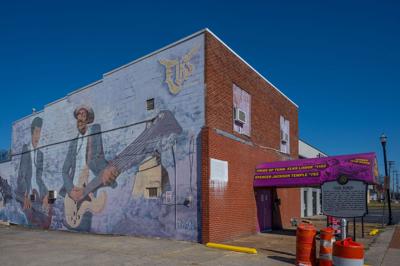


Outside Elks Lodge Pride of Tennessee No. 1102, historic site of Club Baron
The building at 2614 Jefferson St. has been the home of Elks Lodge Pride of Tennessee No. 1102 since 1968. The nonprofit charitable organization purchased the building outright in the early ’70s, at a time when it looked like it was headed for demolition. But from the mid-1950s through the ’60s, it was home to Club Baron, a site in the storied North Nashville entertainment district whose importance as a community and culturally historic landmark cannot be overstated.
Preservation efforts have been ongoing since the Elks bought the building. A restoration campaign — supported by an array of Nashville business and music leaders and including members of the Nashville Convention & Visitors Corp — kicked off in 2022 and has yielded key improvements like replacing the roof and patching up other damage done by Nashville’s March 2020 tornado. Recently, the revitalization project has taken some significant new steps.
On Jan. 23, the building received approval from the Tennessee State Review Board and the Tennessee Historical Commission for placement on the National Register of Historic Places. This is a huge boost toward eventually getting Club Baron the widespread recognition and status it deserves. The designation officially acknowledges the nightclub’s role as “a premier stop on the historic Chitlin’ Circuit and its legacy as a stage graced by legendary artists including Jimi Hendrix, Little Richard, Ray Charles, Muddy Waters, Etta James and many others.”
This step dovetails with the efforts of Elks 1102’s new leadership and their strategic decision to create the Historic Club Baron Preservation Foundation late last year. Federally recognized as a 501(c)(3) nonprofit, the organization was created to support preservation, restoration and culturally focused programming at the site. Lawrence Hall Jr., who became Elks 1102’s Exalted Leader in 2023, says a primary goal is to get Club Baron going again as a hot spot for live music and events.
“That’s what I’ve been striving to see happen since I got in this position,” Hall tells the Scene. “The logistics of that have proven a challenge in some ways, but that’s what we envision happening in the future.”
He adds that the nonprofit status will also aid public interaction. “We are definitely looking to partner with community members and organizations who would be interested in helping us with some of the structural issues that still need to be addressed,” says Hall. At present, the building is open mainly on Fridays (with a happy hour as well as later programming) and Saturdays. Hall adds that the space is available to rent for events, and interested parties should reach out at 615-557-5071 or 615-631-3075.
Club Baron’s colorful history is impressive in aspects of both musical and community history. It was built in 1955 and owned by local pharmacist Jackson H. Brown. The building at one point also housed Brown’s Pharmacy, plus the only roller rink open at that time to Black Nashvillians. While longtime music fans debate whether Club Baron or one of its prime rivals called the Del Morocco was the hottest spot on Jefferson Street, none can dispute the array of greats who performed at Club Baron, including Fats Domino, Otis Redding, Jackie Wilson, Joe Henderson, Arthur Prysock, Little Walter, The Isley Brothers and Ruth McFadden.
Perhaps the most famous event at Club Baron was a 1963 guitar duel between Johnny Jones and a very young Jimi Hendrix, who was a frequent featured attraction at the Del Morocco. The story goes that Jones outlasted Hendrix. Depending on who’s telling it, Jones had a more powerful amplifier, or else Hendrix simply hadn’t finished crafting his awe-inspiring signature sound. In any case, Jones’ 1969 album with the King Kasuals includes a soaring version of “Purple Haze” recorded in tribute to his onstage foe.
Musicians weren’t the only ones attracted to Club Baron. Also in 1963, a rising boxing star who was then going by his birth name Cassius Clay — the world remembers him, of course, as Muhammad Ali — stopped in as he was making his way home to Louisville, Ky., from Miami. Club Baron was the spot Clay retired to for the evening after holding court with reporters outside the Del Morocco.
Club Baron closed and the building was sold at auction in 1966, and it went into a period of neglect. However, it seems there has always been someone who has remembered its importance, and the desire to keep it viable has heightened recently. The Elks’ efforts have been an essential element in keeping the memory and name of Club Baron alive. As Hall stated in a press release earlier this month: “Club Baron is not just a building — it is sacred ground for Black music, culture and community in Nashville. With state-level historic approval, new leadership and a fully recognized preservation foundation, we are now positioned to protect this legacy and activate it for future generations.”
The Historic Club Baron Preservation Foundation plans to formally join forces with the Elks Lodge to raise financial and in-kind support for restoration, preservation and educational initiatives aligned with the historic mission. With help from community members, corporate partners, foundations and preservation supporters, perhaps Club Baron may once again host contemporary giants of music and culture.





Post a comment as anonymous
Report
Watch this discussion.
(0) comments
Welcome to the discussion.
Log In
Welcome to the discussion.
Keep it clean. Please avoid obscene, vulgar, lewd, racist or otherwise abusive language. Comments featuring hate speech or threatening or violent content will not be tolerated.
PLEASE TURN OFF YOUR CAPS LOCK.
Be truthful. Don't knowingly lie or mislead.
Be proactive. Use the “report” link on any comment that violates our comment policy.
Share with us. We'd love to hear your feedback.