
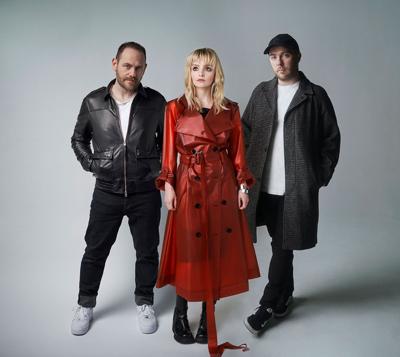


Anyone who truly loves the sound and potential of the synthesizer has doubtless encountered the sound of CHVRCHES by now. The Scottish trio, coming up on the 10th anniversary of its first album The Bones of What You Believe, has been making high-quality electronic pop that has conquered the most rockist of charts and fans with sincerity and sophistication. They have that very rare gift: an ability to play you something you’ve never heard before that hits with the impact of a lifelong fave.
After triumphant shows over the years at Exit/In, Marathon Music Works and the Ryman — and multiple appearances at Bonnaroo, including one following their latest LP Screen Violence — the band heads back to Nashville to headline the sixth annual OutLoud Music Festival. If you’ve seen the show Heartstopper on Netflix, you’ve already felt the tremulous majesty that CHVRCHES craft, and in the service of queer PDA. It’s awesome, and indicative of the arena-size synth pop that they’ve been perfecting over the past decade. The Scene spoke with frontwoman Lauren Mayberry recently via Zoom about her band’s upcoming Music City return.
No band will just come out and say, “We want to make a better record than New Order or Depeche Mode.” But y’all have kind of done that — several times, consecutively. You’ve created a body of work over these four albums that feels timeless, which is not something you can say about a lot of the past decade of popular music. How do you find and evolve that vibe?
That’s very kind of you. We obviously love both of those bands and take a lot of inspiration from that time period in general, but I guess it’s always been about merging those sounds with the rest of each person’s musical tastes also. On Screen Violence, the guys were talking as much about The Prodigy as they were about Brian Eno or My Bloody Valentine. A lot of this album sonically was informed by horror scores, which is a different space of the ’70s-’80s landscape that we hadn’t dipped into too much before.
I’m very interested in how you keep that sort of energy and feel when you’re all working from different parts of the world.
This album was definitely the strangest recording process we’ve had, because everyone was separate for so much of 2020. I think in a way, though, that was a good writing exercise and gave everyone space to experiment and then come back to the group. Lyrically, I think that separation was helpful so I could really take the time to think about the stories and the narrative.
Have you given any thought to album number five, or is that something for down the road a bit?
It’s been really lovely to be able to tour Screen Violence and see how those songs have resonated with people — especially since we weren’t even sure when we were making that record whether we’d get to tour it at all. So we’re really just in that headspace at the moment.
I respect that completely — especially looking at your schedule before you head back for the Australia-Asia leg of the tour. Which brings up an observation about the fascinating people the band has worked with and appeared with: Hideo Kojima, Robert Smith, John Carpenter — and in just a couple weeks, opening for Grace Jones?!
This era really has been blessed by the legends. It was really incredible to work with all those people — artists we really admire and who have really informed the work we make. The Grace Jones show will be really special. I just have to make sure not to act like a weirdo backstage because she doesn’t need my fangirling in her life.
Having seen both of y’all in concert before, that’s an inspired bill. There are sounds throughout your work, and most specifically on Screen Violence, that seem to be engaging in a dialogue with a lot of music history. It’s a bridge that addresses those shared stories of going out, going to big-room dance clubs, but also more intimate goth or shoegaze spaces as well. And that’s not really a question, but it’s rare that one gets the chance to let someone who’s made a work of art that you treasure know the specific ways in which it works for them, and continues to do so.
Thank you. I feel like Screen Violence really did marry together all the influences we all have in a way that feels really cohesive. I like that I can hear everyone’s personality on this album.
There’s tension, certainly, but those elements play nice together, which is most appreciated. Y’all did some tracks with Eurythmics co-founder and sometime Nashvillian David A. Stewart that didn’t make it onto your 2018 album Love Is Dead. Civic pride demands that I ask whether those are going to turn up in some capacity.
Working with Dave was so great. He’s been incredibly kind to us, and obviously a band like ours owes a huge debt to Eurythmics. I don’t think we would have made an album like this one if we hadn’t had that experience with Dave. For me especially, he was so encouraging and really pushed me to think about the whole process of making an album and a concept and advocating for a vision.
You find the emotions in the electronics, and that makes songs just shine when they pop up in TV or film, like “Clearest Blue” does in Heartstopper. Do you find that when you’re creating your music, you’re thinking about how there could be other paths for it outside of an album? Is there a little voice lurking around, asking, “How might this become part of something else in the future?”
It’s always really fun to see your creativity be used to tell a story inside someone else’s creative vision, and we’ve been so lucky with certain syncs in recent years. It’s amazing that songs can get this whole other life now, outside of album cycles or campaigns.
Nashville is definitely a music supervisor town. I could absolutely see “We Sink” and “Asking for a Friend” turning up in something majestic and haunting in the future, changing a few lives in the process.
That would be fantastic. A girl can dream!



