
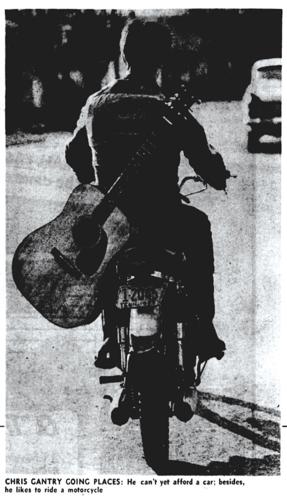


'The Tennesseean,' March 6, 1966, page 202
“As far as anybody acknowledging my past — or who I was or what I’ve done — or acceptance, it’s zero, baby,” says songwriter Chris Gantry, discussing his profile in the music business. The onetime Nashville outlaw singer and tunesmith is speaking to the Scene from his home in Dyer, Tenn., a town about 40 miles north of Jackson. As he tells me about life in Dyer, “It’s very quiet, no traffic, no nothin’ — it’s just real quiet.”
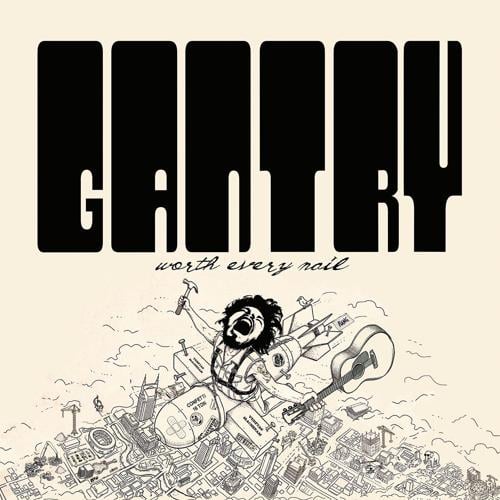
Gantry, who turns 84 in December, returned to Tennessee in late 2023 after spending the preceding three years in Galveston, Texas. He cut two albums while he was living in Galveston, with the full-band Rock Across Texas and the minimalist The Outlaw Bible showing off two sides of his musical personality. His new Nashville-recorded Worth Every Nail revisits his late-1960s work, which made the New York-born songwriter a star in Nashville among a group of fellow innovators that included Kris Kristofferson and Shel Silverstein.

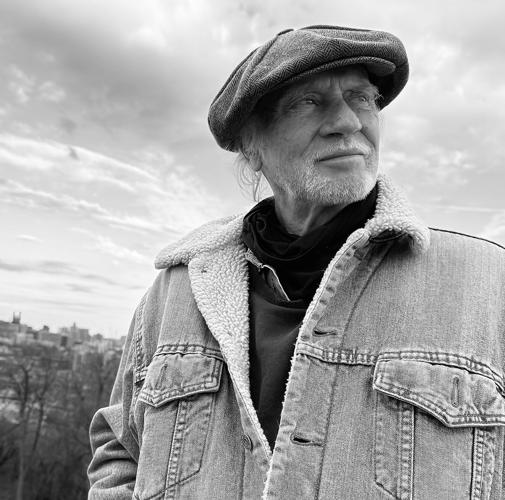
Chris Gantry
Gantry recorded The Outlaw Bible in 2023 and Rock Across Texas in 2023 and early 2024. For Loney John Hutchins, who produced Worth Every Nail and is releasing the record on his label Appalachia Record Co., working with Gantry was an opportunity to expand on the style of his 1968 album Introspection and 1970’s Motor Mouth. Both of those records were cut with Nashville producer Fred Foster. Gantry had talked to Hutchins about doing a project, and Hutchins had a sound in mind.
“I got back to him pretty quickly and I said, ‘Hey man, I want to do something that’s hinting at the Fred Foster stuff — something really eclectic, [where] every song is different,’” Hutchins says. Gantry recorded Worth Every Nail in February 2025 with a crew of players including drummer Brian Kotzur, guitarist William Tyler and keyboardist Tony Crow.
As Hutchins says, the songs on Worth Every Nail are varied, and the backing evokes everything from countrypolitan to jazzy rock. For Gantry, the complexity of his new songs evokes his early Nashville days. His songs were recorded by the likes of Leroy Van Dyke, who cut “Just a State of Mind” in 1965, and — most famously — Glen Campbell, who charted with “Dreams of the Everyday Housewife” in 1968.

“There was this energy going on in Nashville for change,” is how Gantry describes the city’s music scene in the 1960s. He’d come to town in 1963 and signed a publishing deal with songwriter Marijohn Wilkin’s Buckhorn Music in 1965, moving on to Combine Music later in the decade. “People were just drawn to the city for some undescribable reason. We all came in from different places, met each other, hung out, and started to write songs that changed the dynamic of what was the rhinestone gang, or country at the time.”
As he tells me, what he calls the rhinestone gang was made up of songwriters like Mel Tillis and Harlan Howard. In contrast, Gantry was part of the same movement that produced Guy Clark, John Prine and Lee Clayton. Motor Mouth gets into areas undreamed of in the rhinestone-loving philosophy. In particular, “Allegheny” subverts the idea of the narrative country song, so much so that to say more would spoil it.
Gantry’s lyrics have a modernist edge on Worth Every Nail, and the music references country in ways that are often indirect. “Dean” gets sonics that approach soundscape, while the band nods to Introspection on “Catchphrase.” The song is a litany of concepts and words that have lost their meaning. As Gantry sings: “I am a combination of many hearts and minds / God, don’t let me become or be a catchphrase of the time.”
The song is hooky and philosophical in equal measure, but Gantry sounds disinclined to take credit for any catchphrase he might come up with.





Post a comment as anonymous
Report
Watch this discussion.
(0) comments
Welcome to the discussion.
Log In
Welcome to the discussion.
Keep it clean. Please avoid obscene, vulgar, lewd, racist or otherwise abusive language. Comments featuring hate speech or threatening or violent content will not be tolerated.
PLEASE TURN OFF YOUR CAPS LOCK.
Be truthful. Don't knowingly lie or mislead.
Be proactive. Use the “report” link on any comment that violates our comment policy.
Share with us. We'd love to hear your feedback.