

Due to COVID-19, the full in-person programming of AmericanaFest couldn’t happen this year, including the annual Honors and Awards ceremony, which has been postponed indefinitely. But the Americana Music Association moved the conference portion of the annual event online via its charitable and educational arm, the Americana Music Association Foundation. Under the new name Thriving Roots, the three-day virtual conference featured dozens of panels of musicians, journalists, scholars and industry insiders discussing a broad array of topics, all for attendees to watch from the comfort of their own homes. Below, check out five of the best panels the Scene caught at Thriving Roots 2020.
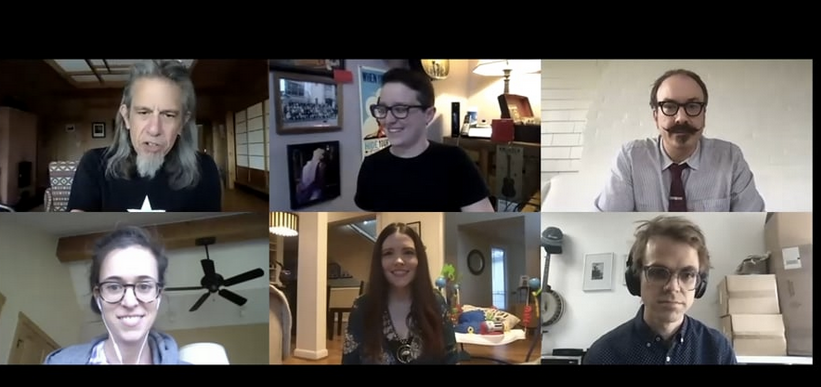
Thriving Roots instrumentalist panel, clockwise from top left: Scott Goldman, Ellen Angelico, Zachariah Hickman, Rich Hinman, Annie Clements, Brittany Haas
Striking a Chord: Insight From Americana’s Instrumentalist of the Year Nominees
Instrumentalist of the Year may not be the flashiest category at the annual Americana Honors and Awards, but it often offers significant insight into the overall state of the genre. This year’s category features three women nominees, a noteworthy feat and perhaps a sign that the genre is moving in a more equitable direction. (One can hope that next year’s group features nonwhite musicians, too.) The Grammy Museum’s Scott Goldman moderated the Sept. 16 panel featuring this year’s instrumentalist nominees: guitarist Ellen Angelico, bassist Annie Clements, fiddler Brittany Haas, multi-instrumentalist Zachariah Hickman and guitarist Rich Hinman. The group shared how they have been coping since live music ground to a halt in March and offered insight to some of the politics behind working as an employee for another artist. It was particularly interesting, though, to hear Angelico, Clements and Haas discuss working in a field dominated by men. Speaking on the early days of her career, Angelico shared, “I didn’t see a lot of people who looked like me in the positions I wanted to be in.”
Change the Conversation Presents: Ladies, Your Roots Are Showing
Change the Conversation has been a vital presence in country music for some time now, highlighting the urgent need for gender equality in the male-dominated country music industry. For Thriving Roots, Change the Conversation brought together artists Brandy Clark, Tanya Tucker and Lee Ann Womack alongside journalist Marissa R. Moss and industry executive and Change the Conversation co-founder Tracy Gershon for a Sept. 16 conversation that charted the parallels and differences in experience for women in mainstream country versus women in Americana. The conversation covered a lot of compelling territory, but of particular note and relevance was the group’s discussion of contemporary country radio airplay, which is and has been dominated by men. Gershon noted that when she moved to Nashville in the late ’80s, her A&R work didn’t consider whether an artist was a woman or man. Referring to women artists, Tucker quipped: “None of us sound alike. Some of them guys are sounding just the same.” While the panel boasted a truly stacked lineup, if next year’s conference includes a similar panel, it would make for an even richer and more representative conversation to include women of color in the mix too.
Beyond Representation: Community Leadership for Black Equity in Americana
In mid-August, the Americana Music Association hosted Black Equity in Americana: A Conversation, a free, livestreamed conversation between musicians Adia Victoria, Rev. Sekou, Lilli Lewis and Kamara Thomas and Muddy Roots Music Festival organizer Jason Galaz about issues of racial equity in the Americana music community. A follow-up to that panel was set for Sept. 16, bringing back together Sekou, Lewis and Thomas for a second conversation with moderator Marcus K. Dowling. Introducing the panel, Dowling noted: “This conversation will probably bear very minimal similarity to what you heard 28 days ago. If only because things are different now than they were 28 days prior. History moves at a ridiculous pace.” And Dowling was right. While the first conversation was an excellent crash-course on the current landscape for Black Americana artists, this Thriving Roots panel dug even more deeply, particularly on ways that white artists and executives can use their platforms and institutional power to make Americana more equitable.
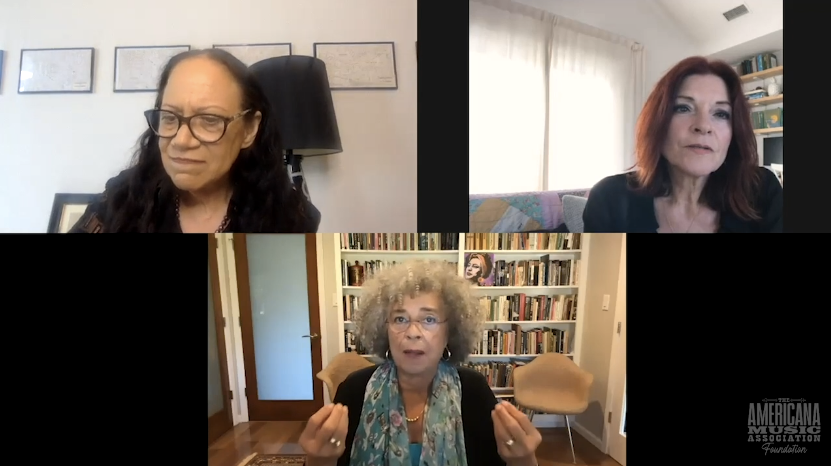
Participants in Thriving Roots' panel Love and Vigilance, from top left: Alice Randall, Rosanne Cash, Angela Davis
Rosanne Cash’s ‘Love and Vigilance’
One benefit of moving things online was the opportunity to bring together panelists who may not otherwise have been able to make the trek to Nashville to speak in person. Rosanne Cash’s Sept. 18 panel featured the artist and activist herself alongside fellow musicians Bonnie Raitt and Ry Cooder, author and songwriter Alice Randall and activist and author Angela Davis. Cash described the panel’s intent as “to play songs and talk with me about the history of protest music, the long, hard journey of Black musicians to achieve justice, and the anger and longing of the present moment.” The group of panelists traded turns performing their favorite protest songs, like Raitt’s take on Jackson Browne’s “World in Motion” and Cooder’s rendition of Woody Guthrie’s “Vigilante Man.” They also discussed the power of music to effect social change. A particularly powerful moment came when Davis shared her thoughts on the song “Suppertime” as performed by Ethel Waters, which obliquely tells of a woman preparing a meal for her children knowing that the man she loves has been lynched. “It relies not so much on the actual lyrics to give you an idea of what is happening, but rather it creates a feeling,” Davis said. “I think this is what music does. It can allow us to feel that which we have not yet learned how to express in words.”
Price Points: Talking Artistic Values with Margo Price
Thriving Roots saved one of its best panels for the last slot on the final day of the conference: an intimate and wide-ranging conversation between critic, journalist and author Jewly Hight and singer-songwriter and local hero Margo Price. On the heels of releasing her third studio album That’s How Rumors Get Started, Price had no shortage of things to talk about with Hight, including navigating the pandemic, moving away from country music on her latest album and Price’s experience recording music while pregnant with her child, Ramona Lynn Ivey. Regarding Price’s recent exploration of rock music, Hight and Price discussed being hemmed in by genre restrictions. Price pointed out that no one questioned The Rolling Stones when they explored blues, soul, country and rock in their music.



Post a comment as anonymous
Report
Watch this discussion.
(0) comments
Welcome to the discussion.
Log In
Welcome to the discussion.
Keep it clean. Please avoid obscene, vulgar, lewd, racist or otherwise abusive language. Comments featuring hate speech or threatening or violent content will not be tolerated.
PLEASE TURN OFF YOUR CAPS LOCK.
Be truthful. Don't knowingly lie or mislead.
Be proactive. Use the “report” link on any comment that violates our comment policy.
Share with us. We'd love to hear your feedback.