


Yola
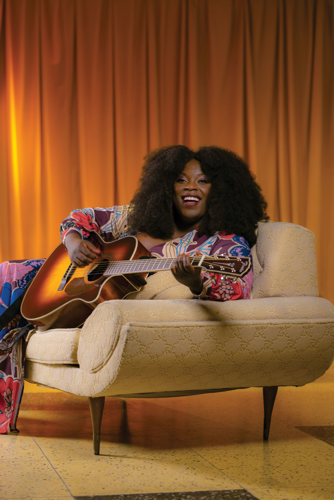
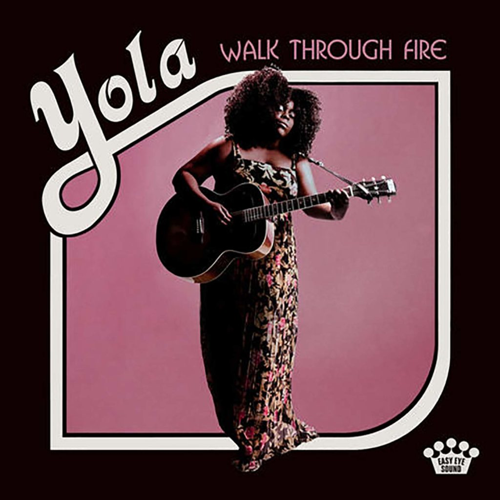
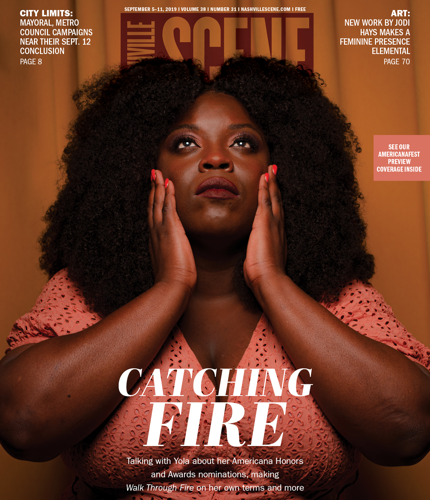
The Scene previously spoke with Yola in February, when the British singer-songwriter was on the verge of releasing her full-length debut album, Walk Through Fire. That album announced Yola as a new musical powerhouse, one whose artistic voice is matched in strength only by her truly astounding pipes. Since then, she’s nabbed a pair of nominations at next week’s Americana Honors and Awards, been tapped for an opening slot on Kacey Musgraves’ fall tour and appeared on the title track of The Highwomen’s debut LP, among other accomplishments.
Yola wrote Walk Through Fire after surviving a literal house fire that nearly claimed her life, but also gave her a clear-eyed revelation about who she is as an artist. Dan Auerbach produced the album, which blends country, soul, rock and folk to dazzling effect.
The Scene once again caught up with Yola for a lively, far-reaching conversation over sherry at East Nashville’s Urban Cowboy in August. Below, read her thoughts on “making it” as an emerging artist, being vulnerable as a black female artist and collaborating with artists like The Highwomen.
I remember seeing some of your earlier AmericanaFest appearances, like your 2017 set at The Groove. How does it feel this time around, with nominations for Album of the Year and Emerging Act of the Year?
It’s crazy. I took three years off from doing music. I had found myself unmotivated by my environment to create music, and I needed to get into a motivating environment. I found one that started me back and writing again, and that inexorably led me to play at AmericanaFest in 2016. That response from that show, and the week of three meetings a day — consequence of those showcases — led me to believe that I should probably release something. So I got back home and prepared something to release. That’s what I brought back through in ’17. …
I was looking at house prices and looking at my business plan for starting a new project, and I had to make a decision. So that decision and business plan put me here now. I was like, “Best-case scenario, we’re here where we are now.” … In my mind’s eye, I’ve been working for so long that maybe the cumulative effort of 20-odd years of releasing music in some fashion or other might have culminated in me being here now. People have said that, all of a sudden after however many years, I’m an overnight success.
As I was getting ready to talk to you today, I glanced back over all you’ve done since our conversation earlier this year, and it’s incredible. That’s three years’ worth of accomplishments for some people, and you managed it in six months.
That’s what’s crazy. Because I’ve been in bands before, who have been nearly and not quite [successful], and established bands who are already “there.” I’ve seen the different stages of how these things work. And because I’ve been a frontwoman for hire, even though I’ve not necessarily been the artist alone, I’ve always been the artist adjacent, because that’s the job. When things started going crazy for this project, I was very much like, “Oh, I’ve seen this!” When I got to the point where I was like, “Oh, I haven’t seen this,” that’s when I knew we were breaking some new ground.
Can you pinpoint that “I haven’t seen this yet” moment?
You know what, the record came out and we did SXSW. I was fully aware that I had 16 appearances to do in seven days. I was going to be dead at the end of it. This was an accepted thing. I was like: “We’re going to kill it. And we’ll be fine. But this is a limited-time strategy.” I’d seen so many people come back from SXSW — no offense to them — going, “That didn’t quite work for me in the way I thought it was going to work. I got something, but maybe not quite the thing I was going for.” I’d been in an old band at the very end of the strip, not near any of the other venues. No one wanted to come because it was so far out of the way. The team we had, had zero business sense, so it was just the most repellant vibe. Great music, repellant energy. I was singing pretty good, but I’d been hoodwinked into being the enemy to myself.
So I’d been in an environment where I’d seen this stuff from a different side, and I was seeing very much the other side of SXSW, where it does work for you. … That was a moment where I noticed the needle pushed forward. I think Kendall Jenner posted, going, “Oh, we heard about this artist. This song ‘It Ain’t Easier’ is my favorite on the record.” I’m like, “Great! Glad you chose the only one I wrote on my own.” That was on National Women’s Day, as well, so it was a double whammy. … Every day, there was some other person posting about it. When you don’t have to push so hard because people are pushing forward, that’s when it takes on a life of its own.
You had some unsavory experiences in your career in years prior, but the phrasing “hoodwinked into thinking you were the enemy” strikes me. When did you have this realization that you’d been made to feel that way?
When I was on fire. Literally. I was burning, and it dawned on me that I’d been hoodwinked, and it was all B.S. … That was my moment. I was like, “Oh, well, that was all real, then!” Everyone tries to tell you it couldn’t have been that bad, and I’m like, “No, it was!” “How do you know?” “I’m not dead! That’s how I know.”
There is something very insidious and that works very successfully when you convince someone to be against themselves or against people like themselves, when the prejudice that is used is so insidious. It’s not hard to do. You don’t have to be a genius to do it. You just have to be enough of an asshole. I’ve talked to my friends a lot about how much it takes for a person of color who has been conditioned to be afraid of wearing natural hair textures — wearing kinky, Afro hair textures. I used to wear a really straight weave. I didn’t have the guts to wear anything kinky yet. It was a real moment of learning to love myself. Some people haven’t gotten there yet, and it’s not a matter of judging them, because it’s a big ol’ hump. Being comfortable in your skin tone — especially if you are darker than Oprah — is a really big thing. I get stopped at shows and people go, “Thank you for being in the front.”
My existence is stone-cold rebellion, least of which that I chose country music as a contributor to my musical palette. How dare you be in the front and dark-skinned and a woman and not apologetic! Maybe I’ve adopted some form of entitlement. Maybe the same entitlement that’s allowed everyone else to sing soul music and hip-hop and jazz and blues and rock ’n’ roll and R&B and house music. … Not like I’m the first. Charley Pride, Ray Charles, there are many people that got there way before I did, using [country] as an influence. … That was a lot of what came from that situation, and what I realized.
It sounds like that period was very meaningful for you, both spiritually and musically. What did that clarity open up for you? Did the songs just pour out after that?
The fire was in 2014. So in 2015 I started getting things down. At that point I didn’t know how to put a whole song together on the guitar. Because part of the hoodwinking also involved keeping me away from instruments that would make me independent as a writer. So I’d always be codependent, and my voice would always be there to be popped onto any song. I’d been picking up guitar a little bit that year, and then I started digging into it with a bit more meaning and a bit more direction. I suppose I wrote myself into playing, basically, because I had to get the ideas out somehow. I had a close friend who showed me a few shapes to get me moving past the handful I had. That was what I needed — just a good friend who was himself a feminist and saw that if any other douchebag can pick up a guitar and strum a few chords and sing, why can’t someone who actually has some form of musicality do it? I had to undo that hoodwinking.
Is that what gave you the freedom to make your first EP, Orphan Offering?
Yeah, I just wanted to capture really good, quality songs with no bells or whistles. I wanted people to just hear the song, and if they needed bells and whistles, they weren’t listening. That’s what I wanted for that first EP. I wanted it to be naked, so that anyone who wasn’t on board could just jump off. Then you can bring the bells and whistles and spend all the money for the full-length. That makes sense to me. I think the EP was a way of figuring out exactly how I wanted to do things.
It seems that was another way, to very plainly say, “This is who I am. Take it or leave it.”
Yes! And it wasn’t even me, finalized. It was, “Accept me. Accept that I’m working on it.” Because there were a number of albums I could hear of people with just them and a guitar, not even always playing it particularly intricately, and totally getting away with it. And I’m like, “I want some of those white-boy perks!” You’re not going to get them if you don’t shoot for them. So put it out there, and you’ll see who gives you those perks. To have those moments where someone actually listens and hears something interesting, where they aren’t distracted by the fact that I’m a woman or a woman of color or whatever their particular beef is right now, that’s getting the perk. …
There were interviews I was doing at that time where people were asking who produced the EP, and I’m like, “Me. It says it. It has my name next to it. It’s not complicated.” … Also, there were people just desperate to put anything they liked about the record onto anyone else other than me. So if at any point any of my white male friends — of which I have many that I love dearly — were too close for too many photos, they’d go, “Did he do it?” No! That’s why my face is on it, and my face alone. And my name. … Even now, working with someone of the reputation of Dan Auerbach, if I hadn’t done that work it would have been harder to tell the story of my autonomy as a writer or my autonomy as a performer.

When you were deciding whether to work with Auerbach, did you worry about it being like those situations you just described, where you’re associated with a white man and people give him all of the credit?
That’s why I had to do that work. I’d specifically been to Nashville two years in a row showcasing before that point. My name did a small loop, but then it hit, and I was doing three meetings a day up and down Music Row. By the time I got to releasing [Walk Through Fire], it had gotten around through all those circles that I had skills. And that’s all it is. You want to be like, “Hi, I’m a person, this is my job,” and you want the people to believe you. It’s really basic. You don’t want to have to limit the kinds of places you can go into. So I knew I had to do that work before so I could be free to do whatever I wanted to do. It’s about how you start the narrative.
What were those early meetings like? What was different about meeting Dan?
They were people who didn’t know what the hell I was. Some people couldn’t really veil their prejudice. Some people did get it, but it wasn’t the right fit. … With Dan, especially production-wise, I knew I could just leave the room. Like, “You’ve got this, babe!” Micromanaging: zero. It was wanting that much confidence in somebody.
So you’re basically a gatekeeper’s worst nightmare. And I mean that as a compliment. You’ve done things on your own terms, and look how it’s turned out.
Honesty, it turns out, people might be a little bit thirsty for, at the moment.
I think you’re onto something! We’ve had a shortage of that lately.
Yes! My timing is impeccable, darling. [laughs]
You really can tell when the song you’re listening to or the book you’re reading or what have you is honest and vulnerable. It seems like we get less of that each day.
Every bloody day. And it’s bloody exhausting. It’s a cheese grater, grating away at your soul, bit by bit. So I just try and mean it. Like any good hug. I try to find a connection. [My co-writers and I] wrote a bunch of songs and chose the ones I could connect with the most. It’s always about getting inside the meaning. Like you mentioned, you don’t get enough moments of black female vulnerability. We’re seen as this eternal, invincible Beyoncé song. We can’t always be Sasha Fierce. We’re fallible and real. It’s a human state to be in. One of the most important things has been delivering that vulnerability through music, and the courage and longing and loss and confusion, to show the dexterity of black female emotion. Because I’m really searching for movies I can watch where the black female character has nuance and isn’t just batshit cray. There’s so much trope in what we get through the media. It’s so important to manifest yourself in that human way.
You appear on The Highwomen’s “The Highwomen.” Thinking of them and Kacey Musgraves, who you’ll tour with later this year, it seems like you found some musical kindred spirits.
Working with The Highwomen was utter joy. Everyone was so comfortable. It would have been easy for anyone in that room to have played the “Do you know who I am?” card. Anyone could have played that card, or the infinite number of cards that privilege affords, and no one played any of them. It was just a big ol’ love-in. Everyone was in the process of worshipping Sheryl Crow, obviously, because she’s worthy of that worship. And again, she’s utterly over herself. I left with lifelong friends. … They were inclusive, as well. Brandi [Carlile] was saying, “I’m fully aware this is a room full of white people, so if at any point we’re missing some point, speak. I can cover the gay stuff and you can cover the of color stuff and we’ll high five in the middle.”
The fact that she said that means I have no problems. Most people are not aware that the environment they’re bringing you into might be unmotivating in some way. It doesn’t even occur to them to care. But there was so much empathy. It gave me hope that success wasn’t going to lead to a place I call “the Ivory Tower of Misery.” It’s the place you go to where you have all the money in the world and you’ve ticked all the career boxes, so everybody expects you to be happy — only you want to slit your own throat because you’re surrounded by douchebags.
Speaking of people who aren’t douchebags, you recently joined The Highwomen and Dolly Parton onstage at the Newport Folk Festival. That must have been surreal.
Dolly’s the O.G. of not taking any shit. I think we all go through that stage, of taking shit, then we get to our 30s and make some massive life-scissors cuts and say, “This is my life!” … So being in an environment where Dolly is really leaning into it and seeing that in first-person, that’s what’s valuable. It’s like being remotivated to not sell out for loads of money. There will always be money somewhere. … Being in a throng of people who have made that decision, and they all happen to be women with agency, is powerful. Headed up by the O.G. of O.G.s — it’s a good place to be in life. Because it was [organized] by The Highwomen, the philosophy was that of The Highwomen, that of uplifting each other. I didn’t even know where to look for a douchebag. There was nowhere to look for a douchebag! I just couldn’t find one. They weren’t invited, babes.




Post a comment as anonymous
Report
Watch this discussion.
(0) comments
Welcome to the discussion.
Log In
Welcome to the discussion.
Keep it clean. Please avoid obscene, vulgar, lewd, racist or otherwise abusive language. Comments featuring hate speech or threatening or violent content will not be tolerated.
PLEASE TURN OFF YOUR CAPS LOCK.
Be truthful. Don't knowingly lie or mislead.
Be proactive. Use the “report” link on any comment that violates our comment policy.
Share with us. We'd love to hear your feedback.