
A quick remedial paragraph, for those of you who may not be up to date on today's trends: Pants with rib-cage-level waists are riding high. Fat isn't evil — sugar is. Great-Great-Grandpa's beard is in, and so is Grandpa's whiskey. But Grandma's blush wine? Out. Way out. Dissing white zinfandel is like dissing Guy Fieri: a risk-free way for non-tastemakers to signal that they at least know what the tastemakers are mocking.
Grandma can still find her blush wine on supermarket shelves, but if she finds it on an urban wine list it's probably there ironically. Chances are better she'll find its fraternal twin: dry rosé.
You don't need me to tell you that rosé is everywhere: on porches and patios, in wine bars and Rick Ross songs. Even a novice eye can pick it out on a store shelf, where the bottles of wildly varying shapes show off their pale-copper to cherry-red hues. Without the accent over the "e," the word rose is French for pink. So is defining rosé as simple as logic implies? Is it just pink wine? The answer is yes — mostly.
A cook can make a pink sauce by combining a red sauce with cream, but following intuition and combining a red and a white wine is a broadly shunned way to produce rosé; the only reason it is worth mentioning is because this "low" method is standard in Champagne, a region whose name is synonymous with quality. In other self-respecting appellations in France and around the world, this method is impermissible, as it is seen as cheap and hacky — which it is, except when it's employed to make expensive and painstaking rosé Champagne.
Rosé has much to teach about winemaking. As I mentioned in an earlier column, the classically straw-hued wines of Champagne are made largely from red grapes. The wines are white only because the juice is not allowed to stay in contact with the grape skins. If contact were allowed, pigments from the skins called anthocyanins would color the juice and result in a red wine. This process, called maceration, can last from a couple of days to several weeks, depending on the level of extraction desired.
What makes a rosé wine is partial skin contact: The winemaker will allow the juice to mingle with the skins for a short time, usually measured in hours. If we regard white and red wines not as categories but as opposite ends of one continuum, rosé is the broad, intensifying territory that lies between the poles. To make a rosé is to pluck a wine off of its road to redness.
How this is done varies, and to understand it, you must understand some winemaking terms. Free-run juice is what runs out of freshly crushed grapes — 60 to 70 percent of the grape's juice escapes this way. The remaining juice can be extracted from the burst grapes through pressing, and is thereafter known as press wine. Press wine is of lesser quality, but has attributes that free-run juice lacks: maybe some tannin and a slight tint.
Crucial to rosé-making is the saignée process, in which free-run juice is bled away from the skins after a brief maceration — the word itself means bled (and saignant means bleeding, which is useful for travelers in France who like their steaks raw). Saignée wines can boast significant color, which is controlled by the length of the maceration. Sometimes makers of red wine will bleed off some juice after a short maceration to achieve higher concentration in the nascent red wine that remains with the skins. They can ferment the rosé saignée, bottle it, and make a profit on what is essentially a by-product of their more "serious" winemaking.
In addition to the maceration time, the type of grape can affect the color of the wine immensely: Juicy thin-skinned varietals like cinsaut will impart less color than, say, cabernet sauvignon. In fact, at a recent tasting of Provence wines, we were poured a wine that, to the eye and even the nose, was white. Can a wine that's not even rose be a rosé? I suppose so, and I suppose we need a more specific definition: Rosé is wine, made with partial skin contact, that is most often pink in color.
Legend has it that sweet California blush wine was a happy (depending on whom you ask) winemaking accident: a stuck fermentation in an attempt to make dry rosé resulted in a pink wine with significant residual sugar. Palates were pleased, and to this day waiters and sommeliers are informing incredulous drinkers of the existence of "red" zinfandel.
Rosé is geographically limitless; where there are red grapes, rosé can be made. It is generally recommended that rosé be consumed in the year following the harvest, but how could it hurt to put a bottle away for a year or two and try it then?
Here are some rosés of varying colors, flavors and styles that are available in Nashville:
Salmon-colored and zesty
The malbec-dominated Calcu from Colchagua Valley, Chile, boasts seriously earthy aromas and a bright citrus and berry flavor. More complex than its price suggests. $13.99, Midtown Wine & Spirits
Vivid and full-bodied
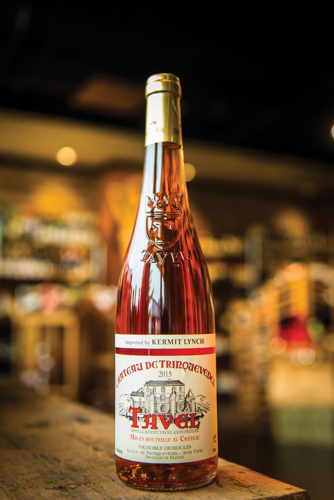
The Chateau de Trinquevedel wine is from the renowned Tavel appellation in France's southern Rhône region. This wine has a demure nose, a full body and a spiced finish. Tavel rosés tend to display an intense strawberry color. $19.99, Midtown Wine & Spirits
I was convinced by a partisan Washingtonian salesman to try the Charles & Charles Columbia Valley rosé. Mostly syrah, but with 7 percent cabernet sauvignon, it has a deep pink hue and is heavy with notes of strawberry and melon, with a full and round mouthfeel. Crowd-pleaser. $13.99, Mr. Whiskers
Peachy and delicate
The Withers comes from the under-regarded but high-elevation El Dorado A.V.A. in California. Pale and peachy with a soft mouthfeel and just enough acid on the finish, it is an easy-to-love rosé. $19.99 Midtown Wine & Spirits, Woodland Wine Merchant, The Wine Shoppe at Green Hills Coppery and unique
If you think rosé is rosé, try the Charles & Charles alongside the Baudry-Dutour Chinon, a rosé from France's Loire Valley made exclusively from cabernet franc. The wine looks like three pennies leached their color into a bottle of water. The nose is of muted bell pepper and cedar, which is confirmed on the palate until mouth-watering post-swallow acidity takes over. In what is sometimes regarded as a monolithic designation, these two rosés could not stand further apart. The most interesting wine of the bunch. $21.99, Mr. Whiskers
Worth the praise and price?
In France's Bandol appellation, Domaine Tempier produces a sought-after rosé that, fortunately for my budget, is not available in Nashville until June. My first sip of Domaine Tempier Bandol Rosé was a revelation, but that was a long time ago. If you are curious about the top end of rosé, put aside 60 bucks, and very politely ask your wine shop to put one aside for you.
Email arts@nashvillescene.com



Post a comment as anonymous
Report
Watch this discussion.
(0) comments
Welcome to the discussion.
Log In
Welcome to the discussion.
Keep it clean. Please avoid obscene, vulgar, lewd, racist or otherwise abusive language. Comments featuring hate speech or threatening or violent content will not be tolerated.
PLEASE TURN OFF YOUR CAPS LOCK.
Be truthful. Don't knowingly lie or mislead.
Be proactive. Use the “report” link on any comment that violates our comment policy.
Share with us. We'd love to hear your feedback.