

Back in Ye Olde Nashville days, there were scant options when it came to immigrant-owned restaurants with authentic international cuisine. In the mid- to late 1990s, immigrants began opening small storefronts on arteries like Nolensville Road, Charlotte Pike and Antioch Pike, in still-affordable areas where they were settling.
For several years at that time, as the Scene’s weekly restaurant critic, I presented a class for University School of Nashville’s evening series called “Eating Globally, Dining Locally.” The concept was that there was a good representation of global food available in Nashville if you knew where — and were curious enough — to look. I would herd about 20 people out of their comfort zones and into one of those restaurants for a meal and an overview, and send them off with a printed (!) guide.
The idea seems quaint now in a Nashville overflowing with multiple places to explore Korean, Kurdish, Ethiopian, Turkish, Peruvian, Uzbek and Venezuelan food. And yet, I bet fewer Nashvillians — no matter how well-traveled or global-cuisine-curious — are familiar with Filipino fare. I’m basing that in part on my three world-traveled companions who ventured with me to the wilds of Madison for dinner at Maemax Market and had never eaten Filipino.
My assumption was confirmed by Chriss Goyenechea, who with his wife Malo (the talent behind the food) owns Maemax, named for their children Maefel and Max. The Filipino immigrants opened the first Maemax in La Vergne in 2018 after building a following through sales of Malo’s siopao (a pork-stuffed white bun common to Filipino street food), which they expanded to catering. They repeated the concept of restaurant plus market on Gallatin Pike in Madison in December 2023 and closed the La Vergne store a year later.
Because I’d eaten at the Filipino pop-up Ate’s, which had a residency in the incubator kitchen at the Nashville Farmers’ Market, as well as the nationally acclaimed restaurant Neng Jr. in Asheville, N.C., I was familiar with Filipino food. But I’m certainly not a guide to be counted on.
When you take your first visit to Maemax, you will be jolted awake by the brightest shade of neon green ever to burst out of a color wheel, swathing everything from walls to chairs to the menu to the restroom stalls. It livens up the two rather cavernous dining rooms, including the one with the small stage for karaoke, a passion among Filipinos and presented on Saturday nights.

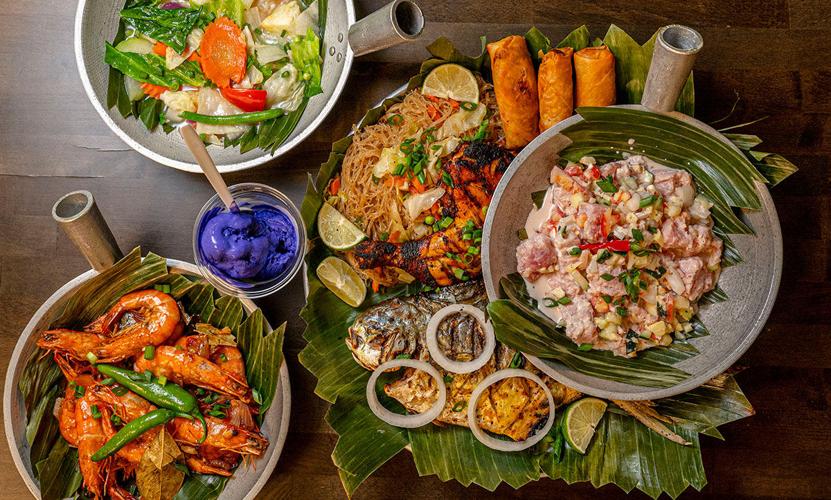
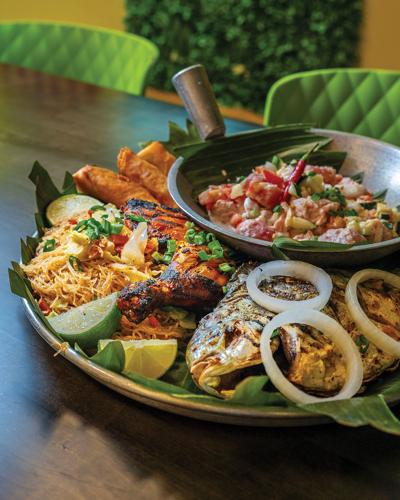
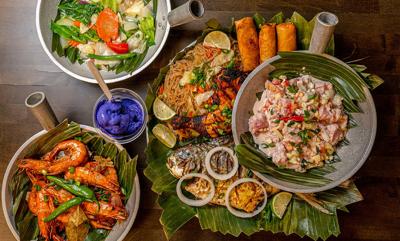
Clockwise from top: kilawin, fried whole pompano, chicken inasal, veggie pancit, veggie lumpia
Unfamiliarity with the food was not the only challenge. The menu itself — placemat-size, laminated, printed on both sides and broken into confusing categories — was not helpful. It’s an issue Chriss readily acknowledges and is addressing with what he calls “menu engineering,” which he expects to complete shortly. He also intends to be more assertive in guiding people to optimal appreciation, citing chicken adobo — the national dish of the Philippines — as an example. “People are ordering pancit [a rice noodle] with chicken adobo, when they should order white rice, because the sauce from the chicken and rice go together,” he says. “The new menu will steer people to the right way to order.”
A good introduction and broad selection of food is found on the fiesta tray or fiesta platter, either as a sharable starter or main. The former includes veggie pancit, BBQ sticks (meat on a stick) and a dozen lumpia — the Filipino version of egg rolls, smaller and with a thinner, crackly wrapper. The platter adds rice, chicken inasal and either lechon kawali (cubes of deep-fried pork belly) or pork liempo (marinated and grilled).
I was especially stymied by the lack of distinction between entrées on one side of the menu and family sharables on the other. The two are not so much a matter of portion size as dining style, Chriss explains. “Filipino cuisine is communal,” he says. “When we have pork, chicken, beef, seafood, it’s laid out on the middle of the table and shared by everyone. That’s the sharable part. Americans are used to their own meal — these are my ribs, my coleslaw, my mac-and-cheese. The entrées accommodate that way.”
My group leaned heavily into sharing, as evidenced by the inordinate number of plates we accrued throughout the meal. And our server was extremely helpful (and patient), suggesting ways we could sample more dishes.

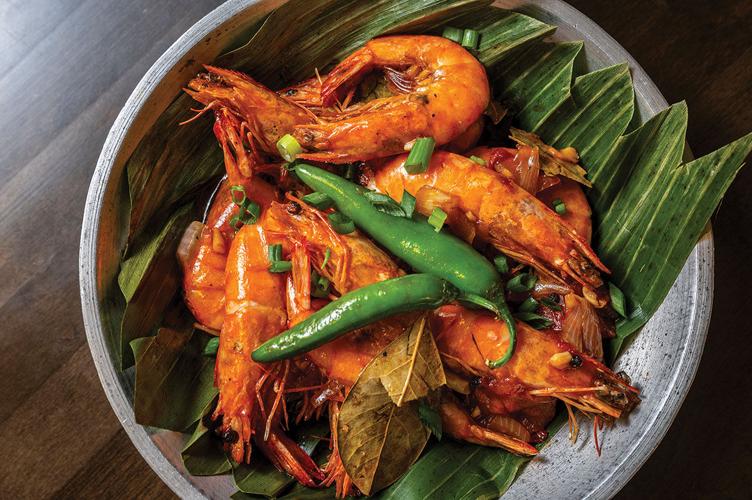
Shrimp adobo
The unanimous Best of Show was kilawin, an item that piqued my curiosity on the website but was nowhere to be found on the in-store menu. I asked our server about it, and 10 minutes later a large bowl of Filipino ceviche was before us — big, meaty chunks of pale-pink tuna, “cooked” in tangy vinegar and lime, mixed with diced tomatoes and crunchy raw cabbage and strewn with sliced scallions.
Another standout was the whole, head-on fried pompano (gluten-free, by the way), seasoned simply with salt and pepper, served with wedges of lime and two vinegar-based sauces for dribbling. (Tilapia, mackerel and red snapper are other options.) I regret not getting a side of atchara, a pickled relish made of grated green papaya, raw carrots, onion, peppers and garlic.
The veggie chop suey is a sleeper hit, thanks to the vibrantly fresh vegetables and silky sauce, served at room temperature. As the only pork eater at the table, I opted for a single BBQ pork belly on a stick and relished every charred, fatty bite of it.
Chicken inasal is super-accessible for less adventurous eaters — a chicken leg quarter marinated in vinegar, lemongrass, garlic, ginger, citrus and oil, then grilled like your basic American-style backyard barbecue. We didn’t want to over-chicken, so we had the adobo treatment on shrimp and received a deep bowl of jumbo shrimp immersed in the traditional sauce made of vinegar, soy sauce, garlic, black peppercorns and bay leaves.

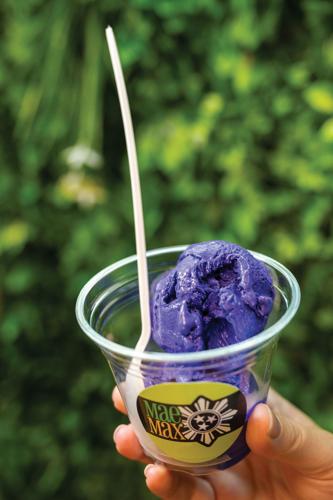
Ube ice cream
Had we not eaten ourselves into a near stupor, we would have gone over the top with the halo-halo — shaved ice piled into a large cup with sweetened beans, fruits, jellies and ice cream. Instead, we shared a bowl of bright-purple ube (sweet potato) ice cream with the consistency of gelato.
If, like most of Nashville, you have not experienced Filipino food, consider the 20-plus-item buffet served Friday and Saturday nights after 6 p.m. as well as on Sunday afternoons. Something for everyone!
Or more fun, try the kamayan — an immersive group experience based on a feast of dishes set on a table covered with banana leaves. The kamayan is also known as a boodle fight, and traces its origins to the military, when men stood at the table and fought for their food. The experience must be reserved in advance for a minimum of six people, $35 per person.
No fighting please. This ain’t the White House lawn.



Post a comment as anonymous
Report
Watch this discussion.
(0) comments
Welcome to the discussion.
Log In
Welcome to the discussion.
Keep it clean. Please avoid obscene, vulgar, lewd, racist or otherwise abusive language. Comments featuring hate speech or threatening or violent content will not be tolerated.
PLEASE TURN OFF YOUR CAPS LOCK.
Be truthful. Don't knowingly lie or mislead.
Be proactive. Use the “report” link on any comment that violates our comment policy.
Share with us. We'd love to hear your feedback.