
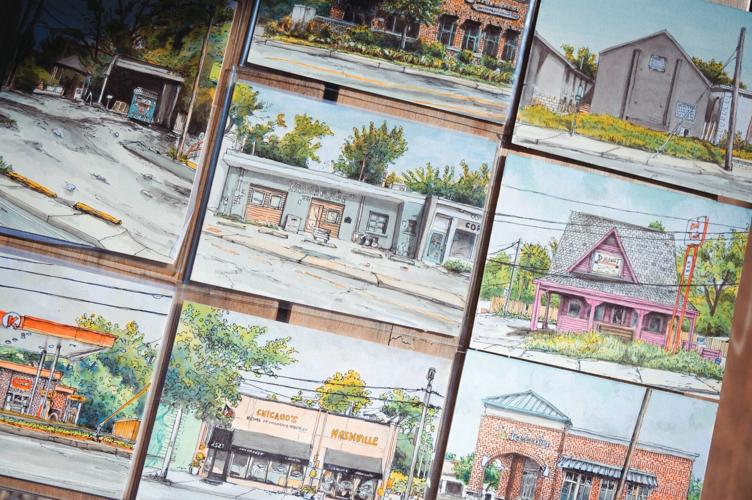

When New Zealand native Wendy Murray set out to draw every building on both sides of a 6-mile stretch of Nashville’s Gallatin Pike, she wasn’t super clear on the conversion from miles to kilometers. In recent weeks, she was informed about just how long that is.
“In my head, I can achieve 6,” Murray tells the Scene, describing her thought process. “But a 10K run on both sides? Are you crazy?”
Murray has completed drawings of 266 buildings as of this writing. She says she’d rather not count how many are left.
She fell in love with Gallatin Pike even before she officially moved to Nashville. She says she’d take the WeGo Route 56 bus up and down the corridor to legendary print shop Hatch Show Print downtown for a 2024 internship; she officially moved here in 2025. She says she’s never been a car person, but her car — which she calls Owen — has helped speed up the project.
Murray started drawing some of the buildings simply because she draws wherever she goes. For her as an artist, Gallatin Pike became a way to tell a deeper story.
With her Every Building on the Gallatin Pike project — which was inspired in part by Every Building on the Sunset Strip, a 1966 project by artist Edward Ruscha, and spans from Main Street to Briley Parkway — Murray observes the creep of gentrification. The Briley end to the north is the old Gallatin Pike, and the Five Points end to the south is the new Gallatin Pike, she observes. When buildings see change, she can’t go back to update her pieces. If she did that, she says, she’d be drawing forever.
“Gallatin [Pike] is an important road in Nashville,” she says. “Doing this project, I’m learning how important it is to the whole community. People kind of hate on it, but there’s so many awesome things about it.”

Wendy Murray
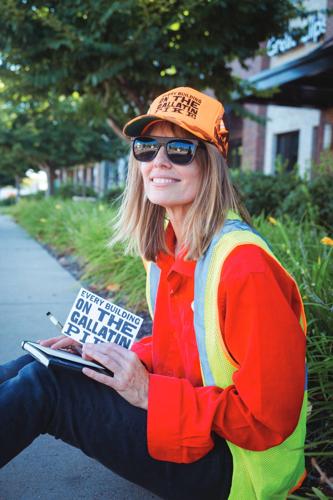
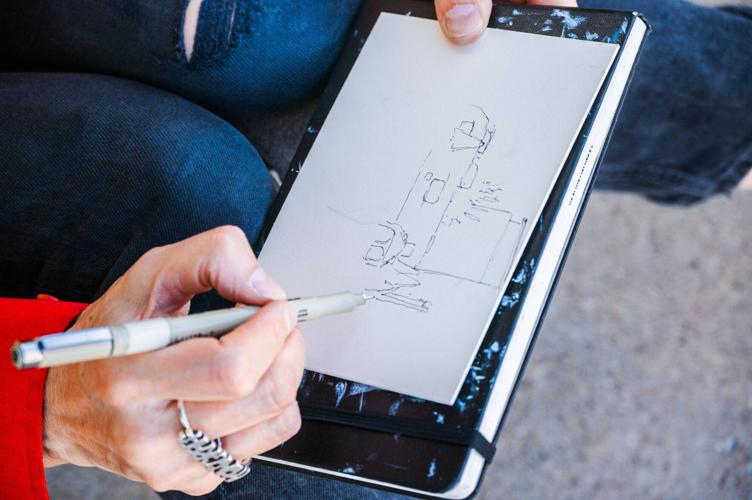
Murray’s process is simple: She draws the outline of the building of the day as fast as she can with her 0.2-millimeter pen, keeping any errors as part of the drawing’s charm. She then uses gouache, a water-based paint, to fill in the colors at home, working off of a reference photo she took while drawing. Each drawing takes four to five hours, and she aims to complete four to five drawings per week — working around the hours of her day job.
Murray finds a soft, shaded perch directly across the street from her subject of the day. If she can’t find a cozy spot, she sits on a few tattered copies of the Scene directly on the sidewalk. She wears highly visible clothing, including a custom neon hat made for her by local chain-stitch shop RangerStitch, from which she’s hung tiny safety cone earrings.
A cone, which she has affectionately named Jeremy Coney after a New Zealand cricket player, stands watch.
“We had a tree fall down over our street during the ice storm, and they put these cones out,” says Murray. “And then they cleaned up the tree eventually, and they took all the cones except for one. And I was like, ‘That little cone is just out there by himself.’”
After she packs up for the day, Murray drops a postcard about her project in the mailbox of the building she’s drawing. There’s no profit involved, Murray says, but she does produce some postcards and prints of her drawings to support the project — and those can be purchased via her website.

Murray is versed in a variety of mediums, including zines, pottery and various types of printmaking. But her latest work is in support of a vision she has of one day lining up all of the buildings in a row in an art museum. She’ll position the east side of Gallatin Pike on one wall and the west side on the other, so people can walk down the middle. She did a truncated version of this in November of last year inside a box truck. Murray also intends to produce an accordion book of her art, as well as a coffee table book complete with more history about the Gallatin Pike — or Gallatin Road, as locals tend to call it.
Murray says something she often hears is, “You call it Gallatin Pike, so you’re obviously not from here.” And certainly not “the” Gallatin Pike. She takes it in stride.
“And I’m like, ‘Well dang, I am not from here,’” she says. “I’m totally embracing that. I’m fine to be an outsider, it’s cool.”
She loves when longtime Nashvillians tell her their personal histories with the buildings she’s drawn. She also asks people to “toot” their horn when they drive past and see her drawing.
“It can feel more lonely out there when there’s lots of traffic,” she says. “I just feel like this tiny, insignificant blob on the side of the street.”
As evidenced by Owen the car and Jeremy Coney the traffic cone, Murray tends to anthropomorphize things. But she says that’s not something she thinks about consciously. She gestures to a nearby building from her perch.
“That building,” she says. “There’s so much history in that. That building’s had a crazy life.”



Post a comment as anonymous
Report
Watch this discussion.
(0) comments
Welcome to the discussion.
Log In
Welcome to the discussion.
Keep it clean. Please avoid obscene, vulgar, lewd, racist or otherwise abusive language. Comments featuring hate speech or threatening or violent content will not be tolerated.
PLEASE TURN OFF YOUR CAPS LOCK.
Be truthful. Don't knowingly lie or mislead.
Be proactive. Use the “report” link on any comment that violates our comment policy.
Share with us. We'd love to hear your feedback.