
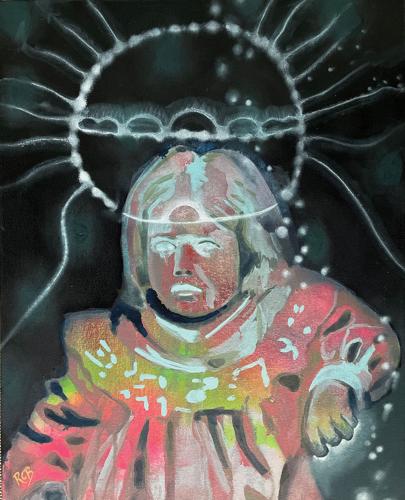


“Mommy We All Have a Crown, but We Don’t See It,” Ruth Chase
We’re used to painters drawing attention to light in their works. The brightness and shadows of Edward Hopper’s scenes spotlit the urban isolation of midcentury America, and J.M.W. Turner pictured light as a manifestation of the divine above the windswept waves of his seascapes. In her exhibition Unbreakable Light at Galerie Tangerine, Nashville-based artist Ruth Chase deploys painting and sculpture to cast light on the notion of the soul as a luminous form. The multimedia work is colorful and graphic in its layered rendering. It’s also charged with spooky paranormal energy, which makes the show feel perfectly timed for its fall run at the gallery.
Chase is primarily a painter, and the show is packed with paintings. Her canvases and panels are populated with portraits, many copied from vintage photographs. (Why are antique clothes so terrifying?) Early photographic images have a strange light all their own, and the artist’s painted takes double down with ghostly halos, eyeball lightning bolts and ectoplasmic tangles that seem to glow and flash across the gallery walls.
My favorite painting in the show has a title like the English translation of a lost giallo film. “Mommy We All Have a Crown, but We Don’t See It” pictures an old-timey little girl in a faded red dress with a lace collar. She’s emerging from a shadowy black background, and Chase’s graphic-looking layered style makes the whole scene read like a chiaroscuro comic book. The girl has radiant white eyes and a halo above her head that looks vaguely like a sun bisected by a distant horizon. The work is emblematic of Unbreakable Light’s supernatural surrealism, which is as stylized as it is strange.

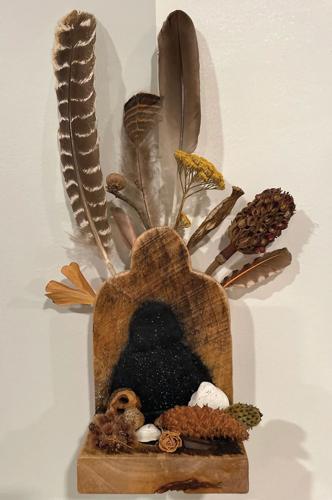
“Light Keeper,” Ruth Chase
Neoplatonists conceived of the augoeides, or “body of light,” which is still thought to be the corpus of consciousness in the most woo-woo circles today. It’s the part of us that’s said to go astral-traveling while our physical bodies are at rest. It’s also the part of us that separates from our earthly flesh when we die. Chase represents light-bodies with simplified anthropomorphic forms that haunt her paintings like the spirits of long-lost ancestors, or even disembodied visitors from another realm. These works are uncanny and intense any time of year, but Unbreakable Light really is a perfect pairing with scary season in autumn. Old European pagan traditions marked the end of October as a time when the veil between the living and the dead was thought to be thinnest, and that’s the feeling you get from Chase’s paintings — a barrier has been removed and something is coming in.
One of the most unusual paintings on view is an interior of a bedroom at night. The bedcovers are turned down, but there’s nobody sleeping. It’s one of the few paintings in the exhibition with no people in it, but the empty space above the bed is bright with orbs of light bouncing around the dark, quiet room. The light-body flickering on the television screen completes a scene that has to be described as Spielbergian, even if Chase’s little painting conveys way more wonder and mystery than Disclosure Day.
Chase also presents her light-body forms as sculptures. The artist’s “Light Keeper” sculpture is essentially a wooden shelf in the same shape as the light-bodies in her paintings. It’s decorated with paint along with dried flowers and seed husks, feathers and stones. I love the idea of representing something ineffable and luminous with something that’s rough and solid and decorative and wild. It’s a formal master stroke for a show about the immaterial communing with the material to spill out of the picture plane and into sculptural space. I also love how these little altars can be altered by the objects placed on them. They’re interactive in that sense, and this is another way Chase speaks to the communicative links that connect us to the invisible, like the so-called “silver cord” that’s said to connect our own physical forms to our light-bodies.
Chase’s show is haunted and haunting, but there is also something familiar and reassuring about our personal lights, our light companions, and even the dark mysteries light leaves in its absence. There’s an old joke that Norm Macdonald used to tell about a moth who goes to a podiatrist. When the doctor asks what’s ailing him, the moth looses a litany of troubles that seem straight out of Dostoyevsky: his crushing job, his loveless marriage, the loss of a child. The podiatrist empathizes, but suggests that the moth needs to see a psychiatrist, and he asks the moth why he came to a foot doctor’s office.
“Because the light was on.”



Post a comment as anonymous
Report
Watch this discussion.
(0) comments
Welcome to the discussion.
Log In
Welcome to the discussion.
Keep it clean. Please avoid obscene, vulgar, lewd, racist or otherwise abusive language. Comments featuring hate speech or threatening or violent content will not be tolerated.
PLEASE TURN OFF YOUR CAPS LOCK.
Be truthful. Don't knowingly lie or mislead.
Be proactive. Use the “report” link on any comment that violates our comment policy.
Share with us. We'd love to hear your feedback.