

Nashville native Carlton F. Wilkinson is a fine-art photographer and educator who has made a lasting impression on Nashville’s contemporary art scene — most notably through his locally legendary art space, In the Gallery. The gallery occupied the historic Onyx Building on Jefferson Street, and it served as the headquarters of the North Nashville art scene from 1987 until it closed in 2007. (The iconic Onyx property was destroyed in the March 2020 tornado.)
Among the many artists Wilkinson championed was painter Barbara Bullock, whose presence was a constant in the gallery from its opening until her death in 1996.
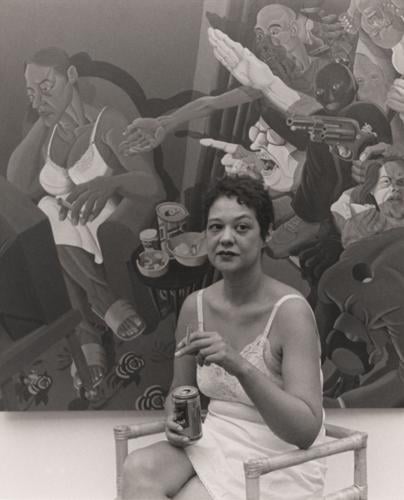
Now, two decades after closing his gallery, Wilkinson has brought Bullock back to the forefront with his curation of Sistah Griot: The Iconoclastic Art of Barbara Bullock, on view through April 29 at the Frist Art Museum. The new show reflects the friendship and working relationship between the two artists, and includes Wilkinson’s own irreverent photograph of Bullock seated in front of one of her canvases, holding a cigarette in one hand and a Miller Genuine Draft beer in the other. This photo is emblematic of Sistah Griot as a whole — it illuminates a Nashville artist whose highly personal and deeply idiosyncratic work always played by its own rules.
“To hear me tell it, I think she’s one of the more significant American artists of the latter 20th century,” says Wilkinson in a phone conversation with the Scene. “She’s phenomenal. She lived here in the Belmont area. She befriended a professor at Belmont — Victoria Boone. [Boone] encouraged me to see a show that [Bullock] was having in Gallatin. I saw one work that was quite impactful — it’s where she’s falling from the sky and you see her through a window. I felt very moved by that and all the works that I saw. I wanted to do a show with her, and I ended up being pretty much her sole dealer.”

Barbara Bullock
A key work in the Frist show is “Falling or the Yellow Room,” a self-portrait that depicts Bullock falling off of a balcony past a window in her childhood home. The work is painted on six separate lateral panels that break up and distort the picture plane. The effect is unsettling, and the roses decorating the precisely rendered yellow wallpaper speak to Bullock’s upper-class childhood, while their thorns speak to the struggles she went on to face as an adult.
As a young artist, Bullock became known for her meticulous graphite drawings, several of which are on view in this Frist exhibition. Following a stroke at age 35, Bullock threw herself into art-making to rehabilitate her hand-eye coordination. The setback became a rebirth. After her stroke, Bullock reinvented herself as a painter of vivid characters set within chaotic scenes, their spaces rendered almost surreal by the distortions of her impaired vision. Bullock’s anarchic compositions still surprise viewers with their strangeness and their commentaries on social ills, but they also attracted a democratic mix of collectors — works in Sistah Griot are on loan from the collections of doctors, policemen and grade-school teachers. Her broad reach among diverse communities across the country speaks to Bullock’s capacity for expressing raw humanity with a personal style that’s as poetic as it is painterly.
“We have works from California to New York — and Montgomery, Ala.,” Wilkinson laughs, recounting the range of collectors Bullock reached in her career. “Literally from all over the country.”
Bullock’s paintings are often described as “earthy” in their depictions of the tragicomic essence of the day-to-day. That said, the most magical aspect of the Frist display is how dreamy it is. Every falling figure, every stylized self-portrait, every beady-eyed businessman, every curious cat is choreographed with a dream logic that informs the exhibition as a whole.

Through April 26 at the Frist
Sistah Griot hangs in the Frist Art Museum’s Gordon Contemporary Artists Project Gallery. It’s directly connected to the institution’s Ingram Gallery, which is currently hosting In Her Place: Nashville Artists in the Twenty-First Century. But Bullock’s work may as well be hanging in orbit around the moon. It exists in a world all its own.
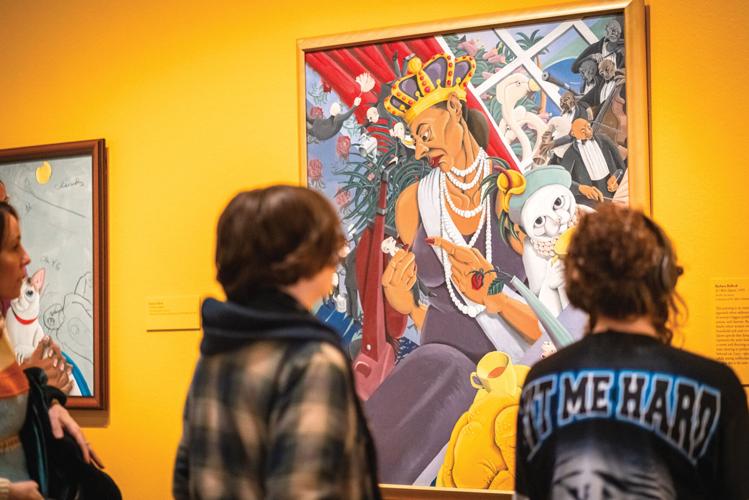
Bullock’s work is visually and psychologically iconoclastic, but her art is often grounded in social concerns. “If I Were Queen” is another self-portrait, and it’s the signature image of the Frist exhibition. In the painting, Bullock wears a crown and a sumptuous string of pearls. She’s seated next to her cat, who is sipping a cup of tea at a table decked out with a lavish meal. All around the scene, tiny little businessmen in suits and ties do the queen’s household chores, dusting and watering plants. The queen lectures a diminutive subordinate, whom she holds between her thumb and forefinger. A few tiny disembodied heads decorate the scene.

Most of you reading this already know that Nashville artist Barbara Bullock died recently, after losing a bout with lung cancer. She was suppo…
“She was just too edgy for some people because she just told the truth the way that she saw it,” explains Wilkinson. “And she was unapologetic about it. Not everybody was ready for Barbara.”
Since the artist’s death in 1996, a whole generation of Nashville artists and collectors has known this community only without Bullock — without her beer and cigarettes, without her strong opinions and her unbridled painting. Sistah Griot fills in that blind spot, celebrating one of Nashville’s most unique and influential artists in this current era, when Bullock’s startling and stubborn canvases still provoke, perplex and persuade.



Post a comment as anonymous
Report
Watch this discussion.
(0) comments
Welcome to the discussion.
Log In
Welcome to the discussion.
Keep it clean. Please avoid obscene, vulgar, lewd, racist or otherwise abusive language. Comments featuring hate speech or threatening or violent content will not be tolerated.
PLEASE TURN OFF YOUR CAPS LOCK.
Be truthful. Don't knowingly lie or mislead.
Be proactive. Use the “report” link on any comment that violates our comment policy.
Share with us. We'd love to hear your feedback.