
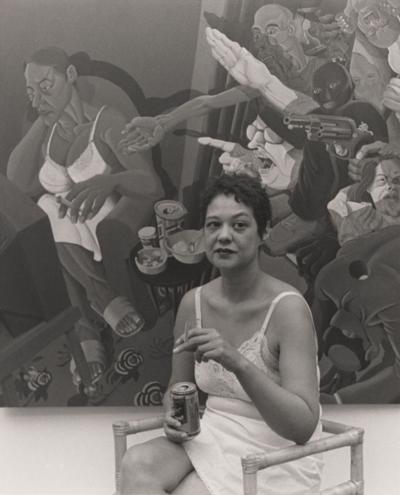
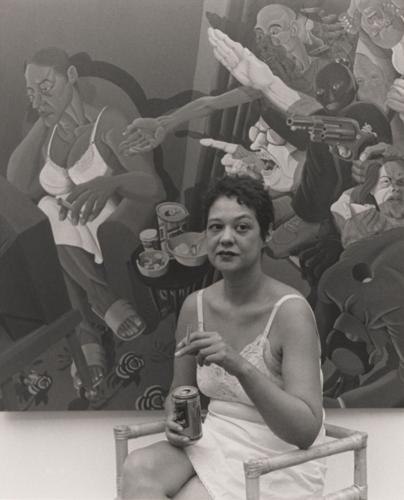
Most of you reading this already know that Nashville artist Barbara Bullock died recently, after losing a bout with lung cancer. She was supposedly recovering and even working on several paintings in preparation for an April show at Cheekwood. Like many in our visual arts community, I didn’t even know she was in the hospital, least of all that she was dying. How could she be? Wasn’t she increasingly included in group exhibitions across the country, gaining more and more patrons who prized her idiosyncratic paintings and drawings? Heck, wasn’t she a classic Scorpio—wonderfully stubborn, outspoken and distinctive—a truly original, colorful character in a time of careful conformity and calculation? How could someone like that just die?
Barbara Bullock was a gadfly artist who pulled no punches. Her art cut with a keen emotional edge. It explored raw personal experience, revealing a welter of intense feelings for the plight of others. She was a gadfly because her art tried to tell the truth, and she usually stepped on lots of toes.
People usually commented on how tough or sassy the art was. Barbara had had the honor of having one work turned down by the Action Auction people—it had condoms and tampons in it, and their auction is always in good taste. Another was removed from a Memphis storefront during a civil rights celebration; local businessmen found the sight of two lynched dummies, one black and one white, too disturbing. A third was rejected by a local committee for travel to the National Museum of Women in Art; the image of a black woman and a white woman exchanging body parts was deemed too violent for children. How could anyone not quiver at works like “If I Were Queen,” in which a menacing black woman dressed as royalty cuts off the heads of tiny businessmen who have failed her orders? At her side, a huge grinning cat watches a throng of other little businessmen, scampering below and attending to the housework. Now, there’s a classic role reversal—funny how much it actually resembles the corporate decapitations at AT&T or IBM.
Barbara was a gifted artist who’d majored in studio art at Peabody College after coming here in 1969. Following her first stroke about 10 years ago, she’d taken up art again as a way of dealing with the ensuing physical and mental struggles. Her pencil drawings were extraordinarily sensitive—I recall the first one I ever saw, which she’d entered in a regional show held at the Hendersonville Arts Council. It was an odd but concise rendering of herself wearing an eye patch and looking into a bathroom mirror, clearly depressed by the view. The style was slightly distorted in the manner of a fisheye lens, yet there was something comical to the image as well. Maybe it was the sad figure holding a crooked toothbrush, the slack-jawed gaze in the mirror, the harsh lighting. Maybe it was the fact that the point of view was taken from within the mirror itself. Realizing Barbara had ruthlessly captured the feelings of that universal scene, it made perfect sense both to shudder and laugh at the crude earthiness of the piece. That was the reaction most of her works engendered.
No stranger to the attractions of smoke and drink, the weight of financial difficulties, or the disappointment of a failed marriage, Barbara intimately know the realities of human experience from many angles. Yet her very best friends, who called her “Bobbi,” knew her as a gentle soul who put aside her own needs to focus on theirs—someone who was skillful at the art of attentive listening. Although she hurt in more ways than she let on, she didn’t sink into self-pity or bathos.
Despite the limitations of a cramped efficiency apartment in the Belmont area, she worked constantly, eventually cobbling together her own quirky style with subject mater to match. Her art became a collage of equal parts cartoon stylization and extreme social consciousness. Themes of anger, absurdity and especially stupidity showed up in work after work, mitigated by a devilish, irreverent humor. In fact, her work is best described as “humanistic,” dealing with basic human struggles. You don’t have to be female, black, or very astute to understand the suffering and satire in them, though it certainly doesn’t hurt.
Barbara emptied her sensitivities of accumulated pain, and by representing her demons she gained mastery over them. The viewer, in turn, couldn’t just walk by one of her pieces and smirk, “That’s nice,” or “I like the green.” Rather, her works grabbed you by the collar and demanded that you confront them on their terms; what you saw would not leave you unaffected. She reminded us that art isn’t just some soothing decoration for the living room, some gaudy trophy to hang on the wall as a mark of collecting prowess.
No, her art affirmed passionate responses to life, no matter how hard life slammed her or how empty it left her or how ironic it looked in the mirror. She reminded us of the everyday pain of injustice with a loud, raucous voice on behalf of the forgotten and marginalized—a bucket of scalding water in the face of cool. She did not make a fortune from her art, nor did she think of art as a way of achieving financial gain. Barbara vividly demonstrated the great power of art to act as a catharsis, to move us closer to a truthful understanding of our existence in all its complicated facets. It returned us to that most vital and neglected of human parts: our conscience.
Barbara called ’em as she saw ’em. When asked why she’d quit attending meetings of local arts group N4Art, she replied, “I’m tired of going to damn things and hearing artists fuss all the time. I just want to make art.” The Renaissance humanist Erasmus of Rotterdam, considered something of a rebellious gadfly himself, once wrote: “Earthiness, though crude, is more honest in the eyes of God.” When Barbara meets him up there, I hope they manage to have a good drink, a couple of smokes, and create some wicked good stuff together. I’ll even bet that he loves Scorpios.



