


"Day Break"
Vadis Turner's exhibit Time of Day, now showing at David Lusk Gallery, celebrates the artist's 2014 return to Nashville from Boston and New York. Turner's paintings are composed of up-cycled ribbon and rope, bits of crochet, and swaths of fabric draped, bunched and woven on homemade canvases. If this sounds to you like a Muppet barfed on a wall, you've probably been exposed to bad textile art in your lifetime. But do not despair. Turner's work does not suffer from All the Things Syndrome, and she's no craftivist. Instead, her assemblages mimic gestural abstract paintings, evoking landscapes and weather patterns with deliberate moves and formal tension. Central to Turner's investigation are transformations. Textiles are born of need, raised to decor and heirlooms, and in some cases, elevated to art. Turner brings up questions of where we tap relevance and worth in our objects and ourselves. What work is most valued in our culture? How do we express its value? There's no great conclusion, but Turner skates around these issues and reminds us that they still exist.
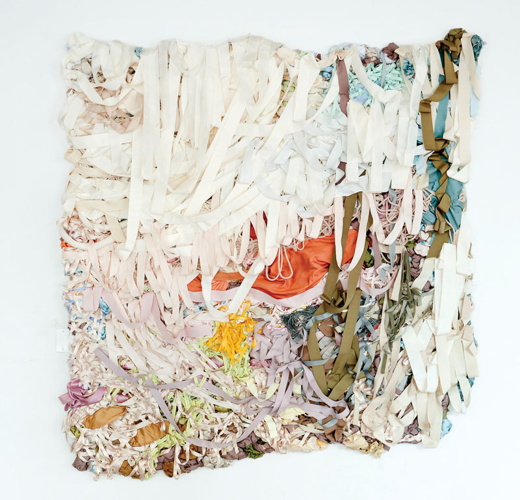
At 7-by-6 feet, "Daybreak" is like a big window that looks out into a luscious, color-filled sky. The eye is drawn first to the top, where thick off-white ribbon plays as broad brushstrokes. The materials become more densely woven as the eye is drawn down, past a gorgeous swath of sun-kissed orange and toward the center of the left corner. Pounds of material are sewn together into a canvas, but "Daybreak" retains an illusion of fragility and effortlessness. In the same way that a woman might spend an hour making up her face for a "natural" look, Turner's ribbon paintings have a deceptively delicate exterior that is achieved by a laborious process.
It's this materiality and labor that connects Turner's paintings to traditional women's work. By using commonplace items associated with femininity, Turner positions us to consider gender as a social construct. This has been a part of her work throughout her career. In 2008, she made a pretty white cake out of tampons, birth control pills and panty hose, addressing the paradoxical nature of feminine beauty versus the messy reality of womanhood. Her "Diploma Eyelashes" calls to mind complicated rites of passage for women and girls, and her vintage quilt-sourced "Sex Swing" resembles much more a crib mobile than a kinky accessory. While I assume the point is to be heavy-handed, I can't help but think her earlier work is too cheeky.
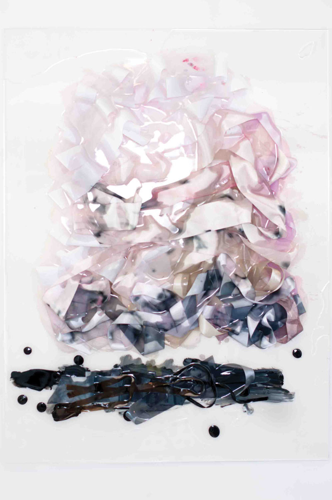
In Time of Day, the theme is rendered with more nuance and subtlety, which allows the work to engage unapologetically in feminist commentary. This is highlighted in a pair of ribbon paintings set in Plexiglas and suspended in resin. "Empty Vessel" could not feel more complete. Pale pink ribbon is nearly translucent when coated in resin, and the composition becomes denser and darker as the eye moves down to a smudgy gray shadow. The piece is pleasing and nonconfrontational. It's like a fairy tale stripped of its darkness for a Disney audience, but still retaining faint elements of its original grit.
But its twin, "Full Vessel," reads as a nucleus of deep reds and blues that's alive with the dread and excitement of beginnings. A splatter of bright red paint mingles with X's of ribbon beneath it, intensifying the corporeal quality. Unlike its delicate and ultra-femme neighbor, "Full Vessel" is disconcertingly sexual. It's a bloody number, signifying the physical truth of fertility, but like a bossy lover, it's also powerful and seductive. The titles of the pair make it obvious that they're about pregnancy, but I don't think that's all — Turner removes the mask of dainty beauty and reveals the messiness and sometimes graphic nature of being a woman. These two steal the show, even more than "Daybreak," because they talk back to one another in a dialogue laced with irony.
Turner's work recalls and builds upon the generations of feminist artists who came before her, but the conversation is far from over.
Email arts@nashvillescene.com



Post a comment as anonymous
Report
Watch this discussion.
(0) comments
Welcome to the discussion.
Log In
Welcome to the discussion.
Keep it clean. Please avoid obscene, vulgar, lewd, racist or otherwise abusive language. Comments featuring hate speech or threatening or violent content will not be tolerated.
PLEASE TURN OFF YOUR CAPS LOCK.
Be truthful. Don't knowingly lie or mislead.
Be proactive. Use the “report” link on any comment that violates our comment policy.
Share with us. We'd love to hear your feedback.