
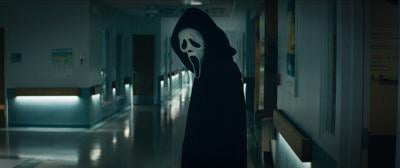

The barometer for legacy sequels keeps shifting all the time. For future reference, let’s set the continuum as follows: At one end is Creed, at the other The Rise of Skywalker. Scream ’22 isn’t a catastrophic failure like the latter, or a left-turn effort like Halloween Kills that unmakes characterizations established over decades' worth of material. But as for having a pertinent reason to exist, there really isn’t one. We’re a few weeks past the 25th anniversary of the original; maybe that’s enough.
The accepted lore about the O.G. Scream is that Bob Weinstein — as he did with pretty much every movie made under the auspices of Dimension Films — was messing with the production, and that a screening of the film’s opening sequence reduced him to silence and kept him (and his brother) out of the way during the rest of production, leading to it becoming the second-ever film (after Pulp Fiction) in the Miramax library to make more than a $100 million dollars. Watching the midsection of the series (2-4), it’s obvious that the Weinstein brothers were taking an even greater presence in the making of the films, and that, coupled with screenwriter Kevin Williamson’s own stacked deck of other projects, left a constantly shifting narrative playing field that perhaps could have used the kind of dedicated and untroubled space the first film was made in.
The metatextual nature of this series has always had to do a lot of the heavy lifting — which is frustrating, because it has always felt like the anchor keeping things in a milieu that studio execs could understand, everything bound to previous films by family ties and the occasional sloppy retcon (think the Saw series) rather than the collective emotional trauma that comes from living in a shunned place. As was one of his gifts, Wes Craven always kept the proceedings thematically focused — which is why we remember 2000’s Scream 3 as breaking unexpected ground in examining the #MeToo era and toxic fandom before the fact, rather than the actual specifics of the script. That film could not let go of blaming Maureen Prescott for having agency (see also: the whole original trilogy, really) and felt the need to bring in Jay and Silent Bob. 1997’s Scream 2 still contains the two greatest moments in the entire series, with its opening sequence remaining the most important 12 minutes in horror history and an essential part of exploring and understanding what horror means, and its rehearsal of Euripides’ Agamemnon, which finds the historical through line that truly elevates Sidney Prescott to iconic.
You need only look at Craven’s clocking of influencer culture (again, before the fact) in Scream 4, or how the remakes of Last House on the Left (barring the utterly stupid test-screening-mandated microwave punishment finale) and the Hills Have Eyes duo to see how he did a better job of understanding what horror was about than anyone else in the game. He found new voices that could remain true to the spirit of the originals even while finding their own way — which is what a producer is supposed to do. His penultimate film, 2010’s My Soul to Take, is waiting to be rediscovered in discount DVD bins nationwide as the remarkable and visionary psychosocial freakout that it is. Not just a Master of Horror, Craven was a master of themes, and that’s one of the big problems with this Scream; there are none.
If the absence of Craven is a major shift in the making of Scream (also known as 5cream, Scream 5 or The New One), it is somewhat balanced by the utter absence of input from the Weinstein brothers. You can’t really call it a complete ground-zero reset — the presence of the grand trio of Sidney, Gale and Dewey keeps us rooted in the ’90s Woodsboro murders — but this effort may very well be more of a piece with the MTV series' take on the material, which was never for me and which I have avoided. Directors Matt Bettinelli-Olpin and Tyler Gillett (of Radio Silence, who made 2019’s delightful Ready or Not, the way-underrated Devil’s Due and the 10/31/98 segment in V/H/S that left me thinking they might could be the ones to make an actual film of The Navidson Record) are an interesting choice for this film. They are good with gore and kinesis, but the repeated avoidance of wide shots in the suspense sequences is confounding, with too many of the kills reduced to being jump-scares from just out of frame.
The biggest problem that you run into with this film is that its third act seems to pivot around something that the previous films emphatically renounced. I step gingerly here, because I don’t want to give too much away, but in all honesty, ever since the second one, these films have been shot so that almost any of the characters could be the killer (to foil internet leaks and consistent characterization alike), and this one’s offerings feel just as ultimately arbitrary. Horror fans can handle cogent criticism (take another bow, Scream 2 opening sequence), but can also recognize a plot that graphs a few points and builds up the rest with whatever — and this film makes a choice that feels antithetical to something addressed explicitly in the first two films.
David Arquette does not get enough credit. He’s a genial personality and a reliable performer (see also Ravenous, At Home With the Webbers and The Grey Zone if you doubt his range), and he’s fucking great in this movie. Of the returning trio of characters from the previous quartet, he’s the one who gets the most to do, and he gives a whole life’s worth of experience between the lines he’s given to speak. (Side note: His 2006 film The Tripper is a work of sublime slasher genius, and is well worth seeking out.) Neve Campbell remains the rock that the Gospel of Ghostface is built on, and Courteney Cox delivers as tabloid media’s own Han Solo. But Arquette is the one who brings it in this film, with a remarkable physical performance that demonstrates the cumulative trauma that horror historically doesn’t often address.
The new cast, Woodsboro’s next generation, is fine. Nobody has the breakout magic of Rose McGowan’s Tatum, the Running Things moxie of Hayden Panettiere’s Kirby, or whatever the folk-magic thing was that Parker Posey did when she took over Scream 3. But Jasmin Savoy-Brown (as Randy Meeks’ niece) and Jack Quaid do good work with unevenly written characters, with Quaid in particular working that Boimler vibe with sweaty material and making it zing. Of all its attributes, what this Scream has in common with its sequel siblings is a messy script — it is very true to the mushy dramaturgy of the series since its first installment. As an R-rated slasher flick, Scream delivers. As a chance to see the latest evolution of the ongoing trauma at the heart of Woodsboro, you get your money’s worth. But as a character says, in what’s meant to be a bit of piss-taking praeteritive autocritique, “The whole series goes off the rails with the fifth one.” And that’s not a knock on the horror-sequel game — I will see any Scream movie that gets made from here on out. But this is truly the beginning of the post-Wes Craven era (despite his death seven years ago), and it’s doubtful we’ll ever see big studio horror working on that same level again.



Post a comment as anonymous
Report
Watch this discussion.
(0) comments
Welcome to the discussion.
Log In
Welcome to the discussion.
Keep it clean. Please avoid obscene, vulgar, lewd, racist or otherwise abusive language. Comments featuring hate speech or threatening or violent content will not be tolerated.
PLEASE TURN OFF YOUR CAPS LOCK.
Be truthful. Don't knowingly lie or mislead.
Be proactive. Use the “report” link on any comment that violates our comment policy.
Share with us. We'd love to hear your feedback.