
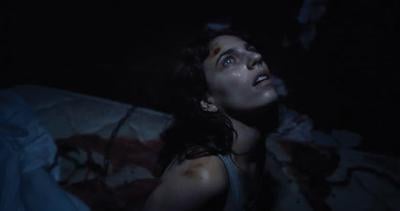

Brock Bodell has synthesized a lifetime of influences and experiences into his feature film debut Hellcat.
The Nashville-based filmmaker’s claustrophobic horror ride is a (mostly) one-location cat-and-mouse game between a Hawksian woman (Dakota Gorman) who wakes up in a moving camper trailer and a mysterious disembodied voice (Breaking Bad’s Todd Terry) communicating via the vehicle’s speaker system. But keep your ears tuned for a small but crucial voice-only role from Nashville native and Saturday Night Live cast member James Austin Johnson as a late-night speculative radio host.
Hellcat alternates between grounded thriller and Lynchian fever dream, making the most of its single location with some creative uses of the trailer’s geography. As summer comes to an end, its warm, atmospheric set design will make for ideal fall viewing.
After a successful global festival run, Hellcat made its domestic premiere on the popular horror-focused streaming service Shudder earlier this month. The Scene spoke with Bodell about his filmmaking influences and the independent production process. This interview has been edited for length and clarity.
Was it always the plan to have the film be a mostly one-location shoot, or did that happen during production?
There are two things that you can really do to help your film in the writing process. … A major part of your budget is going to be the number of locations and the amount of cast that you have. So I was like, “What about one location and one cast member, essentially?” It had to be that way, or we wouldn’t have been able to make it; it’s the nature of a low-budget film.
How did you cobble together a budget for a feature film as an independent filmmaker?
I’ve been a video editor and a writer, to various degrees of success, for almost 20 years now. One thing that I’ve always wanted to do is make a feature film. And I’ve always wanted to make a horror film, because I grew up watching horror. It was my thing from being an 8-year-old watching Tales From the Crypt and then watching MonsterVision with Joe Bob Briggs in high school, and Scream blowing my mind. … It just so happens that low-budget indie horror has always been my thing. Luckily, that’s kind of the easiest thing to make, budgetarily, because horror audiences are generally pretty forgiving. But indie horror also does a lot better than most indie films. There’s more of a marketplace out there for them. And I just reached this inflection point in my life, in my career, where I was like, “I gotta make this movie.” And I’d had some close calls with getting [other scripts made], and ultimately, I had to invest in myself. I got some money together, took a loan, and really took a pretty significant monetary risk on myself. What we were able to pull off, though, was because we had such great and supportive people who were really down to make this movie.
How much of the cast and crew were local?
One-hundred percent of the crew was local. In the cast, we had Liz Atwater, who is local. And then our lead, Dakota Gorman, is from New York by way of L.A. And then we had Todd Terry, who is from Texas. And that was not because there’s not a great acting pool here. There’s a lot of great actors in Nashville. It just so happened that Dakota and Todd jumped off the screen at me.
I went through a casting director here in Nashville named Marisa Munoz, and she was really helpful. When you have one person and one location, the location has to be awesome, but the person has to be incredible. That location could have been not as good, and we would have been fine because Dakota was able to carry the film on her back.
What were some of the influences on the movie?
I worked in college radio, and I’ve always really loved movies like John Carpenter’s The Fog and Pontypool and even Airheads that use the radio DJ angle, especially the late-night DJ. I put a lot of little Easter eggs in this movie, of just things in my life because I was like, “Hey, this might be the only time I ever get to make a movie.” So I want to just put my everything into it.
[David Bruckner’s 2017 film] The Ritual, I remember seeing [the flashback scene] in that and thinking, “I have never seen anything like that, and I am going to do that.” … Lynch is always an inspiration, but you can only get so close to what he did without potentially derailing a movie completely into this surrealistic, weird, dissociative thing. … I have to say that 10 Cloverfield Lane was one that has a very similar structure. I wasn’t thinking about the movie while I made it, but it was a subconscious influence. … I’m a huge John Carpenter fan, a huge Wes Craven fan. I like a lot of recent folks too, like [Demián Rugna]’s film, When Evil Lurks. I love the milking of tension, and that was one thing I really tried to do with Hellcat. I wanted to see how far you can stretch and how little we can divulge.
What’s next?
I have some funding for the next one, which is very exciting. We’ll be shooting here or in Kentucky. I will 100 percent be shooting in Nashville, whether it’s the majority of it or the whole thing. I’ll be taking my crew back out there, because the people I worked with were awesome. We had such a great, fun set, and everyone was so cool. … We made this movie in a trailer in Nashville, Tenn., and it played in Cairo, Egypt.



Post a comment as anonymous
Report
Watch this discussion.
(0) comments
Welcome to the discussion.
Log In
Welcome to the discussion.
Keep it clean. Please avoid obscene, vulgar, lewd, racist or otherwise abusive language. Comments featuring hate speech or threatening or violent content will not be tolerated.
PLEASE TURN OFF YOUR CAPS LOCK.
Be truthful. Don't knowingly lie or mislead.
Be proactive. Use the “report” link on any comment that violates our comment policy.
Share with us. We'd love to hear your feedback.