
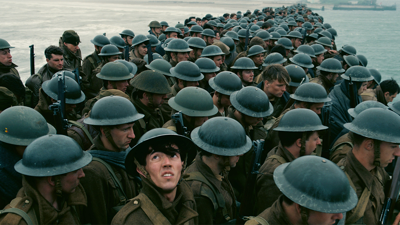


Few things in cinema chill the spine like a beautiful shot in a war movie. It is a painting on canvas that the viewer knows is soon to be shredded by shrapnel and stained with blood. This occurred to me just a few minutes into Dunkirk, Christopher Nolan’s new film and arguably his best. The film’s opening scene provides just such a beautiful, albeit austere image — and the chill too.
After fleeing German gunfire through the streets of a deserted town, a young British soldier (Fionn Whitehead) makes it to the friendly side of a barricade. A few steps more and there, laid out before him, is Dunkirk beach — the dark water against the light sand, a British fog wafting over from across the channel and hundreds of thousands of men arranged in single-file lines leading up to the water’s edge, waiting for boats that are nowhere in sight. The image is suitable for framing, but one needn’t know anything about the historical events of May 1940 to feel the creeping sense of dread. Confirmation comes soon from the distant whine of German planes, heading in for a bombing raid.
Unlike Nolan's past work — save The Dark Knight Trilogy, based on a true story in our hearts — Dunkirk shows the writer-director working with real events. Having been backed up to the French coast by German forces in the spring of 1940, some 400,000 Allied soldiers were left stranded on Dunkirk beach — a situation British Prime Minister Winston Churchill would later describe as “a colossal military disaster.” Nolan’s film tells the story of the harrowing effort to evacuate the beach, one that ultimately called upon a number of small boats with civilian crews to cross the channel and retrieve their countrymen. It would later come to be known as the Miracle of Dunkirk.
But Nolan is not hemmed in by historical source material, and the genre leaves him no less willing to bend the concept of time to fit his own purposes as a storyteller. What might’ve been a straightforward and familiar tale of heroism in other hands is original and innovative in Nolan’s, as he unspools the narrative in three separate strands, each at a different speed. In Dunkirk’s less-than-two-hour runtime — also innovative, at least for Nolan — we spend: one week on the beach, with the men (including Whitehead, Harry Styles and Kenneth Branagh) trying to evacuate; one day on a small private boat captained by a British man (Mark Rylance), his son and his son’s friend; and one hour in the sky above the channel where two fighter pilots (Tom Hardy and Jack Lowden) are trying to provide some semblance of air cover for their bobbing compatriots below.
If that sounds confusing, here’s the good news: It’s executed to perfection, and Nolan has the confidence in his movie — and trust in his audience — to let it play out. Dunkirk is blessedly subtle, free from clunky exposition and clutter. Not a word, image or sound is wasted. This approach contributes to everything that’s great about the film. Despite its epic subject matter, it’s tight throughout and never overdramatized. Hans Zimmer’s score should be among the many things this movie wins awards for, and one reason is because, not surprisingly, it avoids cliche and easy emotional manipulation.
There are times in war movies when the viewer can find relief in the swelling victorious music as the protagonist blows a bad guy out of the sky. Dunkirk offers no such refuge, and in fact, its quiet moments stand out. After Hardy’s skilled pilot downs an enemy fighter, the silence in his cockpit forces the viewer to confront a terrifying truth. He is still one man in a plane, flying over dangerous water in treacherous skies with no backup on the way. Dunkirk does not pummel the audience with graphic violence, but rather pricks the viewer with these subtle horrors of war — the desperation of a man stripping off his gear and walking hopelessly into the ocean, or the futility of ducking on a beach as bombs drop from overhead.
The miracle of Dunkirk is that it is nevertheless triumphant and hopeful.



