
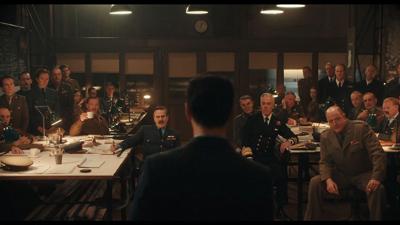

Good war movies always show how much of history follows from the smallest contingencies. Now base everything — an invasion, a war, humanity’s future — on analog weather data, and out comes Anthony Maras’ Pressure, a D-Day historical drama based on David Haig’s stage play of the same name.
Suspense depends on an audience that can’t quite remember its history. Two weathermen, honest Brit James Stagg (Andrew Scott) and obedient American Irwin Krick (Chris Messina), compete for credibility in the tense days leading up to the Allies’ invasion of Normandy. President Eisenhower (Brendan Fraser) has meticulously prepared to launch thousands of troops, air cover and fleets from England, and is sweating the one thing he can’t arrange in advance: clear weather across the English Channel in early June.
With an unseasonal pressure system moving in, obsequious Krick is willing to give the general the all-clear, cherry-picking charts along the way. Stagg, however, won’t budge from a gloomy forecast that predicts towering waves and thick cloud cover along the French coast — the recipe for an Allied slaughter and exactly the news an ornery Eisenhower doesn’t want to hear. This premise sets up a straightforward conflict and a pleasing climax, heightened by Stagg’s speech about trusting science over the pull of a confirmation bias — so long as viewers don’t spoil Eisenhower’s climactic decision by remembering the invasion’s actual date.
Stuffed with cotton dress uniforms, countryside finery and the whirring instruments, maps, charts and machines of the 1940s, Pressure briefly disguises war as an alluring high-stakes parlor game somewhere between poker and chess. Maras does well to puncture this illusion with contemporaneous shots of detained Allied troops numbing their anxiety with liquor while they wait for Eisenhower’s ominous order. When German bombers strike a nearby maternity ward, leaving Stagg’s pregnant wife unaccounted for, it adds pressure of a third kind, forcing him to display an inhuman commitment to the broader war effort.

Few things in cinema chill the spine like a beautiful shot in a war movie. It is a painting on canvas that the viewer knows is soon to be shre…
As Stagg, Scott executes an excellent leading performance, albeit next to a mostly one-dimensional cast that includes Damian Lewis. (The two previously invaded Normandy together with Easy Company in Band of Brothers, Steven Spielberg and Tom Hanks’ classic miniseries.) One exception is Kerry Condon as Kay Summersby, Eisenhower’s aide-de-camp and a subtly effective mitigating force within the apparatus.
Teamwork, sound leadership and all sides of masculinity are tested as Hollywood finds yet another angle from which to dramatize World War II heroics. Eight decades after the invasion itself — a success, it turns out, thanks to an unexpected break in the clouds — the world wars keep getting turned inside-out by entertainment executives. While Pressure may not rise to compete with modern wartime classics like Dunkirk, 1917 or All Quiet on the Western Front, it’s still good enough to terrify a typical American into admiration for the difficult decisions and miraculous luck that shaped generations of relative peace. Its stressful 100 minutes leave a single impression: Let’s never, ever do that again.



