

The first time I saw The Royal Tenenbaums, my first Wes Anderson film, I left the theater wiping happy tears from my cheeks. I had never seen anything like it. I felt buoyant and full of energy, and I wanted to call all three of my siblings to tell them I loved them immediately.
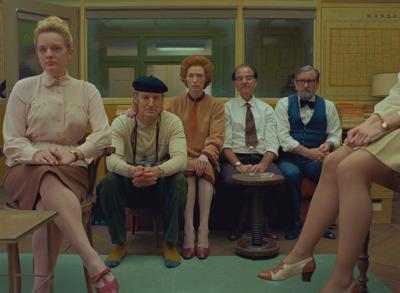
Some six weeks shy of the 20th anniversary of The Royal Tenenbaums’ release comes Anderson’s newest venture, The French Dispatch. Set in the fictional town of Ennui-sur-Blasé, France, the film illustrates the last three features in the Sunday insert of a Kansas newspaper. The French Dispatch, as the insert is called, was created by its editor, Arthur Howitzer Jr. (Bill Murray). We are introduced to the town and each of the newspaper’s eccentric writers in Andersonian fashion, with a brief list of specific, blink-and-you-miss-it details that unfortunately get lost in the cacophony of this busy film.
Howitzer loves his quirky band of writers and tolerates their idiosyncrasies. One has filed her story 9,000 words over the assigned word count. The editor won’t cut a thing. Another has again waxed poetic about “hobos, pimps and junkies” of the town. “Those are his people,” Howitzer says with finality. We quickly head into the first of three stories — the best one. It features Benicio Del Toro as Moses Rosenthaler, a mentally ill man in prison for double homicide who happens to be a groundbreaking avant-garde painter. His muse is prison guard Simone (a sublime Léa Seydoux), and every work is an abstraction of her. Serving time in the same prison for tax fraud is art dealer Julian Cadazio (a flawless Adrien Brody), who discovers Rosenthaler in an inmate art show and decides to make him famous — and make himself and his uncles rich. The story is both surprising and feels true, for Anderson’s script handles backstory and dialogue economically, like a skilled short-story writer.
In the second story, journalist Lucinda Krementz (Frances McDormand) investigates a student uprising and begins sleeping with its leader Zeffirelli (a cloying Timothée Chalamet). Zeffirelli and his compatriots are thin approximations of real people, so committed to being stereotypes that they and their cause are trivialized. Krementz — an old maid who chose journalism over love — is nothing we haven’t seen before. McDormand’s usual deadpan realism can’t save her, but I bet some more workshopping of the screenplay could.
The third story stars Jeffrey Wright as Roebuck Wright, a gay Black American who expatriated because, like James Baldwin, living in the U.S. was simply unbearable. His is a food story that is not about food, but a tale about a dinner gone wrong when the chief of police’s precocious son is kidnapped. Partly animated, the ensuing chase is a dizzying romp that’s enjoyable, if unbelievable. Wright leaves us with a final comment that out-Baldwins Baldwin and hints at what the film might have been if Anderson got out of his own way.
Other usual suspects appear in smaller roles: Owen Wilson (always at home in an Anderson film), Willem Dafoe (on brand and brooding), Edward Norton (could have been anybody), Jason Schwartzman (around for moral support, I suppose) and Anjelica Houston (as a narrator). Like Henry Winkler, Bob Balaban and Elisabeth Moss, they’re crammed distractingly into the film.
If you love Wes Anderson movies, you will find things to love. If you are tired of the twee details, the studied narrative voice, the overly particular characters, you will find little endearing from the director this time around. I did not think myself so jaded, but The French Dispatch’s set pieces, conceits and props clutter up the joint and prevent the director from giving us a story with heart.
For all of the preciousness of The Royal Tenenbaums — the book jackets laid out like wallpaper, the personal artifacts displayed as if in a museum, the matching tracksuits — that film’s gut-punch amounts to more than the sum of these parts. Drug addiction, adultery, forbidden love, fraud, self-pity — whatever their vices, the Tenenbaum clan realize all at once that the jig is up. To surrender means to toss their resentments and disappointments into a burn pile and be cleansed by the fire. We want that for them. As a result, we want that for ourselves and for those we keep loving in spite of their indifference to us. We could pinpoint such an apotheosis in Anderson’s early films: Bottle Rocket, Rushmore, The Life Aquatic and even the middling The Darjeeling Limited.
Anderson is capable of creating a world that is both in love with itself and about much more than itself. There’s plenty to enjoy in The French Dispatch — but if you’re looking for catharsis, you may find yourself out of luck.



Post a comment as anonymous
Report
Watch this discussion.
(0) comments
Welcome to the discussion.
Log In
Welcome to the discussion.
Keep it clean. Please avoid obscene, vulgar, lewd, racist or otherwise abusive language. Comments featuring hate speech or threatening or violent content will not be tolerated.
PLEASE TURN OFF YOUR CAPS LOCK.
Be truthful. Don't knowingly lie or mislead.
Be proactive. Use the “report” link on any comment that violates our comment policy.
Share with us. We'd love to hear your feedback.