
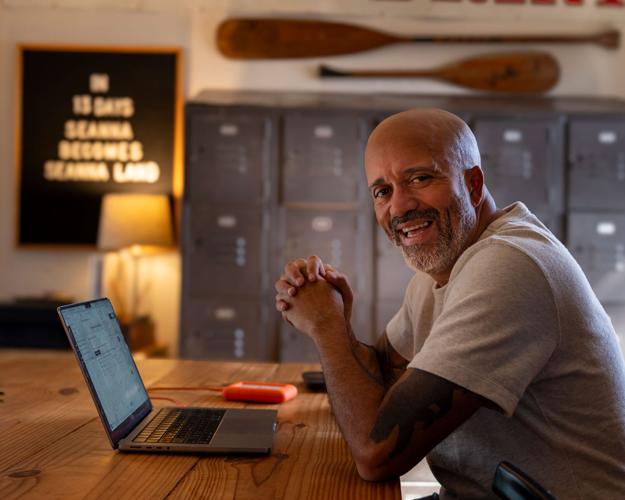


Carlos Whittaker photographed at his Crieve Hall home
Anyone out to reduce their screen time might come across Carlos Whittaker and his 2024 book Reconnected. The book — a mix of self-help memoir, gonzo journalism and reflections on faith — recounts Whittaker’s seven-week experience going device-free and living with Benedictine monks and the Amish during the summer of 2022.
The experiment was inspired by a notification about his average daily phone usage: 7 hours, 23 minutes. With some back-of-the-napkin math, he figured that meant 100 days per year. In the book, Whittaker recounts the panic he felt disconnecting from his sizable Instagram following (349,000 followers at the moment).
“One of the things that terrified me at the beginning [and] that was balm to my soul by the end was silence and solitude,” Whittaker tells the Scene. “It’s actually a gift that we no longer have access to.”
He’s since made small but meaningful changes to his daily life. He doesn’t use his phone or even turn on the radio during short drives. Every year, he learns a new hobby that requires both hands — especially one that gets his hands dirty, like beekeeping or car repair. He uses an alarm clock and charges his phone outside the bedroom.
“I’ve lessened my screen time tremendously,” he says. “I’ve gotten probably four hours a day back.”
Whittaker is not anti-tech. He’s a very popular figure on social media and leverages his following for charitable causes. He’s even a self-described “Claude power user,” referring to the large-language model that’s proven to be a handy coding tool. Companies hire him as a motivational speaker to address “AI fatigue” as these tools become more commonplace, and Whittaker stresses to audiences the need to focus on what makes them human. He talks about “lost art forms” like wondering about topics without Googling the answer, or navigating without GPS. He thinks AI-generated books and movies will become common (which sounds like a bummer), but he also thinks the desire and need for face-to-face interactions will increase (which sounds nice).

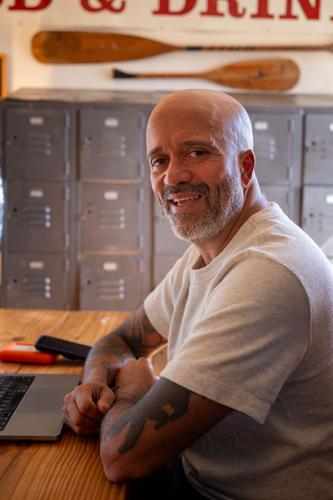
Carlos Whittaker photographed at his Crieve Hall home
Whittaker’s approach to emerging technology was influenced by his time with the Amish. One day he was surprised to see a farmer pull out a flip phone. He soon learned that each Amish order determines its own rules about acceptable technology use — business owners may have permission to make phone calls, for example. Whittaker mentions another nuance in how Amish communities are adopting e-bikes but still eschewing cars. The Amish aren’t so much anti-technology as they are averse to tools that “take them away from their community,” he says. The idea became Whittaker’s North Star. “When I am entering into new technology, the question I ask myself is: Is this piece of technology going to take me farther away from who I want to be, or is it going to keep me close to my community and who I want to be?”
That focus on community can be seen in Whittaker’s social media presence. He filmed his visits to check in on his mother and older neighbors during the late January ice storm, and voiced relatable frustrations and concerns with the multiday delay to restore electricity to homes. His Christmas decorations — including giant inflatable characters and a scoreboard counting down the “sleeps ’til Christmas” — made him a fixture of the Crieve Hall neighborhood. When his 20-foot-tall snowman decoration ripped, he filmed a video pouring one out for the deflated Frosty and woke up to Venmo donations for a replacement. He spun that momentum into a charity drive for Middle Tennessee families.
Faith is a big aspect of Whittaker’s writing and social media content. The son of a Baptist preacher, he moved to Nashville from Los Angeles in 2010 to pursue a Christian music career. But Whittaker’s next book — his seventh overall — is a bit more secular. Titled Burn the Blueprint, it pushes back on that classic American notion that professional adults need to follow some professional roadmap to find happiness or fulfillment.
Slated for September, the book is about “helping people build a compass instead of burning a blueprint.”
“It’s my first book that’s not a memoir,” says Whittaker. “It’s my first book that I thought, ‘You know, I’ve lived enough life that I think I’ve got some things to say that I didn’t learn from monks.’ That I can just kind of take the salt-and-pepper beard and talk a little bit.”

Profiling some of Nashville’s most interesting people, from a Paralympic gold medalist and a longtime horror host to a 'Drag Race' alumna and more



Post a comment as anonymous
Report
Watch this discussion.
(0) comments
Welcome to the discussion.
Log In
Welcome to the discussion.
Keep it clean. Please avoid obscene, vulgar, lewd, racist or otherwise abusive language. Comments featuring hate speech or threatening or violent content will not be tolerated.
PLEASE TURN OFF YOUR CAPS LOCK.
Be truthful. Don't knowingly lie or mislead.
Be proactive. Use the “report” link on any comment that violates our comment policy.
Share with us. We'd love to hear your feedback.