

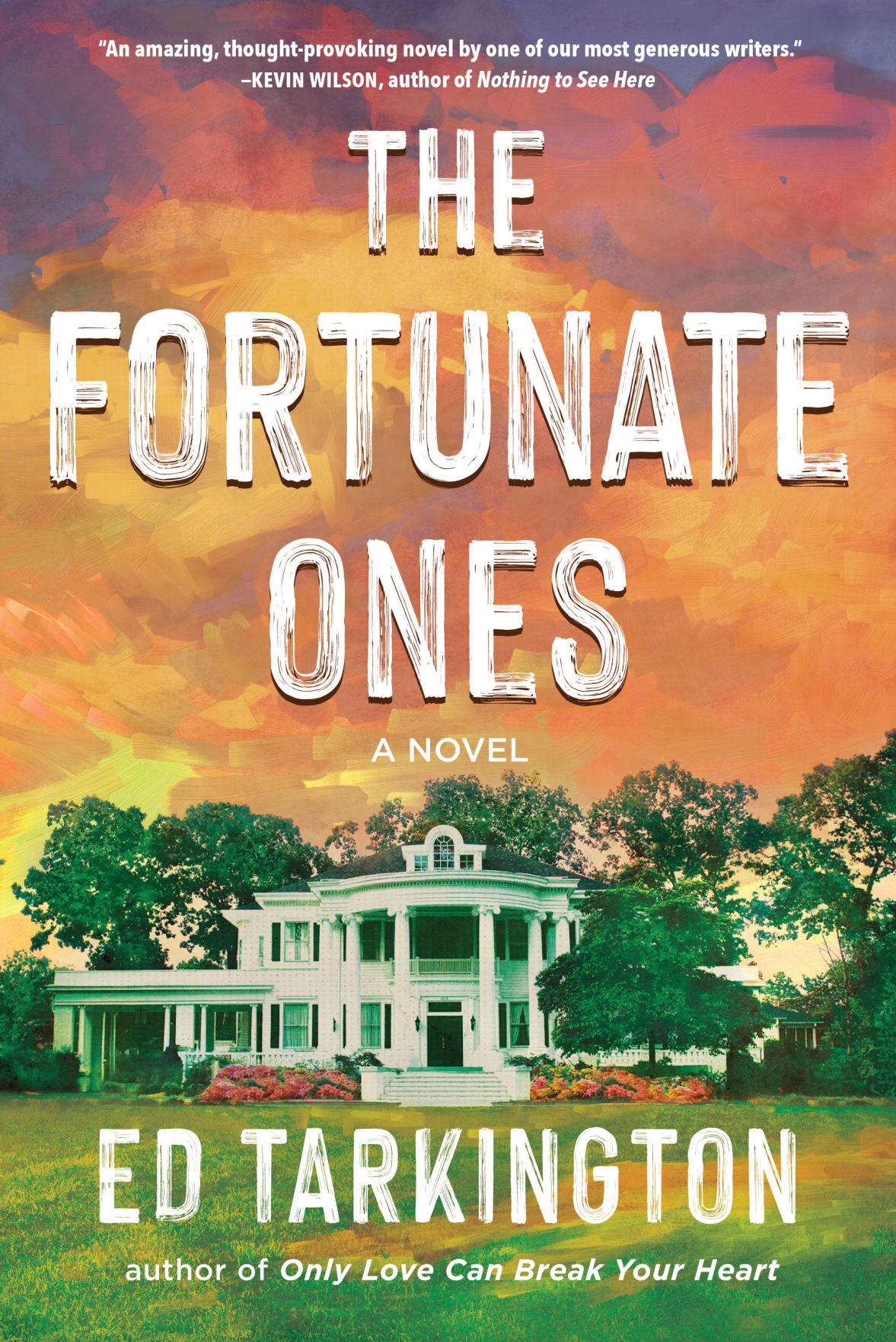
Midway through Ed Tarkington’s novel The Fortunate Ones is a telling exchange between Vanessa, a 20-something product of new Nashville wealth, and Charlie, the outsider artist who has loved her for years. After shattering him with news of her engagement, Vanessa goes on to correct Charlie’s use of “congratulations,” noting that “best wishes” is the polite phrase reserved for the bride-to-be.
This gilded little knock relays the novel’s class tectonics. The story centers on Charlie, Vanessa, her blueblood fiancée Archer and a community shaped by its relationship to an elite prep school, Yeatman. We follow Charlie’s scholarship-fed enrollment in the ’80s and meet the patron network that elevates him and his mother from low-rent apartment life to tony Belle Meade society. Decades after graduation, Yeatman will pull everyone’s orbit in the political space, whether candidate or backer, community activist or — in Vanessa’s case — veneered wife. The Southern sense of tragedy adds to the Gatsby-esque tale, as does the transformation of contemporary Nashville itself.
Given that Tarkington and I write about the South in different ways (full disclosure: he reviewed my novel for the Scene earlier this year), I was excited to ask him about The Fortunate Ones. He answered questions via email.
In writing this novel, you have lived and breathed every character, scene and sentence for some time, telling a story that spans decades. Here’s the author’s challenge: Can you describe The Fortunate Ones in a sentence?
Long version: It’s about the collateral consequences of great hubris, the limitations of perspective, the love-hate relationship between the have-nots and the haves, the often-destructive allure of wealth, and the perils of noblesse oblige. Short version: It’s a cross between The Great Gatsby, Brideshead Revisited and All the King’s Men.
What makes Nashville a distinct setting? What was it like to write about the place you call home?
I initially chose to write about Nashville because I love it, and because its representation in other media strikes me as being largely shallow and inaccurate, and I wanted to correct or broaden that understanding somewhat. But at the outset, the choice felt pretty circumstantial. I thought the story I had to tell could just as well have been set in Atlanta or Birmingham or even outside the South. Looking at it now, however, I feel as if Nashville became a character in the novel — perhaps the main character.
Charlie, Archer, Vanessa and other characters are driven and defined by class status and love. How do the expectations of the former dictate the boundaries of the latter?
Charlie falls in love with the image people like Arch and Vanessa embody and allows his sense of self-worth to be tied to their attentions and affections. He buys into the notion of their exceptionalism and cannot imagine himself happy outside of their world, even if he can never truly be one of them. I think this is really the source of his bitterness at the outset of the novel. The story he has to tell is the process by which he finally achieves self-awareness and a sense of self-acceptance and, I hope, something approaching redemption or even grace.
How does this novel address, complicate, and/or critique the “Southern way of life,” a phrase taught to Charlie and the others from adolescence?
The deconstruction and demolition of so many of the myths about Southern culture and identity have been ongoing in literature for a long time but seem to have accelerated in the public consciousness at a stunning rate in the years since I started writing The Fortunate Ones. Perhaps the most troubling epiphany for white Southerners has been the widespread acknowledgment of the degree to which our culture continues to be influenced by white supremacy. This is a hard truth to swallow for basically decent, fair-minded people who have grown up unconscious of the extent to which they have historically benefitted and continue to benefit from a status quo foundationally rooted in a moral evil, one which still infects so many of us through our inherited biases. It really is an experience of grief, processed according to the Kübler-Ross model: denial, anger, bargaining/rationalization, depression and, finally, acceptance.
One major storyline follows Archer’s ascension into national politics. Was it difficult to turn politics into plot at a time when the subject carries such tremendous baggage?
I started this book long before Trump was elected. Honestly, if I’d seen it coming, I’d probably have written another book. A few years ago, real-life politics felt too surreal for realistic fiction about politics to be of any use. But now, I feel like this book has turned out to be much more pointed and relevant than I imagined, even before the ascendance of Trump. A novel which traces the evolution of a charismatic businessman who jumps into politics and rises to power through sheer force of charm, boundless entitlement and a ruthless conviction that the ends justify the means — that story feels right on time.
What is the state of storytelling in the South? What dynamics are constant or changing?
To me, Southern writing isn’t really so much about setting as it is about the music of Southern language: the slow cadence, the lyricism, the juxtaposition of genteel, elevated diction and the alliterative rhythm of the rural voice that is at once homespun and Homeric. This is why someone like, say, Richard Ford can write about New Jersey or Montana or Ireland and still be writing what I consider Southern stories and novels. It’s the same reason that Colum McCann can write about New York and still be writing what are essentially Irish stories and novels. Ireland and the American South are much alike in the distinct musicality of their language idioms.
Regarding Southern culture or subject matter: As the South goes, so goes the nation. Walker Percy is a great hero of mine. One of my favorite Percy anecdotes is the story about his Today show appearance after he won the National Book Award for The Moviegoer. When rather condescendingly asked why the South produces so much great literature, Dr. Percy tersely replied, “Because we lost the war.” What Dr. Percy may not have understood then as he might today was that the real war never ended, and now, it has no armies or battle lines. Perhaps it never did.
Today, I think, stories set in the South should be recognized not as stories about a particular place and time, but as microcosms of the great crucible in which all Americans now labor in our ongoing struggle over the future of our country’s divided soul. Those stories can be chastening and ominous, but they can also be hopeful. And for my part, I choose hope. I’m thinking now of what the great John Lewis said in a conversation with our friend Margaret Renkl in November 2016: “You have to be hopeful. You have to be optimistic. If you lose that sense of hope, then it’s like not existing at all.”
To read an extended version of this interview — and more local book coverage — please visit Chapter16.org, an online publication of Humanities Tennessee.



Post a comment as anonymous
Report
Watch this discussion.
(0) comments
Welcome to the discussion.
Log In
Welcome to the discussion.
Keep it clean. Please avoid obscene, vulgar, lewd, racist or otherwise abusive language. Comments featuring hate speech or threatening or violent content will not be tolerated.
PLEASE TURN OFF YOUR CAPS LOCK.
Be truthful. Don't knowingly lie or mislead.
Be proactive. Use the “report” link on any comment that violates our comment policy.
Share with us. We'd love to hear your feedback.