


In this week's print issue, we have a short dispatch from Monday's Youth Violence Summit at Pearl-Cohn High School. Over the course of two hours, two sets of panelists discussed issues ranging from the impact of absent fathers to a criminal justice system that can exacerbate the problem.
The summit featured a whole host of comments drawn from professional and personal experiences, many of which are worth highlighting. Mayor Megan Barry says it's just the beginning, with more events to come and the goal of formulating a "concrete action plan" by early March.
For now, here are five quotes from people who took part in the summit that stood out:
Mayor Megan Barry:
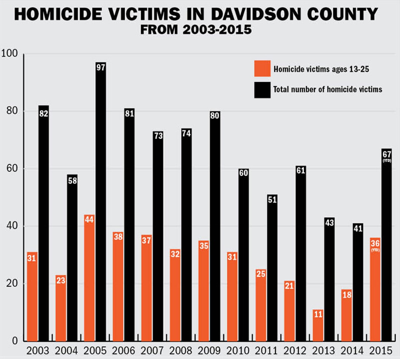
We do a lot of things right in Nashville. We’re still a warm and welcoming place. People still want to live here. But we still have a lot of work to do. After two years in a row when our homicide rate had dropped below 45, that number has climbed to 67 in 2015.That’s 67 people whose families will never see them again. That’s 67 people who will never laugh again and many of those 67 people were young. Thirty-six of them were between the ages of 13 and 25.
Including Georgio Gray who was shot and killed outside his apartment in East Nashville on Saturday. Georgio was 22. Georgio was just the most recent young person who died violently this year. Treyonta Burleson lost her life to a bullet six weeks ago, a bullet that was fired in the street over an argument. She was 14. Cameron Selmon was killed early one October morning on a college campus, gunned down over a game. Cameron was 19. Brandon Williams was killed by gunfire inside a nightclub last spring. Brandon was 17.
There are 32 other names of young people that I could read, that I could mention. These are children. They died violent deaths in 2015. All too often, however, young people were also on the other end of the gun. And we all know that homicides don’t happen in patterns that reflect the makeup of our population. Fifty-one of those 66 victims that I just talked about were African American. That’s more than 77 percent.
As a city, as a community, as a people who care deeply about each other’s health and safety, we can’t stand for this. We need to be doing everything in our power to make sure we don’t hear these kinds of numbers and stories anymore. Tonight is the beginning, it is the beginning to take a hard look at what we can do. We won’t find a solution before we leave this auditorium tonight. But what we will do is start an extremely important community conversation about how to make Nashville safer. I want our community conversation to capture the feelings of hopelessness that exists in some parts of our city. I want to define the problem of youth violence in meaningful ways, I want us to ask the right questions and I want to create a sense of how we can go forward and make a difference in this city that we all care deeply about. And I also want us to solve this problem.
Daquan Summers, Hillwood High School senior :
Let me first say, they say that I’m the voice of the youth. Now let me say in order to be a voice of the youth, I have to go through the things that youth go through today. So let me not simply say that I’m perfect, OK? I’ve had the odds stacked against me since I was born, all right? I was born to a single mother, she had two of us before she was 18, I had my first felony at age 12, OK? I had no positive role models in my life, growing up. I got kicked out of almost every every elementary school in Murfreesboro and it’s no lie.And I had my mom always constantly telling me positive, positive, positive. But it went in one ear and out the other because there was no man in my life, nobody really there constantly telling me what I need to do right. And you finally just wait ‘till that last moment to fix yourself but then it’s too late. And now when it’s gotten to the point when it’s too late, now we want to fix it. Well now at least we’re trying.
I’m here to tell you that there is hope. You think there’s no hope left? There is hope. There are people out there that want to get better. Everybody doesn’t want help, but it’s OK. Because as long as we fix and change the direction of some, the people that don't want help [are] gonna look up to them and they’re going to change their life around. So we’re just inspiring others to do better with themselves.
Howard Gentry, Criminal Court Clerk:
I think many of you already know the programs I’m involved in. One is Criminal Court Clerk and that’s more adults. But we’re involved with bringing justice to you, which takes the struggle of criminal records and drivers license issues off of parents. Because I believe that if you free the parents, you free the children. If you take the pressure of parents, then you take the pressure off of children. If you can move the adults out of poverty, you move the children into another life.
Pastor Frank Stevenson, St. Luke Primitive Baptist Church:
One year ago three murders occurred in a two-week time on the same street. I had the unfortunate responsibility of presiding over all three of those funerals. Six weeks ago I got a call and went to the hospital and when I got there Treyonta [Burleson]’s mother, Rita, of the 14-year-old that was murdered said, ‘Pastor, my baby is back there, will you go back there with me?’ We walked back there and I looked and saw the lifeless body of this 14-year-old. Hair braided, sweatshirt, innocence. And I thought to myself, the cemetery is stealing the value out of so many that have so much to offer.Rita looked at me and said, 'Pastor Stevenson, what am I going to do? How can I live without my baby?' At that moment I felt like I had failed her because I didn’t do enough. She called me two years ago and asked me if I would give her daughter a summer job to keep her out of trouble. She came to work for me and did a pretty good job, you know how it is with teenagers, they want to get paid before they work and all that stuff.
I wanted to share that story because I wanted to make sure that you understand and that we all understand that collaboration is so important. Not fingerprinting, but all of us pulling in the same direction and if one child dies all of us have failed. If one child dies, then it doesn’t just fall on one [inaudible], it falls on all of us. My prayer is that none of you will ever have to experience standing in a room with a mother who’s lost a 14-year-old. This city is greater than that and we are greater than that.
Dawn Deaner, Metro Public Defender:
Why are we making kids felons? Why are we making young people felons? We choose to do that and there are not a lot of laws that exist in the state of Tennessee today that allow you, if you are a felon, to not be a felon anymore. That’s a label that goes with you everywhere.One thing that I hoped would come out of this is a conversation about how not to make our kids felons. And about, when we talk about youth violence, the one thing that I wanted to be able to say tonight is that our kids are seeing violence on their streets and in their neighborhoods and they're not just seeing that violence at the hands of each other or at the hands of their parents. They are seeing that violence in militarized neighborhoods with interactions with law enforcement oftentimes that are violent. We have to do something about that. That contributes to youth violence when kids look around and see that in their neighborhoods they can be stopped, they can be frisked, they can be handcuffed, they can be assaulted. They see that of the adults living in their neighborhoods. That’s violence. That’s what they’re seeing and that’s part of what they’re learning from. So I think that needs to be part of the conversation as we go forward.


Post a comment as anonymous
Report
Watch this discussion.
(0) comments
Welcome to the discussion.
Log In
Welcome to the discussion.
Keep it clean. Please avoid obscene, vulgar, lewd, racist or otherwise abusive language. Comments featuring hate speech or threatening or violent content will not be tolerated.
PLEASE TURN OFF YOUR CAPS LOCK.
Be truthful. Don't knowingly lie or mislead.
Be proactive. Use the “report” link on any comment that violates our comment policy.
Share with us. We'd love to hear your feedback.