
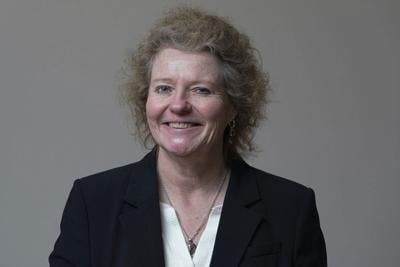

For nearly 40 years, Teresa Walker has covered just about every sport across the state of Tennessee and beyond. She has been front-and-center for seven Olympics, six Super Bowls, Pat Summitt’s Lady Vols dynasty and the Titans’ Music City Miracle.
After beginning her career at The Daily Times in Maryville — where she covered school board meetings, chronicled the police department, took photos and even laid out advertisements — Walker moved to Nashville in 1989 to work for the Associated Press. She took over as the state’s AP sports editor in 1992, a role she held until her recent (partial) retirement this month; she’s finishing out the Tennessee Titans season as a freelancer.
“I was six weeks away from leaving journalism when the Associated Press called,” Walker tells the Scene by phone one afternoon in October.

Talking with Nashville Sports Council CEO Scott Ramsey ahead of a packed Labor Day weekend slate
In the early days of the gig, the University of Tennessee alum cobbled together a sports section out of Vanderbilt athletics, Nashville Sounds games, PGA and LPGA Tour events, high school football and more while moonlighting on the AP’s news desk. But the arrival of three top-flight professional sports teams in quick succession — the Tennessee Titans (at the time still called the Oilers) in 1997, the Nashville Predators in 1998 and the Memphis Grizzlies in 2001 — dramatically changed the beat. Walker, a one-person sports bureau, shifted her attention to sports full time.
“Part of the job, in addition to just covering the sports, has been finding, curating, working with and building a relationship with people,” says Walker. “The fun part is going to the games. Now that I’m retired, that’s the part I get to do now.”
With just a few Titans home games left in Walker’s nearly four-decade AP stint, we spoke with the journalist about her career, the future of the beat and more. This interview has been edited for length and clarity.
When did you first know you wanted to be a journalist?
I love asking questions. I even tried to have a newspaper in my neighborhood when I was a kid. So that’s how nosy I really am. … A long time before I ever saw All the President’s Men or any of the great journalism movies, I always knew that I wanted to be a journalist because I love talking to people and telling stories.
When the pro teams arrived, how did that change the beat? Was there a sudden influx of sports reporters?
Well, it was more of a redistribution. [Publications] did staff up because there was much more to do in town. I was suddenly covering an NFL team, but earlier in the ’90s, Memphis had lost out in the bidding for an NFL expansion franchise to Carolina and Jacksonville. My bureau chief had told me if Memphis wins their bids, then you will be moving to Memphis. So I ended up being able to stay in Nashville and have an NFL team move to me.
With so many sports going on, how did you decide what took precedence and what didn’t?
I refer to what I did for AP as a buffet table. My job was to triage and be exactly where I needed to be when. And if I wasn’t at some place because I was, say, at the Titans, I made sure I had somebody at, say, the Lady Vols.
When it comes to print reporters especially, you were often the only woman on the beat in town. What was that like, and what did that mean to you?
Well, two things. Yes, I noticed, and I was incredibly grateful when I started seeing more women coming through. But on the other hand, I had a job to do, so I tried to keep my head down and do it. Journalists, we’re not trying to make friends. We’re competing with each other. That said, I try to be friendly, but I was very, very happy when we started getting more and more women on the beat. … For a while there, it felt like we could not have more than two women in journalism in sports in Nashville. A few years ago, there were so many women in media that we took a big group picture, and it was really awesome to see that many women working in sports media, no matter the format. It was lonely, but I was doing what I loved, and, for the most part, people were accommodating.
What do you see for the future of the beat in Nashville?
Media is being challenged this year more than ever before. I wish the industry had done a better job of finding a way around the paywall to make people pay for the information they used to get. Because if you’re getting it for free, consider the source. … That said, we’re seeing the development and growth of YouTube and so many different platforms for people to tell stories and to cover teams, and thankfully the teams in the Middle Tennessee area have been very open and accommodating. It does feel like we’re morphing. … My biggest thing is — people, please read a story. You might be surprised at how much you learn and how much you enjoy that.
If you love your folks that work for the team or the university, that’s fine. I also encourage you to get your news and information from other sources, because everybody has a reason for the story that they’re telling, and as great as in-house media is, they are telling the approved versions of things. … Get your news from as many sources as possible. It’s hard work.



Post a comment as anonymous
Report
Watch this discussion.
(0) comments
Welcome to the discussion.
Log In
Welcome to the discussion.
Keep it clean. Please avoid obscene, vulgar, lewd, racist or otherwise abusive language. Comments featuring hate speech or threatening or violent content will not be tolerated.
PLEASE TURN OFF YOUR CAPS LOCK.
Be truthful. Don't knowingly lie or mislead.
Be proactive. Use the “report” link on any comment that violates our comment policy.
Share with us. We'd love to hear your feedback.