
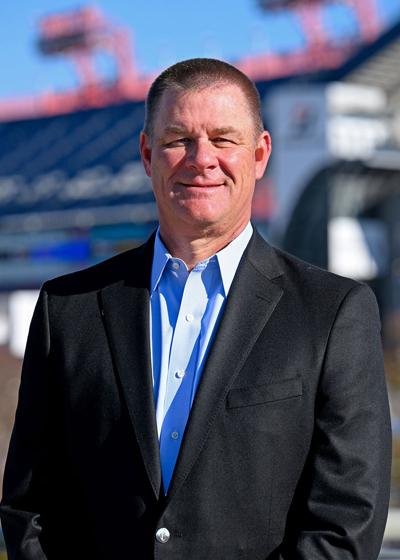

During his 30-plus-year tenure with the Nashville Sports Council, Scott Ramsey has seen the city transform from a national-sports afterthought to slated host of the 2030 Super Bowl. Alongside the usual suspects — the arrival of the Titans and the Predators, the debuts of Bridgestone Arena and Nissan Stadium — Ramsey cites a few key events that helped the city solidify its reputation as a significant sports destination.
“The 2014 women’s [college basketball] Final Four was a huge milestone for us,” says Ramsey, who took over as CEO and president of the council in 2007. “That was the first national championship event we were able to host. The SEC men’s basketball tournament for nearly a 20-year run … then certainly the 2016 NHL All-Star Game kind of changed the way cities stage those events, with hockey on the inside of the arena, but a real party, music-style for us, on the outside of the arena. And then ultimately, the 2019 NFL Draft.”
The 2019 NFL Draft was a turning point for Nashville as a sports-hosting city. The three-day event generated a $224 million economic impact, with a then-record of 600,000-plus fans attending. The city aced its “prove it” exam.
For Labor Day weekend, the council has planned an ambitious multisport lineup that includes the second-ever Broadway Block Party — a doubleheader featuring four of the nation’s top-25 women’s college volleyball teams — and the inaugural Music City Kickoff, Nashville’s foray into the lucrative world of neutral-site college football matchups. The late-summer events serve as a precursor to the holiday roster, which will include the annual Music City Bowl and year two of hosting the Football Championship Subdivision national title game.

Scott Ramsey
Ahead of the Labor Day slate, the Scene spoke with Ramsey about the Nashville Sports Council’s role in landing and facilitating major sporting events. This interview has been edited for length and clarity.
Nashville has been steadily increasing its status as a sports destination for decades. How did that come to be? When I moved here in 1995, we were just starting the Nashville Sports Council. And if you looked around the country at that time, you saw cities starting to invest in arenas and stadiums and ballparks. They really wanted to encourage using those facilities for more than 41 NBA games or NHL games or 10 NFL games a year, and entities like the Sports Council began popping up in other cities to bid on and recruit events that would come to the city that would use those publicly owned facilities, but also to fill up hotels and restaurants and create a lot of media exposure for the city. That’s kind of what the mission of the Sports Council began as.
I really credit Mayor Bredesen [who led Nashville from 1991 to 1999] with the vision of the downtown campus, and building that out to where you could really use sporting events and/or music events to create a multiday trip to Nashville and compact everything downtown, where it wasn’t so spread out as in other cities. That was the impetus of what we’ve been able to build on. … Once you become trusted with events, you’re able to get more and more of those on a regular basis. … We have the facilities, we have the entertainment, we have the hotels, we have the geographical advantage of being pretty central as far as being able to get here and get home pretty easily.
Can you explain the council’s role in the process of recruiting, landing and facilitating a sporting event? Let’s say we’re going to bid on an NCAA national championship event. It doesn’t matter what sport. We’re going to have to look at what year, because typically they’re going to bid out a four- or five-year window. What are the requirements from a facility? [Do we have] the arena, the stadium, the convention center, the hotels, practice facilities, whatever else we might need? We reach out to everybody in the city and make sure they’re available and work through the financial cost of hosting.
Some events we pursue. Sometimes it takes a while to have those fall into place by getting what you need to make the event work. For example, we really wanted to go after a high-level collegiate women’s volleyball event. We felt like it was an emerging sport. It took us almost a year in partnership with ESPN, the SEC and the schools to try to get the schedules lined up, to get the availability in the arena, to get the funding necessary to find a sponsor, to find a broadcast partner. There are other events that are totally dictated by the rights holder. Let’s go to the NCAA, for example; that’s dictated on a bid timeline. So sometimes you’re on the receiving side of the timeline and the bid process, and then sometimes you’re just unable to bid because, from a city standpoint, we don’t have the available resources.
You have landed the white whale with the Super Bowl coming here. What’s left on the bucket list? It’s been pretty well-publicized that the new stadium with the roof really allowed us to pursue some of the largest sporting events in the country. But the men’s Final Four and the college football national championship, I would say, are the two other ones that we weren’t able to even bid on because of a lack of necessary facility requirements. … I certainly don’t want to speak for the Titans or the city, but it certainly opens up the opportunity now to have events year-round, whether it’s music, sports or conventions. It opens up the opportunity for us to continue to build on the reputation that [Nashville is] a great sports environment, but also one that can utilize the downtown campus and our entertainment components maybe better than any other city in the country.



Post a comment as anonymous
Report
Watch this discussion.
(0) comments
Welcome to the discussion.
Log In
Welcome to the discussion.
Keep it clean. Please avoid obscene, vulgar, lewd, racist or otherwise abusive language. Comments featuring hate speech or threatening or violent content will not be tolerated.
PLEASE TURN OFF YOUR CAPS LOCK.
Be truthful. Don't knowingly lie or mislead.
Be proactive. Use the “report” link on any comment that violates our comment policy.
Share with us. We'd love to hear your feedback.