

Rosanne Cash once told me that she had never listened to much country music growing up in California. She had listened to Johnny Cash records, of course, for he was her father, but she hadn't paid much attention to the rest of it, obsessed instead with The Beatles, The Byrds and Bob Dylan. It was only in her early 20s, after several affairs gone bad, that she understood the point of country music. This wasn't dating music for kids — this was relationship music for adults.
By the late '70s, it was obvious country music had to change, because the adult relationships it described were already changing. Baby-boomer women weren't willing to shy away from sex, to take a backseat in marriage or to simplify their complicated feelings. No one personified that transition from traditional country to modern country more dramatically than Rosanne. She was a bohemian writer, a feisty feminist and yet an heir to country-music royalty — not only was she Johnny's daughter but she was also June Carter's stepdaughter and Mother Maybelle Carter's step-granddaughter. When she signed her own contract with Columbia Records, she had purple hair, a salty mouth and an attitude to match. More than anyone else, she had one foot in country music's past and another in its future.
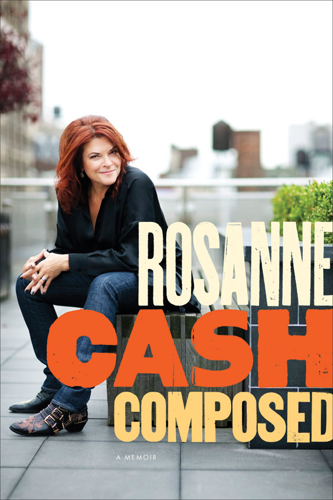
Rosanne's new autobiography, Composed: A Memoir, is best when it describes the weight of that past. The author spends many pages unraveling her complicated feelings about her father, stepmother and mother Vivian Liberto — all dead now, all leaving behind memoirs of their own. The new book is less successful in describing how Rosanne helped forge the future. For that one has to turn to the five remarkable albums she made for Columbia Records in Nashville between 1981 and 1990. In those songs she never makes stump speeches on behalf of feminism or creativity (an occasional weakness of the book) but examines the particulars of specific marriages as if lust, equality and irony were assumptions too obvious to be emphasized.
The breakthrough song was 1981's "Seven Year Ache," a masterpiece of dramatic tension. The set-up, the story of a woman left at home while her man goes out tomcatting, was as old as country music. But the payoff was something altogether new. The woman in the song wasn't willing to give in and let the man get away with hurting her. Nor was she willing to give him up without a struggle. Nor was she ready to condemn his sexual adventurism, for she'd been there and knew all too well its allure. She just believed she had something better to offer.
"Boulevard's empty, why don't you come around?" she sings with an accusing sharpness, which quickly gives way to hurt and the pained question, "Baby, what is so great about sleeping downtown?" It was an extraordinary vocal that demonstrated how one can feel anger and love for the same person at the same time.
This track — and many others like it — marked a sea change in country music, as the genre found its central subject of marriage shifting from patriarchal arrangements to egalitarian ones, from Tammy Wynette's "Stand by Your Man" to Rosanne's "Second to None." And the change wasn't just in the lyrics; it was also in the chord changes and rhythms, which grew more educated, less resolved and more sexual as the country audience did too. Rosanne has never received the credit she deserves for such a momentous shift, and she doesn't give herself much credit for it in her own autobiography.
Rosanne goes out of her way in Composed to emphasize that she thinks of herself as a writer first and as a performer second, but her self-analysis is contradicted by the evidence of her greatest records. The lyrics in a song like "Seven Year Ache," for example, merely provided the context for her voice to work its magic. It was her richly ambivalent alto, all purple bruises and red flushes, that created the drama of affection wrestling with resentment, commitment with independence. Nothing in the autobiography — which is, after all, writing without performance — comes close to the intensity or the revelation of those three minutes of song. One could say the same about many of her recordings, whether the songs are hers or someone else's: "Ain't No Money," "It Hasn't Happened Yet," "I Don't Know Why You Don't Want Me," "On the Inside" and more. Maybe she can't see it, but her second husband John Leventhal recognized her importance as a country music singer when he convinced her to record The List, last year's album of cover songs.
That was more recognition than she would ever get from Music Row. One of the key scenes in Rosanne's memoir occurs in 1989, when she turned in the best recording of her career, Interiors, and Columbia's A&R guy said, "We can't do anything with that. ... Radio won't play it."
"I was stunned," Rosanne writes. "I felt as if I had been slapped in the face. ... To my mind this was the most 'country' record I had given them — almost entirely acoustic, very folk based." It was another turning point in country music history. In choosing how to accommodate the changes in American marriages, Music Row had decided it would accept the sexuality but not the feminism, the swagger but not the irony. Rosanne, her first husband Rodney Crowell and their friend Emmylou Harris were on their way out; Garth Brooks, Clint Black and Reba McEntire were on their way in.
Composed is Rosanne's fourth book, and it fails to alter the impression that prose is not her best medium. There are no big revelations; almost everything has been previously divulged in her notoriously unfiltered interviews. In those interviews — and I've done my fair share — her voice is a delicious mix of tart, caustic commentary and gushy romanticism. Unfortunately, the latter dominates her memoir. She also has a habit of drawing conclusions about a particular period of her life before describing what actually happened, thus supplying the payoff before the set-up. She skips around the chronology of her life in a way that seems more random than she perhaps intended. As a result, much of the book seems to be loosely connected anecdotes and thank-you notes to her family, friends, doctors and colleagues.
Much of the book, inevitably, deals with her famous father. She is frank about the hurt Johnny caused her, her sisters and her mother in the '60s when he was gone from home for weeks at a time, wacked out on pills and falling in love with June Carter. It was an experience that left Rosanne traumatized and deeply ambivalent about subjecting her own children to a touring parent. Yet she's just as frank about how much her own career benefited from having a dad who could take her on tour, teach her songs, write a rent check and pass along a tape. Because the story is told from the mellow perspective of late-life wisdom, it never thrusts us into the drama of the moment, but it does explain how she resolved her mixed feelings about Johnny. On the other hand, the book barely touches on her equally mixed feelings about Crowell or her competitive stepsister Carlene Carter.
The autobiography is at its best when it deals with the early 2000s, when Rosanne spent a lot of time with both her parents as they were nearing death. She never whitewashes her lingering resentments toward her mom and dad, but that only makes her deep feelings more credible, especially when they crystallize in unexpected places, such as a Tennessee hardware store or a California garden. As good as these passages are, however, they're completely eclipsed by her recorded songs on the same subject: "September When It Comes," "Black Cadillac," "The World Unseen" and "Like Fugitives."
If you really want to know Rosanne Cash, that's where to look.
Email editor@nashvillescene.com.



