
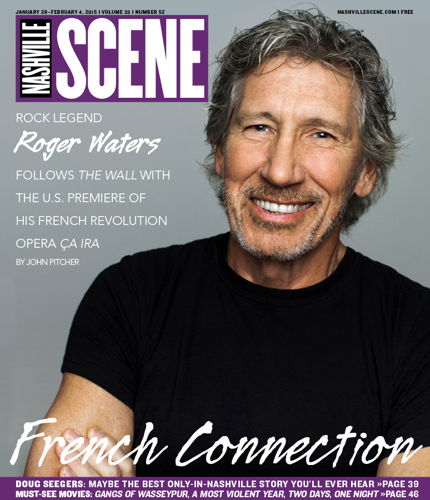
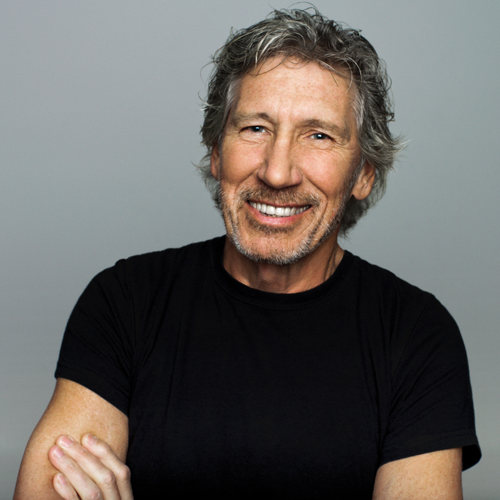


Controversy clings to Roger Waters like a snug-fitting Burberry London suit. So it was no surprise that an offer to interview the British rock star, perhaps best known as the architect of the monumental concept album The Wall, came with a few restrictions. Waters' skittish handlers insisted that questions from the Scene stay focused on the sole purpose of the star's visit to Nashville — the American debut of Ça Ira, his opera about the French Revolution, with the Nashville Symphony Orchestra this Friday at the Schermerhorn.
There were to be no questions about Waters' harsh criticism of Israeli policy toward the Palestinians — a stance that has brought accusations of anti-Semitism from some quarters — and no questions about his sharp disapproval of the U.S. prison camp at Guantanamo Bay, Cuba. Above all, there were to be absolutely no questions whatsoever about Pink Floyd, the band that Waters led to heights of sonic glory from the mid-1960s to his acrimonious departure in the mid-1980s.
One suspected that Waters might be a prickly personality. But when he was finally reached by phone, the 71-year-old singer, songwriter and political activist proved to be an affable and willing interlocutor. For the better part of an hour-and-a-half, Waters spoke in measured, lyrically accented tones about any topic broached.
Waters comes by his controversial political views honestly. His grandfather, appalled by the 1914 German invasion of Belgium and the subsequent "Flames of Louvain," fought with the British Expeditionary Force on the Western front and was killed at the Battle of the Somme in 1916. His father was killed near Anzio, Italy, in 1944 while fighting the Nazis. Given his family history, Waters' left-leaning political opinions seem not only natural but inevitable. He is, after all, one of the few male members of his family in generations to avoid the horrors of war and survive to a happy old age.
That history would also seem to explain the rock star's fascination with the French Revolution. France's violent overthrow of its Ancien Régime in 1789 brought feudalism and absolutism to a screeching halt in Europe, and in one fell swoop it ushered in the modern political age. When discussing this seismic historic event, Waters often seemed more like a Cambridge scholar than a pop entertainer. His conversation was sprinkled with elegant French phrases, and his command of the historical facts was impressively comprehensive.
Waters composed Ça Ira ("It will be fine") in the late 1980s and early 1990s, setting to music a libretto written in French by the noted lyricist Étienne Roda-Gil. The lyricist's wife, the painter Nadine Roda-Gil, created illustrations to go along with the libretto's vivid imagery. The opera boasts the sort of early Romantic (and quite frankly anachronistic) orchestral score that might have been heard during the French Revolution. A recording of the work was released by Sony Classical on a two-disc set in 2005.
Over the years, Waters has substantially revised his work, translating it into English while adding new arias. The first fully staged production of the opera took place in Rome in 2005, and in 2013 it was first performed as a concert piece (without sets and costumes) in Gothenburg, Sweden. The performance with the Nashville Symphony Orchestra will be the work's North American premiere. Waters will present the same concert version of the opera that was performed in Gothenburg, and he will be onstage at the Schermerhorn Symphony Center serving as narrator. During a recent phone interview, Waters spoke at length about the opera, the French Revolution and his views on politics.
Your father was killed fighting Nazi tyranny during World War II. Did your father's story inform your feelings about the French Revolution?
My entire family's story has informed both my politics and my work over the years. My grandfather was killed at the Battle of the Somme in 1916, and my father was killed near Anzio on Feb. 18, 1944, when I was just 5 months old. I feel a strong connection to both men.
My father had been a pacifist and conscientious objector at the start of the war and drove an ambulance during the Blitz. But the extent of the Nazi menace finally convinced him that he needed to put aside his devotion to pacifism and Christianity and take up arms against the enemy. He showed that you can't be half-committed to something in the face of tyranny and totalitarianism. That shaped my views about any kind of oppression, not just the French Revolution.
What do you think the French Revolution got right, and where do you think it went wrong?
It got a lot of things right. First of all, let's not forget that in 1948 the United Nations General Assembly met in Paris to adopt the Universal Declaration of Human Rights. It was absolutely no accident that they met in Paris, because that's where the Declaration of the Rights of Man was passed in 1789. The French Revolution demolished the old concept of the divine right of kings and established instead the principle that all human beings have rights, regardless of race, religion or politics.
It is interesting that Paris was in the spotlight a few weeks ago after the massacre at Charlie Hebdo, and people of all races and religions marched on the street with signs saying "Je Suis Charlie" and "Je Suis Muslim." But they all rose up as one and said, "We're the good guys, and we abhor violence and respect the law." That's something that I have been beating the drum about for years, which is the critical importance of law. We have to understand that Runnymede is important, habeas corpus is important, the American Revolution and French Revolution are important, because they all helped establish precious rights that we must guard and protect.
But didn't the French Revolution also give us the guillotine and that proto-Orwellian institution known as the Committee of Public Safety? It seems to me that one thing that went terribly wrong was the failure of the National Assembly to condemn violence after the storming of the Bastille.
It doesn't surprise me at all that the French Revolution was bloody. People can only be pushed so far. And you have to remember the context. The Seven Years War and France's involvement in your war [the American Revolution] had left the country bankrupt. Also, the winter of 1788-89 was one of the harshest ever recorded, and people were starving. And don't forget that they had a sovereign who saw himself as answerable only to God and who couldn't have cared less about the plight of the people. Yes, the violence was excessive, and the revolution also fueled the aspirations of Bonaparte. But in the end, the revolution resulted in democracy and a republic, which are good things.
Do you see any parallels between the climate of the French Revolution and now?
Yes, of course I do. For one thing, you have a concentration of wealth today in the hands of a few. It's not as extreme as it was in the French Revolution, and it's also not an exact parallel. You don't have a monarch today who believes he's been ordained by God to rule, and you're not going to see people rising up in revolution. But it still seems shocking to me that there is widespread poverty in a country like the United States of America. During the recession of 2008 a lot of people were really screwed, and if I had been one of them I think I would have been pretty angry.
One thing the French got from their revolution was a republic, and their government today provides all of its citizens with universal health care. I am so glad that the United States has now taken the small step in that direction with Obamacare. Some people criticize it as socialism, and I just don't understand why socialism is considered such a dirty word in America, since socialism is a very old American idea.
In fact, the United States is the only country in the world that I know of where the government requires localities to provide universal transportation for children to go to school, riding around in those wonderful yellow school buses. Where else on earth does this happen? America had its own democratic revolution — against some country that I can't recall the name of at the moment — so I'm confident that America will make progress in the future on health care, immigration, climate change and other crucial issues. In America anything is possible.
How did you feel performing The Wall in 1990 before the Berlin Wall, one of the most visible symbols of totalitarianism?
That was an extraordinary gig and happened at the exact same time I was working with Étienne and Nadine Roda-Gill on Ça Ira. The real moving force behind the concert was Leonard Cheshire, a former RAF wing commander who had served as the British observer of the Nagasaki atomic bomb attack. He had asked me to do a charity gig for his Memorial Fund for Disaster Relief. Initially we talked about staging the concert at Red Square in Moscow and asking the Russians to donate old missiles so we could make pens out of them. Those pens are a chilling thought when you think of the massacre in Paris a couple of weeks ago. But when we heard the Berlin Wall had come down we got on a plane the next morning and headed straight for Germany.
We got to the Wall and looked through this hole into a barren no-man's land that had been filled with land mines and heavy ordinance. I said if we're going to do the concert anywhere, it's going to be here. Somehow we got permission to do the concert, and they started clearing what was left of the mines. The place looked like a field of giant mole hills, and there were bunkers there that Hitler had used. I spent the night before the concert lying awake in a dark room thinking about all the things that might go wrong.
The day of the concert, over 350,000 people had bought tickets to get in, and then right before the show the gates were opened and an even bigger flood of people poured in. By the time we started to play, attendance was definitely way north of 400,000. In the end, the concert didn't go off without a hitch, but it went well. But it still took us 10 years to figure out how to make any money from it for Leonard's charity. Eventually we secured the rights to the concert film, and the royalties now go to the charity. I had initially told Leonard that it would be a miracle if the concert ever made any money because it cost $6.5 million to produce. But somehow we did it.
What persuaded you to write an opera about the French Revolution — was it the opportunity to work in an unusual genre (opera), the subject matter (one of history's most influential events) or something else?
Actually, there were a number of things that interested me. First of all, Étienne and I had been friends for a very long time, and I had always admired his writing. So when he contacted me about the work he had created with Nadine, I was of course happy for him to come and see me. What he brought with him absolutely astounded me. It was this 50-page document on sandy-brown sugar paper that was itself a work of art. The libretto was in French, and each page included a meticulously drawn illustration by Nadine.
Well, I started to read the libretto and was immediately intrigued. What sticks in my memory were all these beautiful lines with vivid images, like "Un jour un moineau dans la brousse ... " ("One day a sparrow in a bush ... "). I said, "Wow, that is very poetic, so what do you want me to do?" Étienne thought for a moment and then asked if he could possibly borrow some music that I had already written and use it for the libretto. I told him that would be ridiculous and just wouldn't work. But I was prepared to compose an entirely new score.
So I hired an engineer, went into the studio that I have in my house in London and went to work. We worked eight hours a day for six weeks and produced a two-and-a-half-hour demo. We sent it to the French minister of culture, and it eventually made its way slowly all the way up to François Mitterrand, the president of France. He listened to it — in those days it was on an old cassette tape — and he really liked it. He wrote a letter to the director of the Paris Opera and basically demanded that he use the opera as part of the bicentennial celebration of the French Revolution, which was coming up in 18 months. Well, the director of the Paris Opera was not used to being dictated to, and he scoffed.
We then went to the director of Opera Bastille, and he was keen to produce it. That of course meant I would need to orchestrate it, but at the time I didn't know one end of an orchestra from another. That didn't matter, though, because France decided to spend its bicentennial money on a parade — which was probably wise, because I couldn't have gotten it together in time.
Why did you decide to compose Ça Ira in the style of an early 19th century Romantic opera? Why not turn the French Revolution into another progressive rock concept album, a follow-up to The Wall and The Final Cut? Those albums were already operatic in a thoroughly modern way.
It never occurred to me to do that. I just started writing on page 1 and didn't stop until I'd gotten to page 50. From the very start, everything just proceeded organically. I did all of my work on a piano and string synthesizer, and I didn't have a clear sense of how things were going to sound until I took it to Abbey Road Studios.
Eventually we sent a recording to Peter Gelb at Sony Classical to see if he'd be interested in making a record. Gelb had been [legendary pianist Vladimir] Horowitz's manager and knew the classical record business inside and out. He immediately started nagging me to do the opera in English. He finally prevailed on me to translate part of the libretto, so I chose the very moving letter that [French King] Louis XVI wrote to his cousin [the Bourbon King] Charles IV of Spain. Gelb loved it and insisted that I translate the rest of the opera.
By that time it was 1990, and we had already missed the bicentennial. So I decided to shoot for a completed opera performance on Bastille Day 1990. I called Étienne and found out that Nadine was dying of leukemia. It was devastating news and brought everything to a halt. We didn't get going again for five years. When we finally got back to work, we brought in Rick Wentworth, an orchestra expert who's going to conduct the performance in Nashville. Rick taught me everything that I now know about the orchestra. We got a house in the English countryside and put together [the] opera using an old Atari Notator system.
We finally got to stage the full opera in Rome [on Nov. 17, 2005] and then the next year we staged it in Pozna, Poland, in front of 14,000 people. We were able to do things in Poland that you'd never get away with in the West because of safety regulations, like using a 200-foot crane to lift singers above the stage. A couple of years ago, we presented Ça Ira in Gothenburg, Sweden. It was a concert version, meaning we performed it without a set, which is what we're going to do in Nashville. Two of our singers from the Gothenburg performance, Sally Matthews and Bryan Hymel, will also be coming to Nashville.
The original libretto was in French. How much of the libretto did you change when you translated it into English, and how did you get the English syllables to match up with melodies that were originally composed to French words?
It was technically very difficult to do, and I had to use my imagination and a little creative license to convey Étienne's ideas in English. French is full of idioms, like "poser un lapin à quelqu'un," which literally means "to put a rabbit on somebody," which sounds ridiculous, but in English it simply means "to stand somebody up."
Etienne's libretto was also very episodic, like a series of thumbnails or vignettes, and so an idea on one page didn't necessarily connect with an idea on the next page. I had to use a little license to create a narrative thread to connect all of these ideas. I showed it to Étienne, and he puffed on his cigarette, took a swig of whiskey and said, "I zink it sounds beh-TER zan zee French." He really had a heart the size of a basketball.
My French was not completely fluent, so he helped with the translation. That gave me a better sense of what he was trying to say, and based on that I then wrote my own English poetry, and matched it up as best I could with the melodies.
I loved the initial idea of presenting the French Revolution as a kind of three-ring circus with a Ringmaster. At times, the narrative flow reminded me of a Greek chorus relating events to the audience. What was the inspiration for this idea?
The idea of the circus and Ringmaster came from some of Nadine's illustrations for the original libretto. These were simple, beautiful, colorful works of art in themselves. That's the version we recorded for Sony Classical in 2005, but I quickly drifted away from that approach. Having a Ringmaster telling the narration started to feel clumsy to me. At its core, this opera is about ideas, about how knowledge, learning and enlightenment are all necessary to keep us free from tyranny.
In that respect, Ça Ira is an Age of Enlightenment opera. We performed it in São Paulo in 2013, and the set there included a library with books that stretched from the floor to the ceiling. The importance of books is now stressed in the opera. The idea of a circus was also changed, with the setting now an asylum. Over the years, I have written a lot of new material for the English version of the opera. At some point, I want to have the new material translated into French, and since Étienne is no longer with us, I'll probably bring someone in to help. I am determined that Ça Ira be performed at Versailles. I think this opera must one day go home.



