
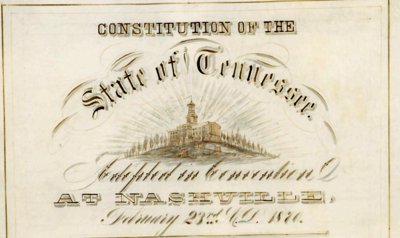


Article 1, Section 33 of the Tennessee Constitution features language very similar to that of the 13th Amendment to the United States Constitution. Both abolish slavery, but with a single exception.
“That slavery and involuntary servitude, except as a punishment for crime, whereof the party shall have been duly convicted, are forever prohibited in this state,” reads the Tennessee Constitution, echoing wording in the 13th Amendment to the U.S. Constitution.
The so-called “punishment clause” has been a target of activism and legal scholarship for some time. But it became a part of the broader consciousness in 2016, with the release of Ava DuVernay’s Netflix documentary 13th. The Oscar-nominated film makes a compelling — and gut-wrenching — case that the punishment clause of the 13th Amendment was a hole in the fence through which white supremacy was smuggled into the post-slavery era. Almost immediately, the film argues, it would become an animating force in America’s criminal justice system.
No individual piece of legislation is going to undo that. But a proposal moving forward in the Tennessee legislature would amend the state constitution to do away with the criminality exception in the original language. House Joint Resolution 226 would rewrite Article 1, Section 33 so it reads: “That slavery and involuntary servitude are forever prohibited in this State.”
“There should be no reason in this damn country that you’ve got slavery,” says state Rep. Joe Towns (D-Memphis), the resolution’s lead sponsor. “That is a despicable thing to even contemplate that we still are talking about in this country. Slavery is still the most horrible stain on this country’s history.”
The proposal was briefly delayed in a House subcommittee when the Tennessee Department of Correction voiced concerns that the new language might empower prisoners to file lawsuits over work programs. But an amendment to the resolution would clarify that “nothing in this section shall prohibit an inmate from working or being required to work when the inmate has been duly convicted of a crime.” The amended language still has the support of prisoner advocates and activist groups who have been supporting the resolution.
“I think the work, obviously, is good,” Towns says. “Most people who are incarcerated probably want to work just to pass the time. Better to learn something and be active.”
Even in a state where Confederate statues have been polarizing, the resolution has bipartisan support. Along with Democratic leadership, Speaker of the House Beth Harwell and Majority Leader Glen Casada are co-sponsors. But amending the state constitution is a slow process. The resolution must first pass the legislature with a majority this year. Then it must pass again next year, with a two-thirds majority. If it clears those hurdles, it will be put on the ballot for a referendum during the next gubernatorial election.
If he succeeds in Tennessee, Towns says he’ll take the effort national, setting his sights on the U.S. Constitution.



Post a comment as anonymous
Report
Watch this discussion.
(0) comments
Welcome to the discussion.
Log In
Welcome to the discussion.
Keep it clean. Please avoid obscene, vulgar, lewd, racist or otherwise abusive language. Comments featuring hate speech or threatening or violent content will not be tolerated.
PLEASE TURN OFF YOUR CAPS LOCK.
Be truthful. Don't knowingly lie or mislead.
Be proactive. Use the “report” link on any comment that violates our comment policy.
Share with us. We'd love to hear your feedback.