
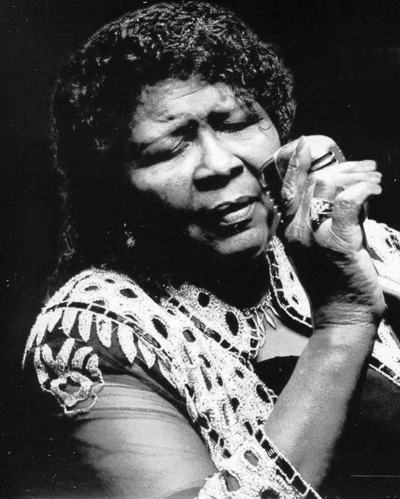

Marion James was a giant among musicians, even though there's no long string of hit singles or albums carrying her name. James, who died New Year's Eve at 81 following a stroke, tackled a challenge so often ignored in the music industry: seeing that legacies are remembered, and addressing the daily challenges of struggling musicians.
A fixture for six decades on the city's R&B and blues scene, James made it a priority to find and help musicians others had forgotten, overlooked or abandoned, raising money and doing whatever she could to make their lives better. At the same time, she sought to ensure that people all over the world never forgot Nashville's pivotal role in the growth and evolution of black music, in particular the blues and soul sounds that she loved.
Those twin goals were behind the start of what became an annual event that jointly celebrated the city's blues history and brought needed funds and exposure to several deserving performers. The Musicians' Reunion benefit was something James never anticipated becoming one of the city's showcase music events — let alone running for 32 years, a milestone celebrated last summer at Bourbon Street Blues and Boogie Bar in Printers Alley. Her presence could be felt in every facet, from the stage to the kitchen.
"I remember seeing from the early days when I got started how tough many musicians had it when their careers started to slow down," James said in a 2012 Scene interview. "But this event grew out of the fact our home in Nashville was a major hangout for traveling black musicians playing in town, especially when they would discover the money they thought they were getting was a lot shorter than expected. My husband [trumpeter-arranger Jimmy Stuart] was playing and arranging songs with B.B. [King]. He really knew the music scene inside out. Later he moved over to Bobby 'Blue' Bland, then Junior Parker.
"Anyway, we did that first one over at the Rodeway Inn. Johnny Jones and Jimmy Church were on that program, and I got some friends to help with the food. I think we got about 350 people at the event, but a lot of musicians came by, and some got on stage and played. Later Christine Kittrell told me she had a great time and this was something that should become an annual event."
Despite the fact that she'd hired Jimi Hendrix in her band long before he was a superstar, or had a dynamic mid-'60s Top 10 hit on Nashville's Excello label with "That's My Man," those were rarely the things Marion James wanted to discuss. Instead, she would talk about what Jefferson Street was like before urban renewal, when the sounds of blues, jazz, soul and R&B lit up a host of clubs and Nashville was a hub of musical greatness.
It greatly disturbed her that large numbers of young people, particularly African-Americans, seemed to have lost touch with the blues. Yet she didn't demean or downplay contemporary music. She served as an advocate for the importance of knowing and accurately recounting cultural history. Her most recent quest at the time of her death was seeing a statue built in front of the Jefferson Street Elks Lodge, once the home of Nashville's famed Club Baron. Her desire was for that statue to feature none other than Hendrix.
Thankfully, Marion James did enjoy a degree of recognition late in her career. The Grammy-winning "Night Train to Nashville" exhibit at the Country Music Hall of Fame and Museum introduced new faces and reacquainted old ones to James' importance. She was also featured on the notable 2013 tune "Back in the Day," an homage to Jefferson Street's brilliance. Musician-writer Ted Drozdowski was among many in the current generation of blues musicians who admired the late singer.
"As for me, I'd say Marion was the first artist I saw when I visited Nashville for the first time, in 1993," Drozdowski said last week. "I was immediately struck by the warmth and depth of her performance, and it was obvious younger artists were drawn to her, as if she was a queen bee. After moving here, it was much the same.
"Many of the best players inside and outside of the blues realm swarmed around her to learn and to absorb her experience by osmosis when she spoke. Even in casual conversation, she was a living history lesson. She also — even while struggling for financial survival and dealing with health issues in her later years — devoted time and energy to helping other musicians suffering under the same burdens. She was a beacon of kindness and generosity."
Through the Musicians' Aid Society and reunion shows she founded, Marion James' impact will continue to be significant. Indeed, her goals of seeing the blues celebrated as a vibrant, evolving and still relevant sound — as well as the mandate to recognize and celebrate Nashville's full musical history — loom even larger with her passing.



